A Classical Mechanics challenge for fun

Click For Summary

Discussion Overview

The discussion revolves around a classical mechanics problem involving a cylindrical bobbin, a rotating string, and a point mass. Participants explore the dynamics of the system under the condition of no gravity, focusing on finding the minimal length of the free part of the string over time.

Discussion Character

  • Exploratory, Homework-related

Main Points Raised

  • One participant proposes a problem involving a cylindrical bobbin with a rotating string and a point mass, specifying initial conditions and constraints on the velocity.
  • Another participant notes that similar problems have appeared in graduate qualifiers, suggesting a level of complexity and familiarity within the academic context.
  • A later reply indicates that the problem is accepted as an unofficial challenge, inviting further participation.

Areas of Agreement / Disagreement

Participants generally agree on the interest and complexity of the problem, but there is no resolution or consensus on the solution or approach to the challenge.

Contextual Notes

The problem is framed without the influence of gravity, and the conditions on the velocity of the point mass are specified, which may affect the analysis. The discussion does not delve into specific mathematical steps or assumptions that may be necessary for solving the problem.

Who May Find This Useful

Students and enthusiasts of classical mechanics, particularly those interested in problem-solving and theoretical challenges in the field.

zwierz
Messages
334
Reaction score
62
I composed a problem and propose it here. I know the solution so it just for fun of the participants.

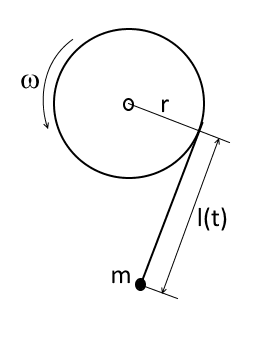
There is a cylindrical bobbin of radius ##r##; the bobbin rotates about its central axis with angular velocity ##\omega=const>0##. An inextensible weightless string is coiled around the bobbin. The string is very thin and very long. On a free end of the string there is a point mass ##m##. Let ##l=l(t)## stand for the length of the free part of the string. There is no gravity.
Initially the value ##l_0=l(0)>0## and the velocity ##v=\frac{d}{dt} l\mid_{t=0}## are given. Moreover it is known that ##-\omega r<v<0##. Find minimal value of the function ##l(t)## that is ##\min_{t\ge 0}l(t)## -- ?.
We consider motion such that the string remains strained for all time
506af59672cf.png
 
Last edited by a moderator:
  • Like
Likes   Reactions: Avimanyu Ray and Buffu
Physics news on Phys.org
Sounds like an interesting problem. I've seen similar ones in graduate qualifiers in the classical mechanics section.
 
After some discussion we are allowing this as a stand alone but unofficial challenge. Good luck!
 
the Lagrangian is
$$L\Big(l,\frac{d l}{dt}\Big)=\frac{m}{2}\Big(l^2\omega^2+\frac{l^2}{r^2}\Big(\frac{d l}{dt}\Big)^2 \Big);$$
the answer is $$l_0\sqrt{1-\Big(\frac{v}{\omega r}\Big)^2}$$
 

Similar threads

  • · Replies 16 ·
Replies
16
Views
3K
  • · Replies 3 ·
Replies
3
Views
2K
  • · Replies 11 ·
Replies
11
Views
1K
  • · Replies 1 ·
Replies
1
Views
2K
  • · Replies 2 ·
Replies
2
Views
2K
  • · Replies 62 ·
3
Replies
62
Views
10K
  • · Replies 4 ·
Replies
4
Views
2K
  • · Replies 2 ·
Replies
2
Views
2K
  • · Replies 2 ·
Replies
2
Views
2K