A formula involving the sum of cosines of the angles of a triangle

Click For Summary
SUMMARY

The discussion centers on proving the formula for the sum of cosines of the angles in a triangle, specifically the equation $$\cos A+\cos B+\cos C-1=\dfrac{a^2b+b^2c+c^2a+b^2a+c^2b+a^2c-a^3-b^3-c^3-2abc}{2abc}$$. Participants analyze the derivation using the law of cosines and half-angle formulas, identifying potential errors in calculations. The correct approach involves simplifying the numerator and recognizing the relationship between the sides of the triangle and the angles.

PREREQUISITES
  • Understanding of triangle properties and the law of cosines.
  • Familiarity with trigonometric identities, particularly half-angle formulas.
  • Basic algebraic manipulation skills for simplifying expressions.
  • Knowledge of triangle semi-perimeter, denoted as s.
NEXT STEPS
  • Study the law of cosines in depth, focusing on its applications in triangle geometry.
  • Learn about half-angle formulas and their derivations in trigonometry.
  • Explore algebraic techniques for simplifying complex fractions and expressions.
  • Investigate the relationship between triangle geometry and trigonometric identities.
USEFUL FOR

Mathematicians, students studying geometry and trigonometry, and educators looking for insights into triangle properties and trigonometric proofs.

brotherbobby
Messages
755
Reaction score
170
Homework Statement
For a triangle ##\text{ABC}##, prove that $$\boxed{\cos A+\cos B+\cos C-1=\dfrac{a^2b+b^2c+c^2a+b^2a+c^2b+a^2c-a^3-b^3-c^3-2abc}{2abc}}$$
Relevant Equations
1. ##\cos\frac{A}{2}= \sqrt{\dfrac{s(s-a)}{bc}}## and its cyclic counterparts.
2. ##\sin\frac{A}{2}= \sqrt{\dfrac{(s-b)(s-c)}{bc}}## and its cyclic counterparts.
3. ##s=\dfrac{a+b+c}{2}##, the semi perimeter of a triangle.
Problem Statement : The statement appeared on a website where a different problem was being solved. I got stuck at the (first) statement in the solution that I posted above 👆. Here I copy and paste that statement from the website, which I cannot show :

1677664505352.png


Attempt : To save time typing, I write out and paste the solution using Xournal++, hoping am not violating anything.
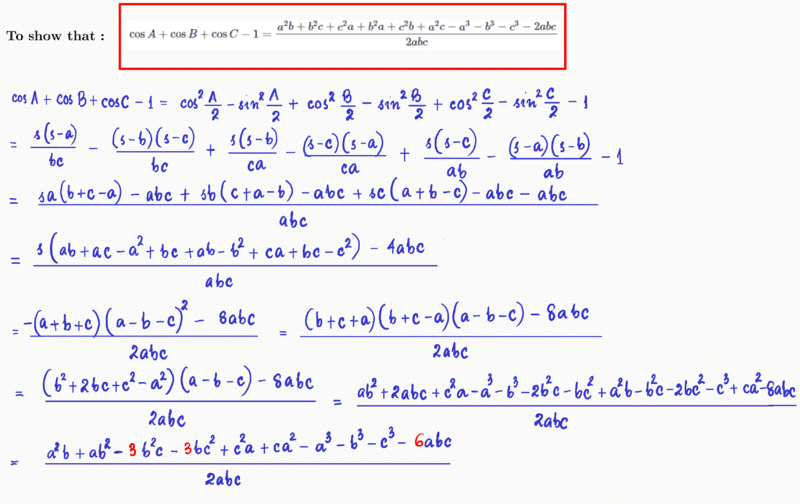
triangle.png
Issue : As evidence by the coefficients that I have marked in red, my answer is not the same as that shown for the problem.

A hint as to where I went wrong would be welcome.
 
Physics news on Phys.org
brotherbobby said:
Homework Statement:: For a triangle ##\text{ABC}##, prove that $$\boxed{\cos A+\cos B+\cos C-1=\dfrac{a^2b+b^2c+c^2a+b^2a+c^2b+a^2c-a^3-b^3-c^3-2abc}{2abc}}$$
Relevant Equations:: 1. ##\cos\frac{A}{2}= \sqrt{\dfrac{s(s-a)}{bc}}## and its cyclic counterparts.
2. ##\sin\frac{A}{2}= \sqrt{\dfrac{(s-b)(s-c)}{bc}}## and its cyclic counterparts.
3. ##s=\dfrac{a+b+c}{2}##, the semi perimeter of a triangle.

Problem Statement : The statement appeared on a website where a different problem was being solved. I got stuck at the (first) statement in the solution that I posted above 👆. Here I copy and paste that statement from the website, which I cannot show : View attachment 323036

Attempt : To save time typing, I write out and paste the solution using Xournal++, hoping am not violating anything.

View attachment 323039Issue : As evidence by the coefficients that I have marked in red, my answer is not the same as that shown for the problem.

A hint as to where I went wrong would be welcome.
I cannot see what you have done in every step except the first one, so let's see.

And btw. here is explained how you can type formulas on PF: https://www.physicsforums.com/help/latexhelp/

\begin{align*}
\cos(A)&= \dfrac{s(s-a)}{bc}-\dfrac{(s-b)(s-c)}{bc}=\dfrac{s^2-as-s^2+bs+cs-bc}{bc}\\&=\dfrac{s(-a+b+c)}{bc}-1=\dfrac{s}{abc}(-a^2+ab+ac)-1
\end{align*}
hence
\begin{align*}
\cos(A)+&\cos(B)+\cos(C)=\dfrac{s}{abc}(-a^2+ab+ac-b^2+bc+ba-c^2+ca+cb)-3\\
&=-\dfrac{s}{abc}(a^2+b^2+c^2-2ab-2ac-2bc)-\dfrac{6abc}{2abc}\\
&=-\dfrac{1}{2abc}\cdot ((a+b+c)(a^2+b^2+c^2-2ab-2ac-2bc)+6abc)\\
&=-\dfrac{1}{2abc}(a^3+ab^2+ac^2+a^2b+b^3+ac^2+a^2c+b^2c+c^3)+\ldots\\
&+\dfrac{1}{2abc}(2a^2b+2a^2c+2abc+2ab^2+2abc+2b^2c+2abc+2ac^2+2bc^2-6abc)\\
&=\dfrac{1}{2abc}(-a^3-b^3-c^3+a^2b+a^2c+ab^2+b^2c+ac^2+bc^2)
\end{align*}
and thus
\begin{align*}
\cos(A)+&\cos(B)+\cos(C)-1=\dfrac{1}{2abc}(-a^3-b^3-c^3+a^2b+a^2c+ab^2+b^2c+ac^2+bc^2-2abc)
\end{align*}
which is the correct answer.

I assume you made a sign error somewhere but I do not see exactly where since I cannot trace your calculation.
 
fresh_42 said:
And btw. here is explained how you can type formulas on PF: https://www.physicsforums.com/help/latexhelp/
I was trying to save work, typing equations out. However, I will now type out the answer and remedy my mistake above.

To prove : For a triangle ABC, show that ##\boxed{\cos A+\cos B+\cos C-1=\dfrac{a^2b+b^2c+c^2a+b^2a+c^2b+a^2c-a^3-b^3-c^3-2abc}{2abc}}##.

Solution : Starting from the left hand side,
$$\begin{equation*}
\begin{aligned}
\cos A+\cos B+\cos C-1 & =\cos^2A/2-\sin^2 A/2+\cos^2B/2-\sin^2 B/2+\cos^2C/2-\sin^2 C/2-1\\
&=\frac{s(s-a)}{bc}-\frac{(s-b)(s-c)}{bc}+\frac{s(s-b)}{ca}-\frac{(s-c)(s-a)}{ca}+\frac{s(s-c)}{ab}-\frac{(s-a)(s-b)}{ab}-1\\
&=\frac{as(b+c-a)-abc+bs(c+a-b)-abc+cs(a+b-c)-abc-abc}{abc}\\
&=\frac{(a+b+c)(ab+ac-a^2)+(a+b+c)(bc+ab-b^2)+(a+b+c)(ac+ab-c^2)-8abc}{2abc}\\
\end{aligned}
\end{equation*}$$

The numerator simplifies to the required ##\mathcal{N} = -a^3-b^3-c^3+a^2b+ab^2+b^2c+bc^2+c^2a+ca^2-2abc##.

Thank you for your help.
 
I think you could have begun with the law of cosines: e.g. ## c^2=a^2+b^2-2ab \cos{C} ##, rather than a formula that most of us probably wouldn't ever memorize, or maybe even recognize. With a little algebra with the 3 cosines, the result follows very routinely.
 
Last edited:
  • Like
Likes   Reactions: Steve4Physics and neilparker62
Charles Link said:
I think you could have begun with the law of cosines: e.g. ## c^2=a^2+b^2-2ab \cos{C} ##, rather than a formula that most of us probably wouldn't ever memorize, or maybe even recognize. With a little algebra with the 3 cosines, the result follows very routinely.
This was certainly my first thought! I don't even know why they included the " - 1 " at the end.
 
  • Like
Likes   Reactions: mathwonk and Charles Link
Charles Link said:
I think you could have begun with the law of cosines: e.g. ## c^2=a^2+b^2-2ab \cos{C} ##, rather than a formula that most of us probably wouldn't ever memorize, or maybe even recognize. With a little algebra with the 3 cosines, the result follows very routinely.
Yes, thank you. I totally overlooked the law of cosines.

Attempt :
\begin{equation*}

\begin{aligned}

\cos A+\cos B+\cos C-1 & =\frac{b^2+c^2-a^2}{2bc}+\frac{c^2+a^2-b^2}{2ca}+\frac{a^2+b^2-c^2}{2ab}-1\\

&=\frac{a(b^2+c^2-a^2)+b(c^2+a^2-b^2)+c(a^2+b^2-c^2)-2abc}{2abc}\\

&=\boxed{\frac{a^2b+ab^2+b^2c+bc^2+c^2a+ca^2-a^3-b^3-c^3-2abc}{2abc}}\\

\end{aligned}

\end{equation*}

Thank you.
 
  • Like
Likes   Reactions: SammyS and Charles Link
neilparker62 said:
This was certainly my first thought! I don't even know why they included the " - 1 " at the end.
Yes, it looks unusual. But that is because it is a portion of a different problem.

I posted requiring to show that $$\cos A+\cos B+\cos C-1=\boxed{\dfrac{a^2b+b^2c+c^2a+b^2a+c^2b+a^2c-a^3-b^3-c^3-2abc}{2abc}}$$

The numerator of the expression in the box factorises to $$\boxed{a^2b+b^2c+c^2a+b^2a+c^2b+a^2c-a^3-b^3-c^3-2abc} = \boldsymbol{(a+b-c)(b+c-a)(c+a-b)}$$
The factorisation is involved.

You can see that, for the triangle, the factorised expressed in bold simplifies readily to $$8(s-a)(s-b)(s-c),$$ furthering the solution to original problem I didn't show. $$\text{Show that, for a triangle}\,\cos A+\cos B+\cos C = 1+\frac{r}{R}$$

I have, with blood, sweat and tears, done the problem.
 
  • Like
Likes   Reactions: neilparker62 and Charles Link

Similar threads

  • · Replies 1 ·
Replies
1
Views
4K
  • · Replies 12 ·
Replies
12
Views
3K
Replies
7
Views
1K
Replies
12
Views
2K
  • · Replies 11 ·
Replies
11
Views
2K
  • · Replies 19 ·
Replies
19
Views
3K
  • · Replies 9 ·
Replies
9
Views
1K
  • · Replies 7 ·
Replies
7
Views
2K
  • · Replies 5 ·
Replies
5
Views
2K
  • · Replies 2 ·
Replies
2
Views
2K