A Mw6.7 coming in from Turkey now

  • Thread starter Thread starter davenn
  • Start date Start date
Click For Summary

Discussion Overview

The discussion centers around the recent Mw 6.7 earthquake in Turkey, its implications, and its relationship to a nearby Mw 5.6 earthquake. Participants explore the geographical context, potential connections between the events, and the impact of building standards in the region.

Discussion Character

  • Exploratory
  • Technical explanation
  • Debate/contested

Main Points Raised

  • One participant reports recording a Mw 6.7 earthquake from Turkey and notes its distance from populated areas.
  • Another participant highlights the proximity of the Mw 5.6 earthquake to populated regions, questioning the relationship between the two events.
  • Some participants suggest that both earthquakes are related to tectonic motion affecting Turkey, with specific rates of movement for the Arabian and Anatolian plates.
  • There is a query about the meaning of "Mw," which is explained as Moment Magnitude, a scale that provides a better representation of earthquake size.
  • Concerns are raised about the rising number of fatalities, with discussions on building standards in Turkey and the construction practices that may contribute to vulnerability during earthquakes.
  • One participant describes the town of Sivrice, noting its modern buildings and questioning the adherence to building codes in an earthquake-prone area.
  • There is a reference to the Northridge earthquake, comparing its impact to the current situation in Turkey, with a focus on building standards in different regions.
  • Clarification is made regarding the relationship between the two earthquakes, with one participant acknowledging a misunderstanding about the faults involved.

Areas of Agreement / Disagreement

Participants express differing views on the relationship between the Mw 6.7 and Mw 5.6 earthquakes, with some suggesting a connection due to tectonic activity, while others argue they are independent events. The discussion on building standards and their implications for safety during earthquakes also reveals a lack of consensus on the effectiveness of existing regulations.

Contextual Notes

Participants mention various assumptions regarding the geological context and the effectiveness of building codes in Turkey, but these remain unresolved within the discussion.

davenn
Science Advisor
Gold Member
Messages
9,725
Reaction score
11,821
TL;DR
Mw 6.7 Turkey
As I type this, I am recording a Mw 6.7 from Turkey coming in on my seismograph

http://www.sydneystormcity.com/seismograms.htmThe orange dot on the right ( the left side yellow dot is a M5.6)
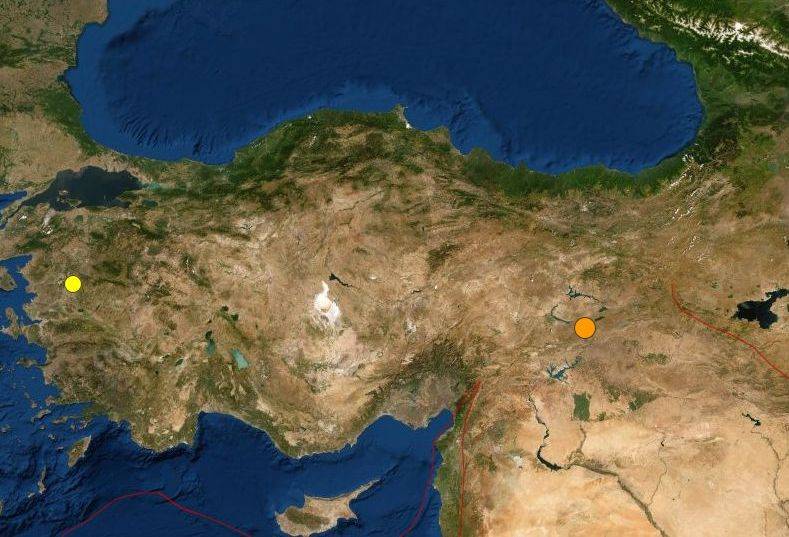
200124  UT Mw6.7 Turkey.jpg

Dave
 

Attachments

  • 200124  UT Mw6.7 Turkey.jpg
    200124 UT Mw6.7 Turkey.jpg
    72.6 KB · Views: 466
  • Like
  • Informative
Likes   Reactions: Klystron, anorlunda and fresh_42
Earth sciences news on Phys.org
The M6.7 is in the middle of nowhere, but the M5.6 is close to high populated areas. They are pretty far apart!?
 
  • Like
Likes   Reactions: davenn
fresh_42 said:
The M6.7 is in the middle of nowhere, but the M5.6 is close to high populated areas. They are pretty far apart!?

Fortunately, it's 100km from the largest nearby city, Diyarbikar. There are a lot of villages and towns closer to the event

Google Earth is good for seeing what else is nearby
 
  • Like
Likes   Reactions: chemisttree
Are the two somehow related, or independent events? The faults don't seem related.
Anatolian_Plate.png
 
  • Informative
Likes   Reactions: Klystron
fresh_42 said:
Are the two somehow related, or independent events? The faults don't seem related.

They are related in that they are both the result of tectonic motion along both of them is squeezing
the central part of Turkey out to the west, as your map indicates.
The northwards motion of the Arabian plate is around 15 - 20mm/year
The Anatolian Plate is moving westwards at around 21mm / year
 
Just curious, what’s “Mw?”
 
  • Like
Likes   Reactions: sysprog
chemisttree said:
Just curious, what’s “Mw?”

Mw = Moment Magnitude, it's the main one now used ( for ~ the last 25 years or so ).
It gives a better representation of the size of the quake and it doesn't suffer from the recording overload
that all the older magnitude do, eg the more commonly ones like ML (Local Magnitude = the old Richter scale),
Mb (Body wave Magnitude), MS = Surface Magnitude ( used to be used for the large non-local events).

ML is still commonly used for quakes within ~ 200 km of the recording station. It was never intended for use
for big distant event. But as usual with the media, they latch onto something and won't let it go and ML
gets wrongly used for many quakes.

There are a few more recent and less commonly ones used eg Mww, Mwp, Me

Mw, the moment magnitude takes into account the length of the rupture, the area of the fault plane that has
slipped and this gives a better indication of the amount of energy released in the quake.
Mw can be calculated for any size event.
Dave
 
  • Informative
  • Like
Likes   Reactions: Klystron, chemisttree, sysprog and 2 others
berkeman said:
Looks like the number of fatalities is climbing...

Sadly, it doesn't surprise me. So many countries like Turkey that have no standards for buildings to withstand
quakes and when you are out into the small towns/villages almost all homes etc are adobe brick/mud huts
that cannot withstand quakes half the size of this one :frown:
 
  • #10
davenn said:
like Turkey that have no standards for buildings to withstand
quakes
Oh, they have those standards, they just do not follow them or do not know they exist at all. Even in dense populated areas like Istanbul there are many buildings which were built illegally, or on which additional stores have been built etc. Cheap concrete and similar savings are an issue, too. You're probably safer in the metro tunnel beneath the Bosporus than in ancient city quarters.
 
  • Like
Likes   Reactions: davenn
  • #11
One of the quakes is reported to be centered around the town of Sivrice. I just visited there a few moments ago (Google Earth) and the place looks charming. Almost like some places in northern California. Sivrice looks like a nice, clean agricultural community that caters to a vacation crowd. No mud or adobe huts in sight from the road. Pretty modern looking buildings. They are and always have been living in an earthquake prone area. I’d be pretty surprised if buildings there weren’t built to some code, but who knows.Google Earth Linkhttps://earth.app.goo.gl/Fh2C1B
#googleearth

The Northridge earthquake was a 6.7 (Ml or Mw?) that did significant damage to buildings in an area prone to earthquake and that has some of the most rigorous building standards in the US. It killed 57.
 
  • Like
Likes   Reactions: Klystron and davenn
  • #12
chemisttree said:
The Northridge earthquake was a 6.7 (Ml or Mw?)

I had to google that to confirm haha ... Mw 6.7
 
  • #13
fresh_42 said:
Are the two somehow related, or independent events? The faults don't seem related.

Hey, Sorry, just realized that I probably misunderstood what you said.
I'm now assuming you were referring to the 2 quakes, the 5.6 and the 6.7, no, not directly related
For some reason I thought you were referring to the two fault systems, the north and east Anatolian Faults

my badDave
 

Similar threads

  • · Replies 2 ·
Replies
2
Views
2K
  • · Replies 10 ·
Replies
10
Views
3K
  • · Replies 9 ·
Replies
9
Views
2K
  • · Replies 2 ·
Replies
2
Views
3K
  • · Replies 1 ·
Replies
1
Views
2K
Replies
3
Views
4K
  • · Replies 2 ·
Replies
2
Views
2K
  • · Replies 2 ·
Replies
2
Views
3K
  • · Replies 10 ·
Replies
10
Views
3K
  • · Replies 9 ·
Replies
9
Views
3K