A question about dehumidifiers and condensation

Click For Summary
SUMMARY

The discussion centers on the design of heat sinks in dehumidifiers, specifically the use of thick, well-spaced fins versus thin fins. Thick fins are preferred as they allow water droplets to form and fall without bridging gaps, which is crucial for effective condensation. A smaller cold sink temperature is necessary to achieve condensation below the dew point, while the design must also consider the removal of condensate to prevent insulation effects. The conversation highlights the balance between surface area and airflow reduction in optimizing dehumidifier efficiency.

PREREQUISITES
  • Understanding of heat transfer principles
  • Familiarity with dehumidifier operation and design
  • Knowledge of condensation processes
  • Basic concepts of thermodynamics related to humidity
NEXT STEPS
  • Research heat sink design principles for dehumidifiers
  • Explore the impact of fin spacing on condensation efficiency
  • Learn about the thermodynamic properties of air at varying humidity levels
  • Investigate methods for effective condensate removal in dehumidifiers
USEFUL FOR

Engineers, product designers, and HVAC professionals interested in optimizing dehumidifier performance and understanding the thermal dynamics involved in condensation processes.

YoshiBeans
Messages
8
Reaction score
0
Hi guys!

My question is about the heat sinks (cold side) used in some dehumidifiers. It appears that thick, well spaced fins are used, as opposed to a larger number of thin fins, which I would expect to provide better heat transfer.
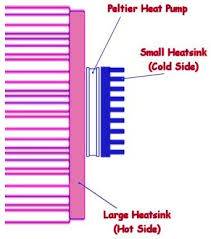
download.jpg


Am I right in assuming that this is to allow space for water droplets to form and fall without bridging the gap between fins?

Or is it because the extra surface area would be conterproductive as it would mean a larger quantity of air would need to be reduced to the dew point before the heat transfer becomes useful? If so, would the multiple thin fins be more efficient in the hyperthetical case of 100% humidity?

Any insight would be appreciated.

Thanks in advance.

Johann
 
Last edited:
Science news on Phys.org
A small cold sink will reach a lower temperature for a given rate of heat transfer. I would imagine that would make for more effective condensation because you want to be well below the dew point.
 
  • Like
Likes   Reactions: Nik_2213
sophiecentaur said:
A small cold sink will reach a lower temperature for a given rate of heat transfer. I would imagine that would make for more effective condensation because you want to be well below the dew point.

So you would agree with the hypothetical about the 100% humidity?
 
YoshiBeans said:
So you would agree with the hypothetical about the 100% humidity?

I guess so. But the point of a dehumidifier is to reduce humidity, is it not? Otoh, if it is used as a condenser, the design could be different (?).
 
sophiecentaur said:
I guess so. But the point of a dehumidifier is to reduce humidity, is it not? Otoh, if it is used as a condenser, the design could be different (?).

True, but unfortunately I can't find much on condenser heat sink design as they are normally larger and use finned pipes with gas or fluid refrigerant instead.
 
So what do you actually want to achieve?
I still think that the cold sink temperature needs to be as low as possible and that is why it's relative small. There is a problem in getting rid of the condensate fast enough because it tends to act as an insulator, increasing the equilibrium temperature of the surface in contact with the air. The hot sink needs to work with radiation or convection whereas the cold sink works by contact with the damp air and should avoid heat gain by radiation as that would reduce the condensation rate. (I just thought of that but I think it must be relevant)
 

Similar threads

  • · Replies 5 ·
Replies
5
Views
3K
  • · Replies 3 ·
Replies
3
Views
2K
  • · Replies 30 ·
2
Replies
30
Views
4K
Replies
2
Views
3K
  • · Replies 9 ·
Replies
9
Views
2K
  • · Replies 1 ·
Replies
1
Views
2K
Replies
1
Views
2K
  • · Replies 7 ·
Replies
7
Views
16K
  • · Replies 7 ·
Replies
7
Views
2K
  • · Replies 4 ·
Replies
4
Views
3K