A question on thermal stress and axial force in a structure

Click For Summary

Homework Help Overview

The discussion revolves around a problem related to thermal stress and axial forces in a structural context, specifically focusing on how a temperature rise affects the forces in structural members. The original poster is seeking assistance in determining the axial forces acting on each member of the structure given specific conditions.

Discussion Character

  • Exploratory, Assumption checking, Conceptual clarification

Approaches and Questions Raised

  • Participants discuss the translation of the problem statement and the necessary parameters such as area, length, and Young's modulus. Questions are raised about the connections between members and supports, as well as the relevance of gravity in the context of the problem. There is also an exploration of the equations related to tensile stress and strain due to thermal expansion.

Discussion Status

The discussion is ongoing with participants providing insights into the problem setup and questioning various assumptions. Some have offered equations related to tensile stress and strain, while others are seeking clarification on specific details of the problem. There is no explicit consensus yet, but guidance has been provided regarding the strain equation and the relevance of Young's modulus.

Contextual Notes

Participants note the absence of information regarding mass or density, leading to the assumption that gravity can be ignored. The connections between members are confirmed to be pinned, and there is a mention of a fixed distance between supports.

manutd@13
Messages
8
Reaction score
0
hi guys
i've really been struggling with this question but I still can't get any glimpse of idea on how to solve the problem,
so the conditions are given in the table and what the question is asking for is the axial force acting in each members of the structure.
ah, almost forgot to tell you that there is temperature rise of 40 degrees Celsius in all members.
help!
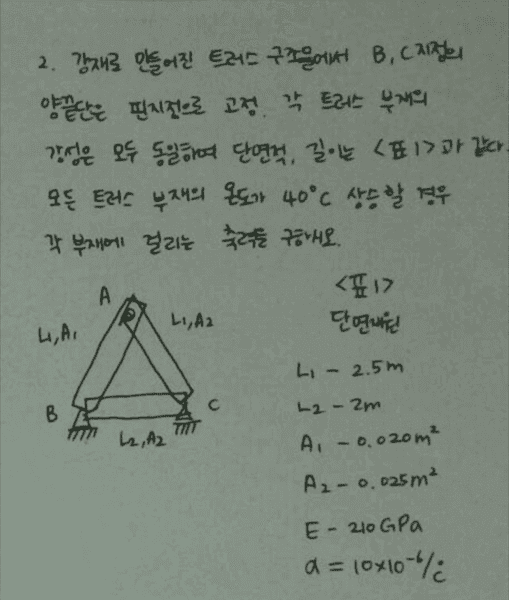
Screenshot_2015-12-10-02-17-29-1.png
 
Physics news on Phys.org
You will need to supply a translation of the question into English.
 
translation of the question:
Area, Length and etc(e.g. young's modulus) information about each of the members are as given below, if there is rise of 40 degrees celsius in every member of the structure what would be the axial force in each of the members?
 
manutd@13 said:
translation of the question:
Area, Length and etc(e.g. young's modulus) information about each of the members are as given below, if there is rise of 40 degrees celsius in every member of the structure what would be the axial force in each of the members?
How are the members connected to each other and to the supports? Is something holding the supports a fixed distance apart?
Is the "A2" on AC correct? Should it perhaps be A1?
There's no mention of mass or density, so I assume we ignore gravity.
 
What is the equation for the tensile stress in a member as a function of the tensile strain in the member if there is thermal expansion present, with a temperature rise of ΔT? Have you learned such an equation?

If point A is displaced v in the y direction and u in the x direction, what is the strain in each of the members AB and AC? Member BC is easy to do because the strain in this member is zero.
 
The connections are pinned connections, the strain equation is strain=a(▲t)L, and the A2 stated is correct
 
haruspex said:
How are the members connected to each other and to the supports? Is something holding the supports a fixed distance apart?
Is the "A2" on AC correct? Should it perhaps be A1?
There's no mention of mass or density, so I assume we ignore gravity.
The connections are pinned connections, the strain equation thermal increase/decrease is strain=a(▲t)L, and the A2 stated is correct, they are fixed distance apart, and the gravity is ignored yes
 
manutd@13 said:
The connections are pinned connections, the strain equation thermal increase/decrease is strain=a(▲t)L, and the A2 stated is correct, they are fixed distance apart, and the gravity is ignored yes
Your equation for the strain is not correct. Try again.

I'll give you a freebie, the answer to my first question in post #5 is:
$$σ=E(ε-αΔT)$$
where E is Young's modulus, σ is the tensile stress, and ε is the tensile strain.
 
Chestermiller said:
Your equation for the strain is not correct. Try again.

I'll give you a freebie, the answer to my first question in post #5 is:
$$σ=E(ε-αΔT)$$
where E is Young's modulus, σ is the tensile stress, and ε is the tensile strain.

Ah i left out the youngs modulus;; that helps a lot, i'l try again,thanks
 
  • #10
manutd@13 said:
Ah i left out the youngs modulus;; that helps a lot, i'l try again
Also, the L should not be in your strain equation.

Chet
 

Similar threads

  • · Replies 14 ·
Replies
14
Views
12K
Replies
2
Views
2K
  • · Replies 5 ·
Replies
5
Views
2K
  • · Replies 9 ·
Replies
9
Views
2K
Replies
4
Views
3K
  • · Replies 1 ·
Replies
1
Views
4K
Replies
6
Views
2K
  • · Replies 35 ·
2
Replies
35
Views
7K
  • · Replies 6 ·
Replies
6
Views
15K
  • · Replies 2 ·
Replies
2
Views
4K