A simple problem just for fun

  • Level: Undergrad 
  • Thread starter Thread starter wrobel
  • Start date Start date
Join the discussion
Registration is free. Ask a follow-up in this thread, or start your own.
8 replies · 507 views
Science Advisor
Insights Author
Messages
1,415
Reaction score
1,170
A uniform massive cylinder is free to rotate about its fixed horizontal axis. A uniform disk of smaller radius rolls without slipping along the inner surface of the cylinder. The system is in the uniform gravitational field g. Prove that any motion of the system starting from rest is periodic or an equilibrium.
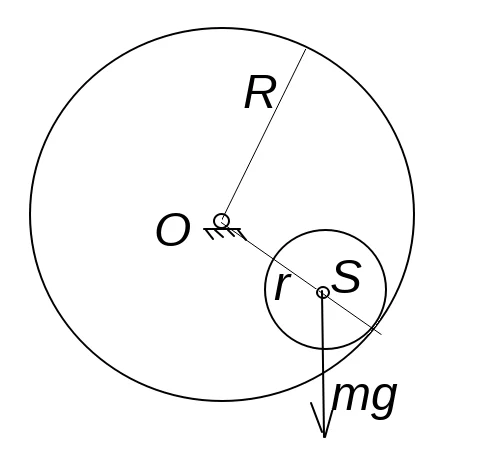
1.webp
 
Last edited:
Physics news on Phys.org
So the fixed horizontal axis supports the outer cylinder against the "uniform gravitational field". The inner cylinder must be supported by a "sticky" contact with the large cylinder?
The system is put into motion by pushing the outer cylinder, the inner cylinder, or both?

It seems to me that the gravitational field serves no real purpose. As long as there is a way to "fix" the axis, the experiment could be done in free fall.
 
wrobel said:
A uniform disk of smaller radius rolls without slipping along the inner surface of the cylinder.
Does the disk have a finite thickness, volume, mass and inertia?

Is the disk constrained to remain in a plane orthogonal to the cylinder axis, or can it fall onto one side and so stop rolling, then just flip heads and tails?
 
I believe that rolling without slipping means there is no loss so energy and momentum are conserved. If you start it from rest as in the picture, this system is a clock. However, if in equilibrium at the lowest point and you slowly move the big cylinder, the bottom disk will stay at the bottom maintaining the equilibrium I think.
 
wrobel said:
A uniform disk of smaller radius rolls without slipping along the inner surface of the cylinder.
"Along" the cylinder's length, helical, or along an inner circumference.
If the disk became a short cylindrical roller, it might restrict the question.
 
Here is my conception of the motion. The angles are measured from the vertical axis. The small disk is ##\theta## and the cylinder is ##\phi##. I chose positive angles to the right and positive angular velocities the sense they would have at ##t=0## which is swinging to the left. In this scenario we gently roll the disk from its position at the bottom at rest to the position at ##t=0##.

IMG_6707.webp
 
As far as proof goes, if we write the Lagrangian it will be a complicated expression of the masses, radii, angles ##\theta## and ##\phi##. But the angles are related through the no-slip condition so we really only end up with one variable, say ##\theta## and the equation of motion will just be an equation of harmonic motion because all the forces are non-dissipative it can be reduced to $$\ddot{\theta} + \omega_0^2 \sin(\theta) = 0$$
where ##\omega_0^2## is some complicated function of the problem parameters.
 
I describe the cylinder rotation with a phasor. Since the cylinder is massive, there can be no step function in the cylinder rotation. The disk can roll, has inertia, so will swing like a pendulum. Take the Fourier Transform of the cylinder phasor and multiply it by the FT of the disk pendulum. Inverse FT that product to get the disk position in time. Since the result is represented by a FT, the result must be periodic or an equilibrium.