About the Orbital Dipole Moment

Join the discussion
Ask a follow-up here, or get your own question answered by working scientists, mathematicians and engineers — people, not an autocomplete.
Real named experts · corrections over time · the nuance an AI answer skips
5 replies · 4K views
S Aditya
Messages
2
Reaction score
0
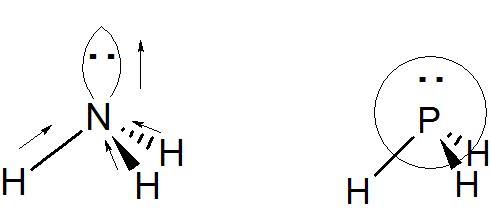
I was going through the chapter Chemical Bonding in one of the books and found something about orbital dipole due to lone pairs.

In each diagram the orbital dipole due to lone pair was directed from the central atom to the end of the hybridized orbital (lone pair).

Why is that so?
images?q=tbn:ANd9GcTppo3bTjfMZ_0gNXZCIfQXrz-4xO3CBBSshEKmjkUDLMYLfy5Ztg.jpg
 
Chemistry news on Phys.org
Conventionally, in chemistry, the dipole moment is indicated as pointing from δ+ to δ-. This is in contrast with the convention in physics where the dipole moment points towards the positive charges.

The presence of the lone pair contributes to the δ-. In addition, the fact that there is a lone pair is an indication that the atom on which it resides is more electronegative, which explains the presence of the arrows pointing from H to N n the first figure. All this makes the dipole moment point towards the lone pair.
 
DrClaude said:
Conventionally, in chemistry, the dipole moment is indicated as pointing from δ+ to δ-. This is in contrast with the convention in physics where the dipole moment points towards the positive charges.

The presence of the lone pair contributes to the δ-. In addition, the fact that there is a lone pair is an indication that the atom on which it resides is more electronegative, which explains the presence of the arrows pointing from H to N n the first figure. All this makes the dipole moment point towards the lone pair.

Sir, my argument is why is the dipole moment of the lone pair (and the lone pair alone) poining upwards (in this case) from the central atom (Nitrogen) to the extremity of the hybridized lone pair orbital?
 
DrClaude said:
Conventionally, in chemistry, the dipole moment is indicated as pointing from δ+ to δ-. This is in contrast with the convention in physics where the dipole moment points towards the positive charges.
I never heard of such a convention. Rather, I think that the arrows denote the polarity of the bond, and not the dipole moment. But admittedly, for a non-bonding pair there is n't much sense in speaking of the polarity.