Discussion Overview
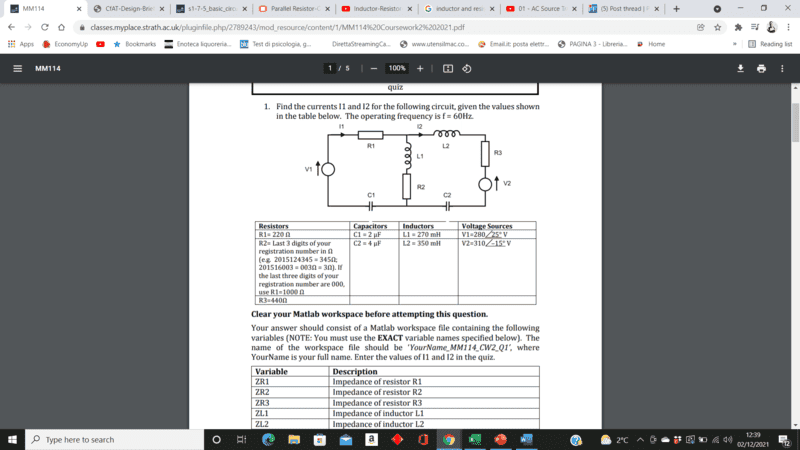
The discussion revolves around analyzing an AC circuit that includes resistors and inductors, specifically focusing on finding the currents I1 and I2. The context includes coursework from a university setting.
Discussion Character
- Homework-related
- Technical explanation
Main Points Raised
- One participant requests assistance in solving the circuit for currents I1 and I2, expressing uncertainty about where to begin.
- Another participant suggests reorganizing the circuit for clarity by moving capacitors next to their respective resistors and converting inductors and capacitors to reactance.
- The same participant proposes writing the impedances as complex numbers and transforming Y to delta to eliminate floating nodes.
- A later reply confirms that the inquiry is related to university coursework and asks how to convert inductance and capacitance to reactance.
- Another participant provides the formulas for converting inductance and capacitance to reactance, indicating that the angular frequency ω is also relevant.
Areas of Agreement / Disagreement
Participants appear to agree on the need to convert inductors and capacitors to reactance, but the discussion remains unresolved regarding the specific steps to take and whether voltages should also be converted to complex numbers.
Contextual Notes
There are limitations in the discussion, including missing assumptions about the circuit configuration and the specific values for frequency and components, which may affect the calculations.