disclaimer
- 25
- 0
Hi there;
I guess this must be really easy and obvious but I just can't seem to be able to figure it out right now. I need to find (grapho-analytically) the acceleration of B (which is obviously the same as of C) in the position show in the picture. [tex]v_1=2 m/s[/tex] is the input velocity.
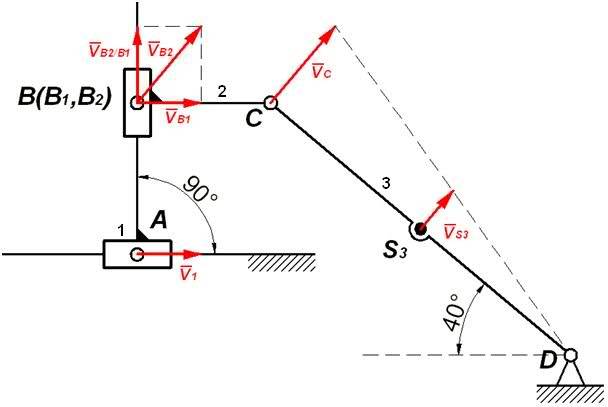
Data:
[tex]|AB|=0.068 [m],<br /> |BC|=0.06 [m],<br /> |CS_3 |=0.088 [m],<br /> |S_3 D|=0.088 [m],<br /> v_1=2 [m/s][/tex]
I calculated all the velocities:
[tex] v_{B1}=2 [m/s],<br /> v_{B2}=3.111 [m/s],<br /> v_{B2/B1}=2.384 [m/s],<br /> v_C=3.111 [m/s],<br /> v_{S3}=1.555 [m/s],[/tex]
[tex]\omega_3=\frac{v_C}{|CD|}=\frac{3.111}{0.176}=17.676 [1/s][/tex]
As for the accelerations, certainly the acceleration of A is zero ([tex]v_1=const[/tex]). Also, the normal component of the acceleration of C:
[tex]a_C^n=\omega_3^2\cdot{|CD|}=54.989 [m/s^2][/tex]
And here I am a bit lost. It looks like slider#2 is accelerating with respect to slideway#1. Any thoughts? I analyzed the structure in SAM, and the absolute acceleration of B (and C) is [tex]85.574 m/s^2[/tex]. What other accelerations should I consider? Thanks in advance for taking your time.
I guess this must be really easy and obvious but I just can't seem to be able to figure it out right now. I need to find (grapho-analytically) the acceleration of B (which is obviously the same as of C) in the position show in the picture. [tex]v_1=2 m/s[/tex] is the input velocity.
Data:
[tex]|AB|=0.068 [m],<br /> |BC|=0.06 [m],<br /> |CS_3 |=0.088 [m],<br /> |S_3 D|=0.088 [m],<br /> v_1=2 [m/s][/tex]
I calculated all the velocities:
[tex] v_{B1}=2 [m/s],<br /> v_{B2}=3.111 [m/s],<br /> v_{B2/B1}=2.384 [m/s],<br /> v_C=3.111 [m/s],<br /> v_{S3}=1.555 [m/s],[/tex]
[tex]\omega_3=\frac{v_C}{|CD|}=\frac{3.111}{0.176}=17.676 [1/s][/tex]
As for the accelerations, certainly the acceleration of A is zero ([tex]v_1=const[/tex]). Also, the normal component of the acceleration of C:
[tex]a_C^n=\omega_3^2\cdot{|CD|}=54.989 [m/s^2][/tex]
And here I am a bit lost. It looks like slider#2 is accelerating with respect to slideway#1. Any thoughts? I analyzed the structure in SAM, and the absolute acceleration of B (and C) is [tex]85.574 m/s^2[/tex]. What other accelerations should I consider? Thanks in advance for taking your time.