Addition/Multiplication of Natural Numbers - Bloch Th. 1.2.7

Click For Summary
SUMMARY

The discussion centers on Theorem 1.2.7 from Ethan D. Bloch's "The Real Numbers and Real Analysis," specifically regarding the subset relationship between the set G and the natural numbers N. Participants clarify that G is defined as the set of natural numbers satisfying the cancellation property, thus establishing G as a subset of N. The conversation also addresses concerns about the potential emptiness of G, concluding that even if G is empty, the subset relationship remains valid due to the properties of set theory.

PREREQUISITES
  • Understanding of set theory, particularly the Axiom Schema of Specification.
  • Familiarity with the concept of natural numbers and their properties.
  • Knowledge of cancellation properties in mathematical sets.
  • Basic comprehension of the structure and content of "The Real Numbers and Real Analysis" by Ethan D. Bloch.
NEXT STEPS
  • Study the Axiom Schema of Specification in Zermelo-Fraenkel set theory.
  • Explore the properties of cancellation in algebraic structures.
  • Review the definitions and properties of subsets in set theory.
  • Examine further examples of theorems in "The Real Numbers and Real Analysis" to understand their proofs and implications.
USEFUL FOR

Mathematics students, educators, and anyone engaged in the study of real analysis or set theory, particularly those focusing on the foundational aspects of natural numbers and their properties.

Math Amateur
Gold Member
MHB
Messages
3,920
Reaction score
48
I am reading Ethan D. Bloch's book: The Real Numbers and Real Analysis ...

I am currently focused on Chapter 1: Construction of the Real Numbers ...

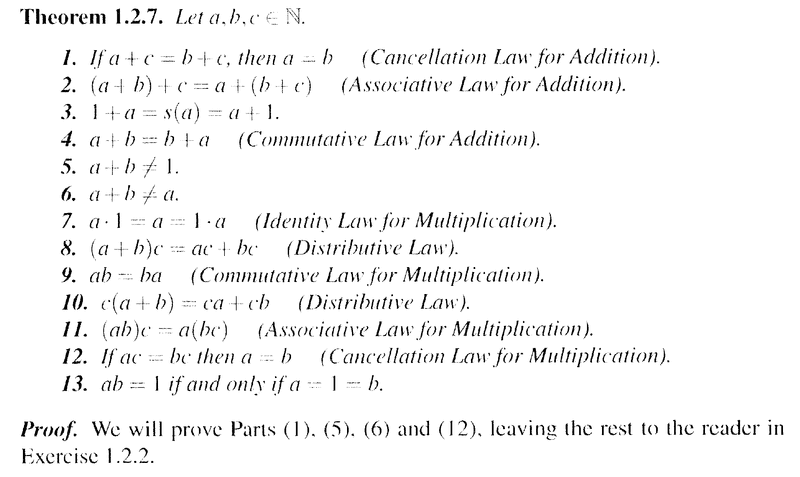
I need help/clarification with an aspect of Theorem 1.2.7 (1) ...

Theorem 1.2.7 reads as follows:
?temp_hash=10af9cc36ca677ab540d906429ca0a63.png

?temp_hash=10af9cc36ca677ab540d906429ca0a63.png

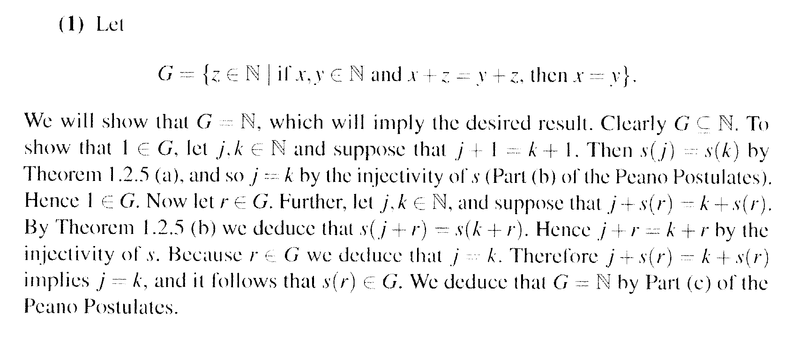
In the above proof of (1) we read the following:" We will show that ##G = \mathbb{N}##, which will imply the desired result. Clearly ##G \subseteq \mathbb{N}##. ... ... ... "Before he proves that ##1 \in G##, Bloch asserts that ##G \subseteq \mathbb{N}## ... what is his reasoning ...?

It does not appear to me ... from the order in which he says things that he is saying

##1 \in G## ... therefore ##G \subseteq \mathbb{N}## ...

Can we immediately conclude that ##G \subseteq \mathbb{N}## without relying on ##1 \in G## ... ... ?

(Bloch does the same in a number of places in this chapter ... )Hope someone can help ... ...

Peter
 

Attachments

  • Bloch - 1 - Theorem 1.2.7 (1) - PART 1 ... ....png
    Bloch - 1 - Theorem 1.2.7 (1) - PART 1 ... ....png
    29.4 KB · Views: 742
  • Bloch - 2 - Theorem 1.2.7 (1) - PART 2 ... ....png
    Bloch - 2 - Theorem 1.2.7 (1) - PART 2 ... ....png
    35.3 KB · Views: 630
Physics news on Phys.org
Math Amateur said:
Before he proves that ##1 \in G##, Bloch asserts that ##G \subseteq \mathbb{N}## ... what is his reasoning ...?
This follows directly from the definition of ##G##, which is defined as the set of elements ##z## of ##\mathbb N## that satisfy the required cancellation property:
$$G=\{z\in\mathbb N\ |\ z\textrm{ satisfies the cancellation property}\}$$
In other words, ##G## is defined as the subset of ##\mathbb N## obtained by applying the criteria that elements must have the cancellation property. IIRC, in Zermelo-Frankel set theory axioms, this is using the Axiom Schema of Specification, which says we can make a subset of an existing set by applying a criterion to filter the elements.
 
  • Like
Likes   Reactions: Math Amateur
andrewkirk said:
This follows directly from the definition of ##G##, which is defined as the set of elements ##z## of ##\mathbb N## that satisfy the required cancellation property:
$$G=\{z\in\mathbb N\ |\ z\textrm{ satisfies the cancellation property}\}$$
In other words, ##G## is defined as the subset of ##\mathbb N## obtained by applying the criteria that elements must have the cancellation property. IIRC, in Zermelo-Frankel set theory axioms, this is using the Axiom Schema of Specification, which says we can make a subset of an existing set by applying a criterion to filter the elements.
Thanks Andrew ... appreciate the help ...

But ... what if no ##z## satisfy the criteria for membership of ##G## ... and ##G = \emptyset## ... ?

Peter
 
Math Amateur said:
Thanks Andrew ... appreciate the help ...

But ... what if no ##z## satisfy the criteria for membership of ##G## ... and ##G = \emptyset## ... ?

Peter
Then the proof won't be able to be completed. But the statement that ##G\subseteq \mathbb N## will still be valid, because the empty set is a subset of every set.

Perhaps your concern is not about the claim that ##G## is a subset of ##\mathbb N## but rather about whether it is non-empty. He proves that further down, first by showing that ##1\in G##.

As a bit of trivia, a handy way to define the empty set, given a set ##A##, is to write it as
$$\{x\in A\ |\ x\neq x\}$$
 
  • Like
Likes   Reactions: Math Amateur
andrewkirk said:
Then the proof won't be able to be completed. But the statement that ##G\subseteq \mathbb N## will still be valid, because the empty set is a subset of every set.

Perhaps your concern is not about the claim that ##G## is a subset of ##\mathbb N## but rather about whether it is non-empty. He proves that further down, first by showing that ##1\in G##.

As a bit of trivia, a handy way to define the empty set, given a set ##A## is to write it as
$$\{x\in A\ |\ x\neq x\}$$
Yes, it was about Bloch claiming that "clearly" ##G \subseteq \mathbb{N}## before he had proved that ##G## contained some elements ... I would have been happy if he had proved ##1 \in G## ... and then claimed ##G \subseteq \mathbb{N}## ... ...

... ... indeed for me ... we should be aware that all elements of ##G## are also elements of ##\mathbb{N}## - which we have ... AND ... we need to know that G is not empty ... Mind you ... you now have me thinking that ##G \subseteq \mathbb{N}## anyway since ##\emptyset \subseteq \mathbb{N}## ... ...

Peter
 

Similar threads

Replies
4
Views
2K
  • · Replies 7 ·
Replies
7
Views
2K
Replies
4
Views
2K
  • · Replies 3 ·
Replies
3
Views
4K
  • · Replies 2 ·
Replies
2
Views
2K
  • · Replies 8 ·
Replies
8
Views
3K
  • · Replies 3 ·
Replies
3
Views
2K
Replies
2
Views
2K
  • · Replies 1 ·
Replies
1
Views
1K
  • · Replies 1 ·
Replies
1
Views
2K