Adiabatic compression of gas at two temperatures

Click For Summary
SUMMARY

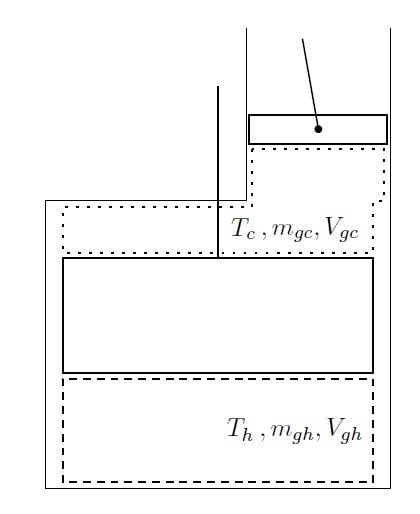
The discussion focuses on the adiabatic compression of gas in a system comprising a piston and a displacer. The pressure and temperature relationships during adiabatic compression are defined by the equations \( P = \left(\frac{V_0}{V}\right)^{\gamma} \) and \( T = \left(\frac{V_0}{V}\right)^{\gamma-1} \). The user seeks to modify the existing isothermal equations to account for temperature changes due to adiabatic compression, emphasizing that mass exchange between chambers does not occur during this process. The key takeaway is the understanding of how volume ratios affect pressure and temperature in an adiabatic system.

PREREQUISITES
  • Understanding of adiabatic processes in thermodynamics
  • Familiarity with the ideal gas law
  • Knowledge of the specific heat ratio (\(\gamma\))
  • Basic principles of gas compression and expansion
NEXT STEPS
  • Study the derivation of the adiabatic process equations in thermodynamics
  • Explore the implications of the ideal gas law on gas behavior during compression
  • Investigate the effects of varying \(\gamma\) on gas properties
  • Learn about practical applications of adiabatic compression in engineering systems
USEFUL FOR

Engineers, physicists, and students studying thermodynamics, particularly those interested in gas compression systems and their thermal properties.

Kalus
Messages
36
Reaction score
0
I have a system that looks like this:
zKjqb.jpg


The top part is a piston, whereas the bottom is a displacer.

I have looked at the Isothermal case for this system in a separate thread (https://www.physicsforums.com/showthread.php?t=553165)

But in short, the result was that the pressure of the system is equal to:

m=m_{gc}+m_{gh}
P=\frac{mR}{V_{gc}/T_c +V_{gh}/T_h}

How can I modify this to take into account the temperature rise caused by adiabatic compression? I suppose I need to write the T_gc + T_gh as functions of the compression by the top piston, but how?
 
Science news on Phys.org
Even if, as described in the linked thread, it is possible for the two chambers to exchange mass during compression (through a small gap surrounding the lower piston, so that the pressures are equalized at all times), when the system as described is compressed adiabatically, such exchange will not happen. Instead, both gas chambers will be compress by the same volume ratio at the overall volume:
$$\frac{V_c}{V_{c0}}=\frac{V_h}{V_{h0}}=\frac{V}{V_0}$$
Furthermore, the pressures in the two chambers will remain equal during the compression, and will vary as:
$$\frac{P}{P_0}=\left(\frac{V_0}{V}\right)^{\gamma}$$And the temperatues in the two chambers will vary as $$\frac{T_c}{T_{c0}}=\frac{T_h}{T_{h0}}=\left(\frac{V_0}{V}\right)^{\gamma-1}$$
 

Similar threads

Replies
14
Views
1K
  • · Replies 22 ·
Replies
22
Views
6K
  • · Replies 20 ·
Replies
20
Views
3K
  • · Replies 3 ·
Replies
3
Views
2K
  • · Replies 0 ·
Replies
0
Views
2K
  • · Replies 6 ·
Replies
6
Views
2K
  • · Replies 60 ·
3
Replies
60
Views
10K
  • · Replies 5 ·
Replies
5
Views
3K
  • · Replies 13 ·
Replies
13
Views
2K
Replies
7
Views
2K