Amplify AC signal using dual rail op amp

Click For Summary

Discussion Overview

The discussion revolves around amplifying the output of a hall effect current transducer using a dual rail operational amplifier (op-amp). Participants explore issues related to circuit design, power supply connections, and the practical challenges faced when transitioning from simulation to real-world implementation.

Discussion Character

  • Technical explanation
  • Debate/contested
  • Experimental/applied

Main Points Raised

  • One participant describes their setup with a hall effect sensor output of 15.6mVac and a desired gain of 101 from the op-amp, noting discrepancies between simulation results and practical output.
  • Another participant suggests adding a resistor to ground on the output side of the capacitor to improve measurement accuracy.
  • Concerns are raised about the power supply connections, with multiple participants questioning the grounding and configuration of the dual rail power supply.
  • One participant realizes they may have incorrectly connected the power supply, leading to potential issues with the op-amp's functionality.
  • Suggestions are made to use a voltage divider to create a ground reference for the split supply, although this is noted as a compromise that may limit current delivery.
  • Another participant emphasizes the importance of ensuring proper power supply connections before troubleshooting other aspects of the circuit.
  • There are discussions about using a Darlington pair for amplification, with questions about how to amplify the AC signal from the hall effect output.
  • One participant points out that high resistance values in the feedback network may lead to unexpected behavior due to parasitic effects in the breadboard setup.
  • Concerns are raised about the gain-bandwidth product of the op-amp affecting frequency response.

Areas of Agreement / Disagreement

Participants generally agree that the power supply configuration is critical and that the current setup may not work as intended. However, there are multiple competing views on how to resolve the issues, particularly regarding the use of voltage dividers and the implications of using high resistance values in the feedback network.

Contextual Notes

Limitations include potential misunderstandings about the power supply connections and the impact of high resistance values on circuit behavior. There is also uncertainty regarding the frequency response of the op-amp based on its gain-bandwidth product.

Who May Find This Useful

Readers interested in practical circuit design, particularly those working with operational amplifiers and signal amplification in experimental setups.

florenceooi
Messages
15
Reaction score
0
Hi !

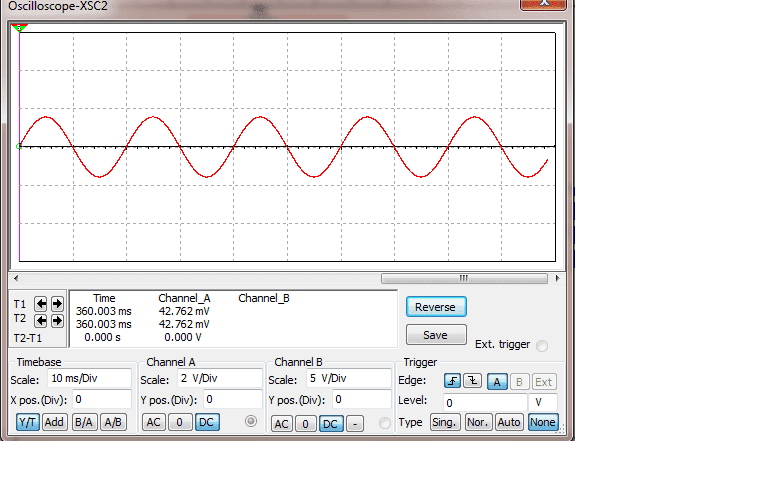
I want to amplify the output of my hall effect current transducer ( CSLA2CD ). The output of my hall effect sensor is 15.6mVac. And I used a dual rail op - amp to amplify this small ac voltage which the gain is 101 ( as shown in the schematic below ). I tried to simulate using multisim, and it does show me the correct output. However, in practical, I can't get the correct output from op amp.

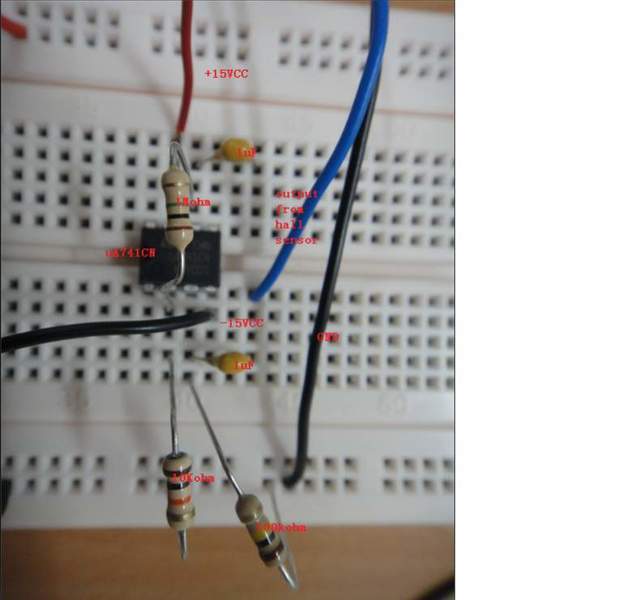
I attached the photo of my hardware circuit as well.

I built it exactly like the schematic. But I couldn't get the correct output as the simulation result.

Is there anything wrong with my circuit?

FYI, from what i measured, the output of hall sensor when the bulb is off, is around 0.5mVrms. and the output of hall sensor when the bulb is on, is around 15.6mVrms, which is very small.

I should get the output with 101 gain from op amp. But it doesn't work.
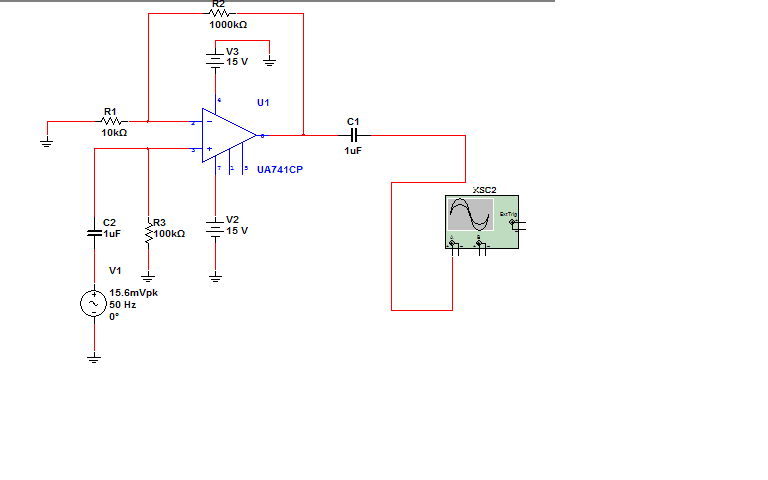
opamp.png


waveform.png


amplifier.jpg
 
Engineering news on Phys.org
And here is how I coil the Live wire through hall effect sensor current transducer.
bulb.jpg
 
Forgot to mention. For the hardware part, the other pin of the 1uF at pin 6 of op amp is connected to multimeter to measure the output. ( it is not floating )
 
Put a resistor to ground (10k or more would work) on the output side of your capacitor (so the resistor is in parallel with the voltmeter).

Also, double check that you don't have any unintended grounds. Make sure, for example, that the negative side of your negative rail supply isn't unintentionally grounded.
 
I don't see any power (+/-) connections going to that IC on the breadboard...
 
And when you do hook up +/- Vcc, be sure to decouple the rails to ground well with capacitors.
 
uart said:
Put a resistor to ground (10k or more would work) on the output side of your capacitor (so the resistor is in parallel with the voltmeter).

Also, double check that you don't have any unintended grounds. Make sure, for example, that the negative side of your negative rail supply isn't unintentionally grounded.


Yes. I already connect a 10k resistor at the output.

I think I built the wrong +/-15V circuit. This is how my connection.

dual rail.jpg


I am using a 24V regulated voltage adaptor to supply the voltage to LM7815 and LM7915.
which means now the gnd from 7915 is supply to the input of 7815 and vice versa. This should be wrong right? I should have a common ground for both 7815 and 7915. So I assume that I have to use a Step down transformers to build Dual Regulated Power Supply +/-15v. Am I right?
 
Last edited:
Do you have a connection to this 24 volt adapter in any way to ground?
 
No. the ground of adaptor has been connected to input of 7915. and the ground pin of 7915 is connected to the input of 7815, which means actually I just try to get the negative value by changing the polarity. Which I just realized that I did a huge mistake. Is this the main cause that my op amp doesn't work?
 
  • #10
berkeman said:
I don't see any power (+/-) connections going to that IC on the breadboard...

I did connect my circuit to GND and VCC exactly as shown in my schematic diagram.
 
  • #11
florenceooi said:
No. the ground of adaptor has been connected to input of 7915. and the ground pin of 7915 is connected to the input of 7815, which means actually I just try to get the negative value by changing the polarity. Which I just realized that I did a huge mistake. Is this the main cause that my op amp doesn't work?

Ok, without a diagram I'm not sure exactly what you've done there, but it doesn't sound very sensible. Not sure if I'm reading it correctly, but it sounds like you've made the two supplies in parallel (without any isolation) and then connected them in series. You definitely need to get the power supply sorted before any other aspect of the design can possibly work. Always measure that your DC levels are correct in any circuit as the first part of any fault finding exercise.
 
  • #12
uart said:
Ok, without a diagram I'm not sure exactly what you've done there, but it doesn't sound very sensible. Not sure if I'm reading it correctly, but it sounds like you've made the two supplies in parallel (without any isolation) and then connected them in series. You definitely need to get the power supply sorted before any other aspect of the design can possibly work. Always measure that your DC levels are correct in any circuit as the first part of any fault finding exercise.

I'm sorry. I posted the wrong image just now. Could you please check the post #7 again, that diagram shows my connection on building the dual-rail power supply. Thanks.
 
  • #13
Just had a look at post #7. There is no way that can work. That is the problem. If you want to make a split supply you need 3 leads coming from the actual power supply. You can cobble it and make your circuit work by forming a voltage divider out of the 24 volt supply using 2 470 ohm 1/2 watt resistors. The node formed between the 2 resistors will be your ground connection. This will work, but you cannot expect your circuit to deliver much current. It will amplify your signal and it will display nicely on the scope, but it is a compromise. The 470 ohm resistors will run a bit warm.
 
  • #14
florenceooi said:
I'm sorry. I posted the wrong image just now. Could you please check the post #7 again, that diagram shows my connection on building the dual-rail power supply. Thanks.

Ok yeah I can see the correct image now. Yes that circuit won't work as intended, you need to have the two grounds common.
 
  • #15
uart said:
Ok yeah I can see the correct image now. Yes that circuit won't work as intended, you need to have the two grounds common.

Thanks a lot ! I will try to get a step down transformers and rebuild the dual rail power supply.
Meanwhile, I'm trying to build a darlington pair to amplify the ac signal. Can Darlington pair amplify small Vac? From my understanding, the darlington transistor amplify current that pass through base right? Then how do I amplify the VAC from hall effect output, I don't even know what is the current of the output??
 
  • #16
Don't bother until you get a proper power supply. Otherwise it's like building a house on a foundation made of spaghetti.
 
  • #17
Averagesupernova said:
Don't bother until you get a proper power supply. Otherwise it's like building a house on a foundation made of spaghetti.

Agreed. A better short-term goal would be to get the 741 opamp circuit working with two 9V batteries as the +/- voltage sources...

And please do connect wires to the +/- power supply inputs of the opamp on the breadboard... :smile:
 
  • #18
Averagesupernova said:
Just had a look at post #7. There is no way that can work. That is the problem. If you want to make a split supply you need 3 leads coming from the actual power supply. You can cobble it and make your circuit work by forming a voltage divider out of the 24 volt supply using 2 470 ohm 1/2 watt resistors. The node formed between the 2 resistors will be your ground connection. This will work, but you cannot expect your circuit to deliver much current. It will amplify your signal and it will display nicely on the scope, but it is a compromise. The 470 ohm resistors will run a bit warm.

Something like this? So you mean the node between the 2 resistors will be my ground connection right? which means i have to connect all my capacitors to the node between these resistors? Am i right?


supply.jpg
 
  • #19
I did not read through all the posts. From reading your original post and the pictures. You use too high resistance. You want gain of 101, use 10K feedback and 100Ω instead of 1M and 10K. You are using a breadboard, with high resistance, you are going to see strange things because of wires in the air, no ground plane and parasitic capacitance.

Also put a 0.1uF cap between pin 4 and 7 to give some filtering.

Also, You have gain of 100, the frequency response of the op-amp is reduced by about 100. If you use an op-amp with 1MHz GBW, you only get 10KHz! Make sure you opamp is fast enough.
 
Last edited:
  • #20
Think about it, your rails are 30v apart, while you input 24v. Not going to work. The input to your regulators is 12v so you will not be able to get 15v out. You need a lower voltage regulator.
 
  • #21
yungman said:
I did not read through all the posts. From reading your original post and the pictures. You use too high resistance. You want gain of 101, use 10K feedback and 100Ω instead of 1M and 10K. You are using a breadboard, with high resistance, you are going to see strange things because of wires in the air, no ground plane and parasitic capacitance.

Also put a 0.1uF cap between pin 4 and 7 to give some filtering.

Also, You have gain of 100, the frequency response of the op-amp is reduced by about 100. If you use an op-amp with 1MHz GBW, you only get 10KHz! Make sure you opamp is fast enough.

Thanks for the advices :)

yes. the op amp that I'm using has only 1Mhz gain bandwidth products. This is bad right? If I amplify my signal twice? Is it better? Each amplifier with the gain of 10?
 
  • #22
Integral said:
Think about it, your rails are 30v apart, while you input 24v. Not going to work. The input to your regulators is 12v so you will not be able to get 15v out. You need a lower voltage regulator.

Thanks for pointing out the mistake. I did not realize bout it. I will correct it :D
 
  • #23
florenceooi said:
Thanks for the advices :)

yes. the op amp that I'm using has only 1Mhz gain bandwidth products. This is bad right? If I amplify my signal twice? Is it better? Each amplifier with the gain of 10?

It depend on your signal BW. If the signal bandwidth is over 10KHz, it's not going to work. What is the highest frequency component of the signal?

Remember I am just making some common sense observation and ask question.

Yes, I never make it a habit to have a single stage opamp to have gain of 100. But that don't mean it's not going to work. I just don't do 100 per stage.
 
  • #24
florenceooi said:
Something like this? So you mean the node between the 2 resistors will be my ground connection right? which means i have to connect all my capacitors to the node between these resistors? Am i right?


View attachment 49744

The drawing you show don't work exactly, the total voltage you have is 24v, you can't get +/-15V out. But you don't need +/-15V. you don't even need regulators. You can try single supply of +24V and 0V. Bias pin 3 to +12V by a voltage divider. You are AC coupling to input and output so you don't even need to worry about the DC offset.

But I won't be surprise your circuit will work as the regulator might follow. You might get +/-10V from the two regulator and the opamp is powered by say +/-10V instead of +/-15V. It'll work, you just clip at +/-10V instead of +/-15V.
 
  • #25
Hi Guys ! Thanks for all the helps and advices ! I've fixed my dual rail power supply! My op amp can works finally. Thank You! ^^)
 

Similar threads

  • · Replies 3 ·
Replies
3
Views
2K
Replies
9
Views
8K
  • · Replies 6 ·
Replies
6
Views
6K
  • · Replies 9 ·
Replies
9
Views
5K
  • · Replies 3 ·
Replies
3
Views
3K
Replies
6
Views
4K
  • · Replies 6 ·
Replies
6
Views
3K
  • · Replies 6 ·
Replies
6
Views
2K
  • · Replies 6 ·
Replies
6
Views
3K
  • · Replies 11 ·
Replies
11
Views
3K