Analysis of a RLC circuit and a Voltage Controlled Switch

Click For Summary

Discussion Overview

The discussion revolves around the analysis of an RLC circuit involving a voltage-controlled switch and its behavior when subjected to a square wave generator. Participants explore the implications of the switch's operation on node voltages and current flow, particularly focusing on the conditions when the switch is on and off, as well as the effects on output voltage.

Discussion Character

  • Homework-related
  • Technical explanation
  • Debate/contested

Main Points Raised

  • One participant describes the circuit's operation, stating that the switch is off during the positive phase of the square wave, leading to the assumption that Va is constant when the switch is on.
  • Another participant challenges the initial description, asserting that when the switch is on, Va is zero, and questions the clarity of the problem statement.
  • There is a discussion about the current behavior when the switch is closed, with one participant noting that all current goes to ground, while another suggests analyzing the circuit's time constants to understand the voltage buildup across capacitors.
  • One participant mentions that the voltage at Vout appears to exceed the input voltage of 3V, raising questions about the circuit's behavior and the role of the diode in this context.
  • A later reply explains that the diode stops conducting at a certain point, allowing the voltage across one capacitor to double due to changes in capacitance and current flow.

Areas of Agreement / Disagreement

Participants express differing views on the behavior of the circuit, particularly regarding the voltage at Va and the output voltage Vout. There is no consensus on the correct interpretation of the circuit's operation or the implications of the SPICE simulation results.

Contextual Notes

Participants highlight the importance of time constants in analyzing the circuit, noting that the discharge time constant is large compared to the cycle time, which may affect the overall behavior of the circuit. There are also unresolved questions about the maximum voltage at Vout and the conditions under which it exceeds the input voltage.

yttuncel
Messages
28
Reaction score
0
Hello everybody,
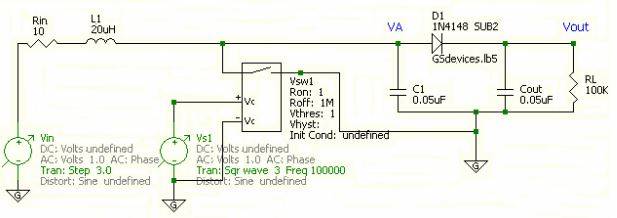
I am stuck with a circuit that involves voltage controlled switch.
Homework Statement


3FYukOs.jpg

The switch is controlled with a square wave generator, Vs1, whose frequency is 100kHz. As far as I know, switch is off when source is on positive phase and vice versa. Therefore, I only need to compute Va when Vs1 is on negative phase, i.e. when the switch is on.
(When it is off, Va is grounded and Vout will decay to zero, however switch goes off before Vout decays. Therefore, me and my friend think that we can assume it to be constant.)

We assume diode is ideal. Then apply Node-Voltage analysis to node VA.

The node between inductor and Rin is called VB and iR is the current on Rin.

Homework Equations


ic(t)=C\frac{dVc(t)}{dt} ... (1)
VL(t)=L\frac{diL(t)}{dt} ...(2)

The Attempt at a Solution


When switch is on (when Va is not grounded),

iR=\frac{3-VB}{10}...(3)

With equations (1) and (3), the following is our Node-Voltage equation,

\frac{3-VB}{10}=0.05μ\frac{dVA}{dt}+0.05μ\frac{dVA}{dt}+\frac{VA}{100K}

and from (2) we have,

VB-VA=20μ\frac{diR}{dt}→VB=VA+20μ\frac{d\frac{3-VB}{10}}{dt}

Is this approach correct?
I mean, if I solve this system of DE, will I obtain the correct functions for node voltages when the switch is on?

Any help is appreciated :)
 
Last edited:
Physics news on Phys.org
Badly defined problem. When the switch is on, Va is clearly zero from the diagram, contradicting your verbiage. There are other parts of your narrative that confuse.

I would approach the problem with determining the 'big picture' first:

Start with everything discharged and the switch ON, grounding Va. Is there a build up of current? Then, when the switch is OFF, where does the current go and what is the effect on voltage across C1 and count? Then, as the number of cycles repeat, how does the voltage Vout build up? To what level? What is the effect of the 100K load? Note that the RL-count discharge time cosntant is large compared to the cycle time. Note also that the L1/Rin t.c. is very small.

The time constants tend to be greatly removed from each other, facilitating the analysis of this circuit.
 
Hello,

By saying "on" I meant switch is open.

Is there a build up of current?

No, all the current go directly to ground when switch is closed.

Then, when the switch is OFF, where does the current go and what is the effect on voltage across C1 and count?

The current charges up both capacitors very fast due to small time constant(Rin and 0.05μF) to a maximum voltage value of VA.

Then, as the number of cycles repeat, how does the voltage Vout build up?

Vout is the voltage on count. The time constant of count when discharging is huge compared to the cycle time as you pointed out Therefore, it decays very little when switch is closed and charges up when it is open.

To what level?

I suppose it is limited to the value of VA?

Update: I simulated this circuit using SPICE. What I said is mostly true, the only part I am wrong is the max value of Vout. How does it get higher than our input which is 3V ? The final voltage at Vout seems to be something between 5 and 6 volts.
 
Last edited:
yttuncel said:
Hello,

Update: I simulated this circuit using SPICE. What I said is mostly true, the only part I am wrong is the max value of Vout. How does it get higher than our input which is 3V ? The final voltage at Vout seems to be something between 5 and 6 volts.

You can look at your SPICE results to answer that question.

What happens is that eventually the diode stops conducting and count is cut off from further charging, leaving only C1 to accept the large inductive currents. Since C1 is half of C1 + count, the voltage across C1 eventually doubles compared to the initial voltage across C1 and count in parallel, since dv/dt = i/C and C changed from the initial 0.1 uF to the eventual 0.05 uF. The diode stops charging count only when Vout has reached Vout = i T/C where T = 5e-6 s and C = count = C1.
 

Similar threads

  • · Replies 10 ·
Replies
10
Views
4K
  • · Replies 2 ·
Replies
2
Views
2K
  • · Replies 6 ·
Replies
6
Views
3K
Replies
15
Views
3K
  • · Replies 5 ·
Replies
5
Views
3K
  • · Replies 5 ·
Replies
5
Views
4K
  • · Replies 2 ·
Replies
2
Views
2K
  • · Replies 11 ·
Replies
11
Views
5K
  • · Replies 5 ·
Replies
5
Views
2K
  • · Replies 7 ·
Replies
7
Views
5K