Analytical Expressions for Frequency Response

Click For Summary
SUMMARY

The discussion focuses on the mathematical transformation of the function r(t) = Acos(wt) + Bsin(wt) into its phasor representation, specifically sqrt((A^2)+(B^2))cos(wt - arctan(B/A)). The transformation utilizes Euler's formula and properties of exponentials to simplify the expression. Additionally, the conversation addresses the forced response R(s) in the context of Laplace transforms and the separation of forced and transient solutions through partial fraction expansion, emphasizing the significance of poles in determining system behavior.

PREREQUISITES
  • Understanding of phasors and their representation in electrical engineering
  • Familiarity with Laplace transforms and their applications
  • Knowledge of linear time-invariant (LTI) systems
  • Basic proficiency in trigonometric identities and Euler's formula
NEXT STEPS
  • Study the application of Laplace transforms in control systems
  • Learn about partial fraction decomposition in signal processing
  • Explore the concept of poles and zeros in system stability analysis
  • Investigate the relationship between sinusoidal steady-state response and LTI systems
USEFUL FOR

Electrical engineers, control system designers, and students studying signal processing who seek to deepen their understanding of frequency response analysis and mathematical transformations in LTI systems.

MarkDECE
Messages
1
Reaction score
0
Hi,

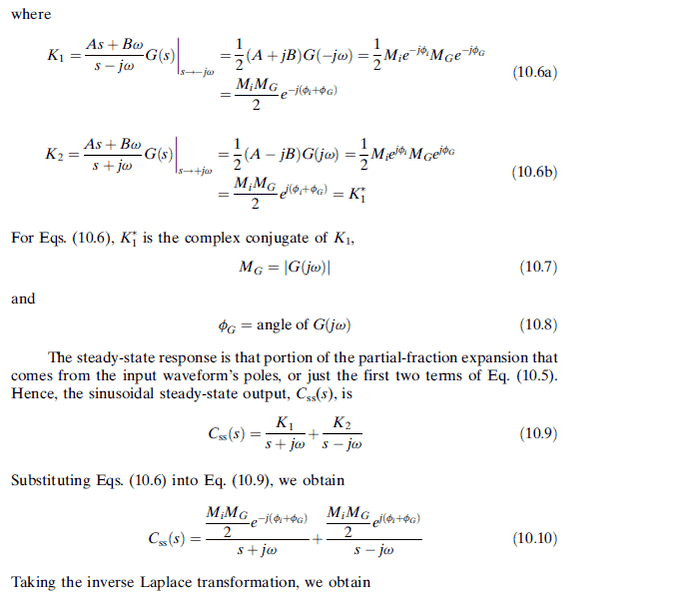
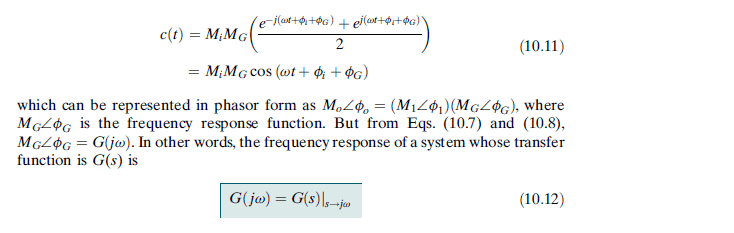
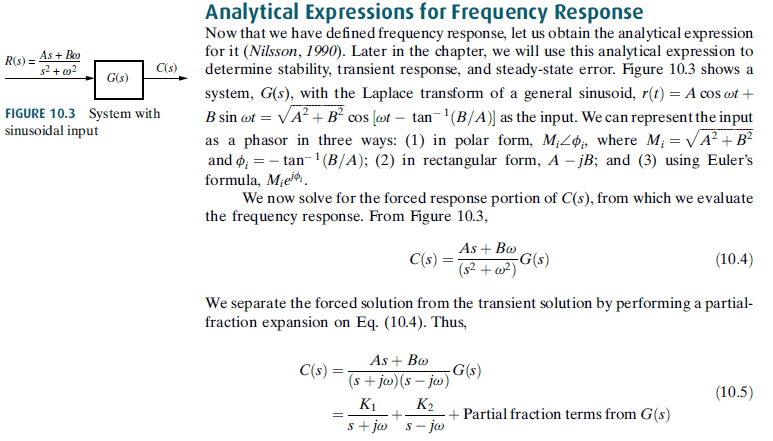
I am struggling to understand the maths in the text shown below.

(1) How does: r(t) = Acos(wt)+Bsin(wt)
become; sqrt((A^2)+(B^2))cos(wt - arctan(B/A))?

(2) He states that we can represent the input as a phasor and in one of three ways but doesn't say which one.

(3) He then focus on the forced response {R(s)} the laplace transform of the input.

(4) He then then separates the forced solution from the transient solution by performing a partial faction expansion but I am unsure what is meant by this separation?

Any help genuinely appreciated.
upload_2015-12-17_22-30-21.png

upload_2015-12-17_22-30-58.png

upload_2015-12-17_22-31-20.png
 
Engineering news on Phys.org
1) First write r(t) in rectangular phasor form:
r(t)=Acos(wt)+Bsin(wt)
=Re{A exp(jwt)}-Re{jB exp(jwt)}
=Re{(A-jB) exp(jwt)}
=Re{sqrt(A^2+B^2) exp(-jarctan(B/A)) exp(jwt)}
=sqrt(A^2+B^2)cos(wt-arctan(B/A) //

2) You can see from 1) that I started in trignometric, went to rectangular then used Euler's formula and a property of exponentials to simplify. This can also be done with trig identities but there are extra steps and since you have a linear system this is an easier approach anyways.

3) I believe the author has implicitly assumed a linear time invariant system, G(s), which is stable and hence the transient contribution is negligible in the long term therefore he focuses on the sinusoidal steady-state response only, C_ss(s).

4) partial faction expansion is a method to isolate the "poles" of a rational function. Remeber the location of the poles are growth (or decay) rates of the exponential functions in the time-domain. Incidentally in this example the poles s=+-jw are associated with the output (and input) frequency since sinusoids are the eigenfunctions of LTI systems.
 

Similar threads

Replies
6
Views
5K
  • · Replies 13 ·
Replies
13
Views
2K
  • · Replies 17 ·
Replies
17
Views
6K
  • · Replies 1 ·
Replies
1
Views
2K
Replies
10
Views
3K
Replies
1
Views
11K
  • · Replies 2 ·
Replies
2
Views
5K
  • · Replies 21 ·
Replies
21
Views
6K
  • · Replies 1 ·
Replies
1
Views
3K
  • · Replies 6 ·
Replies
6
Views
3K