Analyzing a Combination of Beer+Lower Arm for Maximum Acceleration

Click For Summary
SUMMARY

The discussion focuses on analyzing the dynamics of a system comprising a beer glass and a lower arm to maximize tangential acceleration. Participants agree that the forces acting on the system, specifically the elbow joint and muscles, must be considered separately to simplify calculations. The key equation derived for tangential acceleration is a_t = -1.61 + (0.67)F_{Et} + (5.782)M_E, where F_{Et} and M_E are variables that need to be maximized. The importance of considering both positive and negative values for these variables to achieve maximum acceleration is emphasized.

PREREQUISITES
  • Understanding of Free Body Diagrams (FBDs)
  • Knowledge of equations of motion and dynamics
  • Familiarity with concepts of tangential and normal acceleration
  • Basic principles of moment of inertia and mass distribution
NEXT STEPS
  • Explore the derivation of equations of motion for complex systems
  • Study the principles of maximizing functions in physics
  • Learn about the effects of angular acceleration on tangential motion
  • Investigate the relationship between forces and moments in dynamic systems
USEFUL FOR

Mechanical engineers, physics students, and anyone involved in the analysis of dynamic systems, particularly those interested in optimizing motion and acceleration in multi-body systems.

greg_rack
Gold Member
Messages
361
Reaction score
79
Homework Statement
ARTISTIC BEER CHUGGING CHAMPIONSHIP
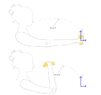
In order to win this championship, a girl has to move a beer from a defined
starting position (when her arm is stretched out) to her mouth, in a stylish manner.
To win, she needs to be majestic(have the center of gravity of the beer to follow a prescribed path, ##f(x,y)=x+30y^2=0##, w.r.t. the coord. system defined as in the figure below), speedy(move the glass to her mouth as quickly as possible) and accurate(always keep her forearm perpendicular to the path):
Initially, as shown in the first figure, she has her arms stretched out with the beer at rest.

Note that in the lower figure, not only her lower arm has moved, but also her
elbow, upper arm and shoulder have translated and rotated.

In this problem, we will limit our scope to the motion of only the lower arm,
which we will model as a simple rod with infinitesimal thickness.

Her lower arm has length of L=0.35 m , with a uniform linear density of
ρ=3.8 kg/m .
The beer (including the glass) has a mass of ##m_{beer}=0.41 kg## .
It is assumed that the beer may be idealised as a point mass.

Due to her limited muscle strength, her upper arm and elbow are only able
to exert the following reaction forces and moments on her lower arm:
-In the axial direction of the lower arm, a force of at most Sn=± 21 N
-In the direction normal to her lower arm, a force of at most St=± 39 N
-Her elbow is able to exert a moment of at most Mcr=± 4.5 N⋅m

At a certain instant in time, the beer is located at y=0.1 m and the velocity
of the beer is equal to ##v_B=5 m/s##. For this instant, compute the following:
-Magnitude of the maximum attainable tangential acceleration she is able to give to the beer
-Magnitude of the corresponding angular acceleration of the arm
-Magnitude of the corresponding reaction force that she should exert on her lower arm
Relevant Equations
Relative motion equations
cba1.jpg
Hello guys, to analyse the above-described situation I have opted for considering the body "beer+lower arm" as a whole, therefore computing the new position of the COM for the correct FBD and equations of motion.

With some uncertainty on the statement of the problem, I have interpreted the values given for maximum ##S_n, S_t, M_{cr}## as(referring to my FBD below) the maximum attainable magnitudes of forces ##F_{En}, F_{Et}, M_E## respectively.
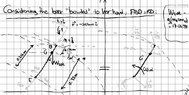
cba3.jpg
First, would you agree with this?

Assuming this assumption is correct and thus that the forces are those exerted by the elbow joint and muscles on the forearm, I proceeded to writing down the equations of motion for this situation:
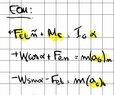
cba4.jpg
From this we can conclude that ##F_{En}## is fixed for a certain(given, for this instant) angular velocity, being just a function of the normal CG acceleration and of the weight(I have assumed, to get to the angular velocity from ##v_B##, that the instantaneous center of zero velocity here is the radius of curvature, given our position along the path).

Using the equations of relative motion, we are able to write down:
$$\mathbf{a_t}=\mathbf{(a_G)_t+ \alpha \times r}\rightarrow \mathbf{(a_G)_t}=\mathbf{a_t-\alpha \times r}$$
(where ##\alpha## is the angular acceleration vector)which, by knowing the directions of the vectors and writing it in scalar form, enables us to substitute for ##(a_G)_t## in the EOM;

We now end up with a system of 5 unknowns(##\alpha, a_t, F_{Et}, F_{En},M_E##) in 3 equations.
Since we are aiming to maximize ##\left \| \mathbf{a_t} \right \|##, what I thought of doing was manipulating the system to write the tangential acceleration in terms of ##F_{Et}## and ##M_E##, to then seek for values of those two forces(into the range given by the problem) so that the value for the tangential acceleration would be maximized, but by doing so, I keep getting to wrong results...

What am I messing up in my analysis?
 
Last edited:
  • Haha
Likes   Reactions: berkeman
Physics news on Phys.org
greg_rack said:
therefore computing the new position of the COM
A quick comment for now... in my experience this is nearly always an unnecessary complication. Just determine the moments etc. for each component separately and add them up as appropriate.
 
haruspex said:
A quick comment for now... in my experience this is nearly always an unnecessary complication. Just determine the moments etc. for each component separately and add them up as appropriate.
So you mean to analyze all the FBDs separately? Because no moment will act on the hand exerted by the beer, since the latter is modeled as a particle
 
greg_rack said:
So you mean to analyze all the FBDs separately? Because no moment will act on the hand exerted by the beer, since the latter is modeled as a particle
No, I mean e.g. that to find the MoI of the arm+beer about the elbow find each separately and add them.
Any equation concerning the arm+beer system will involve a particular mechanical attribute: mass, moment about some point, moment of inertia about some point. In each case, you can calculate the attributes of each component separately and sum them.

I would start the problem by figuring out the instantaneous motion of the arm. You are given that of the beer and the fact that the arm remains normal to the trajectory. Remember that the elbow can move.

Edit:
In "instantaneous motion of the arm" I include its acceleration and angular acceleration. These will depend in part on the acceleration of the beer, which will be an unknown to be maximised.
 
Last edited:
haruspex said:
I would start the problem by figuring out the instantaneous motion of the arm. You are given that of the beer and the fact that the arm remains normal to the trajectory. Remember that the elbow can move.

Edit:
In "instantaneous motion of the arm" I include its acceleration and angular acceleration. These will depend in part on the acceleration of the beer, which will be an unknown to be maximised.
I have managed to relate the acceleration of the CoG to the angular acceleration and the beer's one, is that what you mean? I got to this expression for the tangential acceleration of the beer:
$$a_t=-1.61+(0.67)F_{Et}+(5.782)M_E$$
and then this is where I got stuck
 
greg_rack said:
I have managed to relate the acceleration of the CoG to the angular acceleration and the beer's one, is that what you mean? I got to this expression for the tangential acceleration of the beer:
$$a_t=-1.61+(0.67)F_{Et}+(5.782)M_E$$
and then this is where I got stuck
I was thrown for a while by your having used ##\alpha## for both the angle and its acceleration. Maybe change the angle to ##\theta##.
Your equations look ok, but you have not used the information about the beer's trajectory.

You don't necessarily have to get it all into one equation before differentiating.
 
I have a question about this problem. If we were to draw the FBD for just the beer, there would be two forces acting on it, gravity and the normal force from the bottom of the glass. Presumably this point-mass beer must be constrained to remain in place at the bottom as the glass is accelerated by the hand. How is this constraint guaranteed, or is this a detail that we don't have to worry about?
 
kuruman said:
I have a question about this problem. If we were to draw the FBD for just the beer, there would be two forces acting on it, gravity and the normal force from the bottom of the glass. Presumably this point-mass beer must be constrained to remain in place at the bottom as the glass is accelerated by the hand. How is this constraint guaranteed, or is this a detail that we don't have to worry about?
I'd say it is way too into detail for this case; I think just assuming the beer+glass as a particle is what it's meant
 
haruspex said:
I was thrown for a while by your having used ##\alpha## for both the angle and its acceleration. Maybe change the angle to ##\theta##.
True! Sorry for the confusion
haruspex said:
Your equations look ok, but you have not used the information about the beer's trajectory.
Hmm, I have used the path information in the first place to calculate the radius of curvature, and thus the distances of notable points along the arm from the IC(instantaneous center of curvature); might I use this information even further?
 
  • #10
greg_rack said:
might I use this information even further?
It gives you a relationship between the tangential acceleration of the beer and its acceleration normal to the trajectory. Since the arm is always normal to the trajectory, it also gives the complete relationship between ##a_t## and the instantaneous acceleration of the arm.
 
  • #11
greg_rack said:
I got to this expression for the tangential acceleration of the beer:
$$a_t=-1.61+(0.67)F_{Et}+(5.782)M_E$$
I also arrived at this expression.

(I got 5.772 instead of 5.782, but if you only need 2 sig figs in your answer, OK.)

greg_rack said:
and then this is where I got stuck

Maybe I'm overlooking something, but why not calculate ##a_t^{max}## by choosing appropriate values for ##F_{Et}## and ##M_E## within the given possible ranges of these quantities?
 
  • #12
TSny said:
Maybe I'm overlooking something, but why not calculate ##a_t^{max}## by choosing appropriate values for ##F_{Et}## and ##M_E## within the given possible ranges of these quantities?
Yeah that's what I have done, trying to find the sweet spot playing with values of force and moment within the ranges, maximizing those in order to maximize the accel., but that didn't seem to work.
 
  • #13
haruspex said:
It gives you a relationship between the tangential acceleration of the beer and its acceleration normal to the trajectory. Since the arm is always normal to the trajectory, it also gives the complete relationship between ##a_t## and the instantaneous acceleration of the arm.
Could you please elaborate a bit more in mathematical terms?
I'm not sure I'm understanding what you are saying... isn't this what I have already done?
How could you relate the tangential acceleration to the normal one, being the latter just a function of the instantaneous velocity of the mass?
 
  • #14
greg_rack said:
Yeah that's what I have done, trying to find the sweet spot playing with values of force and moment within the ranges, maximizing those in order to maximize the accel., but that didn't seem to work.

$$a_t=-1.61+(0.67)F_{Et}+(5.782)M_E$$
Can't you maximize this expression by maximizing the second and third terms separately?

Do you know what the anwser should be for ##a_t^{max}##?
 
  • #15
greg_rack said:
being the latter just a function of the instantaneous velocity of the mass?
Ah, yes...
 
  • #16
TSny said:
$$a_t=-1.61+(0.67)F_{Et}+(5.782)M_E$$
Can't you maximize this expression by maximizing the second and third terms separately?

Do you know what the anwser should be for ##a_t^{max}##?
Unfortunately no, I don't know what the answer is... I can just know whether the final result is or is not correct
 
  • #17
It's encouraging that we get the same result ##a_t=-1.6+0.67F_{Et}+5.8M_E##.
It seems to me that by inspection of this expression you can get the maximum value of ##a_t## by just using the maximum possible values for ##F_{Et}## and ##M_E##. Am I overlooking something?
 
  • #18
Since they want the maximum value of the magnitude of ##a_t##, you need to consider both positive and negative values for ##a_t##. ##F_{Et}## and ##M_E## can be negative as well as positive.
 
  • Like
Likes   Reactions: greg_rack
  • #19
TSny said:
Since they want the maximum value of the magnitude of ##a_t##, you need to consider both positive and negative values for ##a_t##. ##F_{Et}## and ##M_E## can be negative as well as positive.
Hooly cow, it's correct now!
There's no way that was the problem... with negative values it just works!
I had minded the absolute value, but still didn't think of plugging in values which would have taken me to a negative(to the right) acceleration.
That didn't seem to make sense since I thought she was taking the glass towards her mouth, and not dropping it on the floor... but apparently that's how they thought it. Definitely an ambiguous one, I would say:oops:
 
  • #20
TSny said:
Since they want the maximum value of the magnitude of ##a_t##, you need to consider both positive and negative values for ##a_t##. ##F_{Et}## and ##M_E## can be negative as well as positive.
Actually, it says "Magnitude of the maximum ...", not maximum of the magnitude. Of course, you can't really refer to the maximum of a vector without meaning its magnitude, but it does suggest to me there's no intention to be tricky.
If the official solution corresponds to the beer moving away from the mouth then that clearly violates the instructions. I think they just stuffed up. Maybe they used a method that did not make it obvious they had found the wrong solution
 
  • Like
Likes   Reactions: greg_rack
  • #21
haruspex said:
Actually, it says "Magnitude of the maximum ...", not maximum of the magnitude. Of course, you can't really refer to the maximum of a vector without meaning its magnitude, but it does suggest to me there's no intention to be tricky.
Good point.

haruspex said:
If the official solution corresponds to the beer moving away from the mouth then that clearly violates the instructions.

The glass of beer is moving toward her mouth. But maybe she is decelerating the glass to avoid smashing the glass into her face. A collision between the beer mug and her mug would violate the instructions of “in a stylish manner”.

At the position considered, the maximum tangential deceleration turns out to be more than 5 g’s. And the glass is tilted almost to a horizontal orientation. So, if she decides to provide maximum deceleration of the glass at this point, the beer will exit the glass and _____! Again, not stylish.

Decelerating the glass of beer when the glass is oriented almost horizontally would mean that she would effectively be decelerating only the glass (since the beer would start to lose contact with the glass). So, the mass being decelerated would not be the full .41 kg. This would affect the answer for the maximum deceleration. Thus, trying to find the maximum deceleration doesn't seem to be very realistic.
 
  • Like
Likes   Reactions: greg_rack
  • #22
TSny said:
Good point.
The glass of beer is moving toward her mouth. But maybe she is decelerating the glass to avoid smashing the glass into her face. A collision between the beer mug and her mug would violate the instructions of “in a stylish manner”.

At the position considered, the maximum tangential deceleration turns out to be more than 5 g’s. And the glass is tilted almost to a horizontal orientation. So, if she decides to provide maximum deceleration of the glass at this point, the beer will exit the glass and _____! Again, not stylish.

Decelerating the glass of beer when the glass is oriented almost horizontally would mean that she would effectively be decelerating only the glass (since the beer would start to lose contact with the glass). So, the mass being decelerated would not be the full .41 kg. This would affect the answer for the maximum deceleration. Thus, trying to find the maximum deceleration doesn't seem to be very realistic.
Just checked the diagram again... the mouth is at a negative x coordinate. Which way is positive for ##a_t## in
TSny said:
##a_t=-1.6+0.67F_{Et}+5.8M_E##.
?
 
  • #23
haruspex said:
Just checked the diagram again... the mouth is at a negative x coordinate. Which way is positive for ##a_t## in

?
In that equation positive for ##a_t## is in the same direction as the velocity (towards the mouth).
 
  • #24
TSny said:
In that equation positive for ##a_t## is in the same direction as the velocity (towards the mouth).
Then I give up. y=0.1m must be early in the trajectory. Hard to believe the fastest path involves getting it up to 5m/s by then having to brake hard. But then, the whole model is an arbitrary framework for what needs to be treated as an abstract question.
 
  • #25
haruspex said:
y=0.1m must be early in the trajectory.
y = .1 m makes |x| = .3 m, which might correspond to about halfway to the mouth. The length of the forearm in this problem is .35 m. At this position, the forearm is almost vertical (about 10o from vertical).
 

Similar threads

Replies
15
Views
2K
Replies
3
Views
2K
  • · Replies 2 ·
Replies
2
Views
1K
Replies
3
Views
2K
Replies
2
Views
1K
Replies
46
Views
4K
  • · Replies 3 ·
Replies
3
Views
6K
  • · Replies 7 ·
Replies
7
Views
2K
  • · Replies 97 ·
4
Replies
97
Views
6K
  • · Replies 11 ·
Replies
11
Views
2K