Angular frequency of a non-sinusoidal pulse

Click For Summary
The discussion centers on understanding the concept of "characteristic angular frequency" in the context of nonlinear acoustics, particularly when dealing with non-sinusoidal pulses. The original poster is confused about how to define this frequency for a discrete pulse, as opposed to a simple sine wave. It is suggested that Fourier analysis can decompose the pulse into various frequency components, each with its own angular velocity. The significance of the characteristic angular frequency may relate to the dominant spectral component of the waveform, which is identified as the highest amplitude in a Fourier transform. The conversation highlights the challenges of applying linear frequency concepts to nonlinear systems, emphasizing the need for numerical solutions to the governing differential equations.
Intoto
Messages
5
Reaction score
1
Hey all, so I’ve been learning nonlinear acoustics and have encountered a conceptual hurdle in my studies. When using a model, such as a form of the classical Burgers equation, to propagate sound waves, you generally have a “characteristic angular frequency” in the equation (often represented by omega). For a simple sine wave, this is very easy to understand. However, let’s say the wave to be propagated is a discrete, non-sinusoidal pulse.

I have attached an illustration below as an example of what I am talking about.
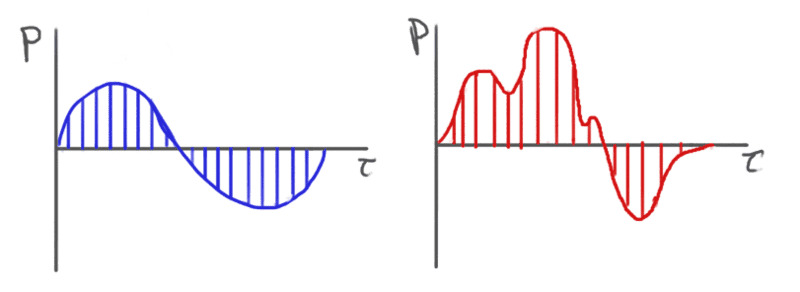
45682469.png


(Excuse my art skills, blue is supposed to be a uniformly sampled sin wave and red is supposed to be a uniformly sampled pulse.)

I am unsure of what the “characteristic angular frequency” is supposed to represent when using a wave such as the single, non-sinusoidal pulse. I am assuming that it may require the use of Fourier transforms (which I am vaguely familiar with), but I am unsure of what I would even be looking for (e.g. a fundamental frequency, or perhaps a different frequency at every point in the waveform).

Any insight would be greatly appreciated.
 

Attachments

  • 45682469.png
    45682469.png
    10.5 KB · Views: 951
  • 45682469.png
    45682469.png
    10.5 KB · Views: 774
Physics news on Phys.org
You are correct. You could use Fourier analysis to break it into a sum of terms, each with a different frequency. But then each term would have its own angular velocity. So the question back to you is, "what do you think the significance of “characteristic angular frequency” is for the case of interest?
 
I am not entirely sure how to respond to the question regarding the significance of the angular frequency, but I will try. The angular frequency of a wave is commonly encountered in many equations in nonlinear acoustics. An example of this would be the nondimensionalization of the classical Burgers equation.

2361366.png


Without getting into details, time t in the Burgers equation is commonly nondimensionalized through the use of a characteristic angular frequency:

tau = t * omega .

In this case tau is the dimensionless time and omega is the characteristic angular frequency. You can see the nondimensionlized equation containing the characteristic angular frequency terms above.

Most texts do not comment on this matter, but in one of the texts I have gone through, they mentioned that for pulses the angular frequency may correspond to the dominant spectral component in the source waveform. I have not been able to determine what exactly they mean by dominant spectral component. Would this just correspond to the highest amplitude in a Fourier transform?
 

Attachments

  • 2361366.png
    2361366.png
    2.3 KB · Views: 545
Doesn't the whole concept of describing arbitrary waveforms as a sum of sinusoids fall apart when you consider nonlinear systems? The reason you can do all these convenient acrobatics of angular frequencies etc is because sinusoids are the solution to the *linear* wave equation. The moment nonlinearities appear you can no longer view these frequencies as independent, and you have to stick to the differential equation and its numerical solutions.
 
Intoto said:
I have not been able to determine what exactly they mean by dominant spectral component. Would this just correspond to the highest amplitude in a Fourier transform?
Yes.
 

Similar threads

  • · Replies 16 ·
Replies
16
Views
35K
  • · Replies 42 ·
2
Replies
42
Views
4K
  • · Replies 22 ·
Replies
22
Views
3K
  • · Replies 12 ·
Replies
12
Views
2K
Replies
7
Views
4K
  • · Replies 6 ·
Replies
6
Views
4K
  • · Replies 15 ·
Replies
15
Views
5K
  • · Replies 4 ·
Replies
4
Views
11K
  • · Replies 3 ·
Replies
3
Views
2K
Replies
6
Views
5K