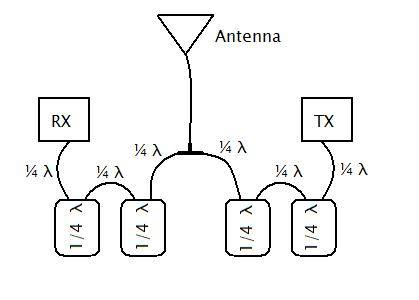
SUMMARY
The discussion centers on the operation of quarter-wave cavity duplexers, specifically regarding impedance transformation and the use of cable lengths. Participants confirm that while typical receiver and transmitter ports operate at 50 ohms, the use of λ/4 (quarter-wave) cables can lead to undesired impedance transformations, unlike λ/2 (half-wave) cables, which maintain consistent impedance. The quarter-wave cables are utilized to deepen the rejection notch of unwanted frequencies in bandpass filters by transforming low impedance to high impedance, effectively blocking unwanted signal energy. Understanding these principles is crucial for optimizing duplexer performance in amateur radio applications.
PREREQUISITES
- Understanding of transmission line theory
- Familiarity with impedance transformation concepts
- Knowledge of bandpass and notch filter functionality
- Experience with amateur radio duplexer configurations
NEXT STEPS
- Research "Transmission Line Impedance Transformation" in depth
- Study "Bandpass Filter Design" techniques
- Explore "Cavity Duplexer Configurations" for amateur radio
- Learn about "Quarter-Wave and Half-Wave Transmission Lines" applications
USEFUL FOR
Amateur radio enthusiasts, RF engineers, and anyone involved in designing or optimizing duplexers for communication systems.