Apply the Legendre Transformation to the Entropy S as a function of E

Join the discussion
Ask a follow-up here, or get your own question answered by working scientists, mathematicians and engineers — people, not an autocomplete.
Real named experts · corrections over time · the nuance an AI answer skips
4 replies · 2K views
GravityX
Messages
19
Reaction score
1
Homework Statement
Apply Legendre Transformation to Entropy
Relevant Equations
##g(m)=f(x(m))-m*x(m)## and ##x(m)=(f')^-1(m)##
Hi,

Unfortunately I am not getting anywhere with task three, I don't know exactly what to show
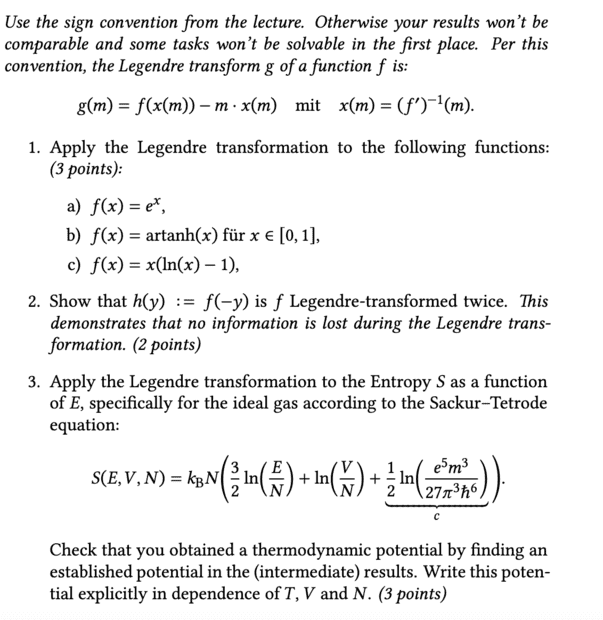
Bildschirmfoto 2022-11-28 um 16.30.54.png

Shall I now show that from ##S(T,V,N)## using Legendre I then get ##S(E,V,N)## and thus obtain the Sackur-Tetrode equation?
 
on Phys.org
You should rather think in terms of differentials. The "natural independent parameters" for ##S## are ##(E,V,N)##. Now you want to get another potential with the "natural independent parameters" ##(T,V,N)##. So first write down the differential ##\mathrm{d} S## in terms of ##(E,V,N)## and then think about, how to Legendre transform to a new potential with the other set of independent parameters.
 
Thanks vanhees71 for your help 👍

I have now represented ##ds## as follows

$$ds=\frac{\partial S}{\partial E}dE+\frac{\partial S}{\partial V}dV+\frac{\partial S}{\partial N}dN$$

$$ds=\frac{1}{T}dE+\frac{P}{T}dV-\frac{\mu }{T}dN$$

Now I would just have to get rid of the ##dE## or rather I would have to express ##dE## with the help of ##dT##, ##dV##, ##dN##, right?
 
Write it in the form of ##\mathrm{d} E=...## then find a new potential, ##F## ("free energy"), such that instead of a differnetial with ##\mathrm{d} s##, ##\mathrm{d} V## and ##\mathrm{d}N## you get one with ##\mathrm{d} T##, ##\mathrm{d}V## and ##\mathrm{d}V##. Note that
$$\mathrm{d}(Ts)=s \mathrm{d} T + T \mathrm{d} s!$$
 
Reply
  • Like
Likes   Reactions: GravityX
Thanks for your help vanhees71 👍 I think I got it now 😀