Applying force to a flat object with contact points

Click For Summary

Homework Help Overview

The discussion revolves around calculating forces acting on contact points of a flat object subjected to gravity and an additional downward force. Participants explore the mechanics of torque and force distribution at multiple contact points, seeking clarity on the relationships between these forces.

Discussion Character

  • Exploratory, Conceptual clarification, Assumption checking

Approaches and Questions Raised

  • Participants discuss the need to calculate moments of force relative to contact points versus the center of mass. There is uncertainty about how to derive forces at contact points from torque calculations and the implications of varying contact point locations.

Discussion Status

The conversation is ongoing, with participants offering insights into the limitations of static equations and the necessity of assumptions regarding the nature of the surfaces involved. There is recognition that multiple interpretations exist regarding the calculation methods for forces at contact points.

Contextual Notes

Participants note the challenge of having more contact points than equations available for statics, which complicates the analysis without additional assumptions about the system.

santeri
Messages
3
Reaction score
0
Hi all!

This isn't actually a homework question, but thought this subforum is the place for this anyway. It's been some ten years since I last touched the topic of mechanics and I guess this is a real simple question, but what can you do when I don't get it! Any help is appreciated!

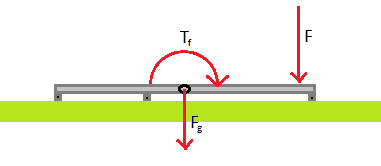
How do I calculate the forces acting on contact points in situation like the picture?
There is the force from gravity on the object, and another force at some point pushing the object down. Torque in the pic is from the force pushing down on right.

Calculating torque from the force and lever arm is simple yes, but getting that back to forces on the contact points is what baffles me.
SY1Ua.png
 
Physics news on Phys.org
Pondering this a little further, does the moment of force need to be calculated relative to the contact points? I was under the impression that its calculated relative to mass center, but that seems to give me really counter intuitive results
 
From your picture, it appears that there are three contact points. Without knowing something about the object, there are not enough equations of statics to calculate the reactions at each support knowing the loads and their locations relative to the supports.
 
SteamKing, thank you for you reply. I should have said that I would love to know how to calculate these things, not the exact numeric results.

How to, meaning the equations. Or an explanation how to calculate the resulting force, I can look the equations up from wikipedia.


First I thought calculating the forces would be:
First calculate the momentum relative to center of mass ( M = F*l, M = momentum, F = force, l = lever arm length) and then reverse it for each point of contact to get the force acting on that point. But that leads me nowhere, for example if I would have a contact point close to CM the force would be huge as the divider is small. F = M/l, l = 0.001m -> huge numbers.

Then it came to my mind that maybe the moment should be calculated relative to every contact point and from those (in this case, 3) moments calculate the forces on each contact point. Is this the correct way?
 
You will only get two equations from a set-up like this, one for linear vertical forces and one for moments. You can take moments about various points, but it does not give you any extra equations: given any two you can deduce the rest.
Therefore, you can only solve it in general for two contact points. With more, there are multiple combinations of forces that satisfy the equations. To get further you have to make some assumptions about the nature of the surfaces, typically, that they are uniformly springy (how ever slightly). So if the two planes are perfectly flat and make some small angle, you can calculate the ratios of the forces at the contact points.
 

Similar threads

  • · Replies 7 ·
Replies
7
Views
2K
Replies
16
Views
3K
  • · Replies 7 ·
Replies
7
Views
2K
  • · Replies 12 ·
Replies
12
Views
2K
  • · Replies 12 ·
Replies
12
Views
4K
  • · Replies 4 ·
Replies
4
Views
2K
  • · Replies 8 ·
Replies
8
Views
2K
Replies
31
Views
2K
  • · Replies 25 ·
Replies
25
Views
2K
  • · Replies 11 ·
Replies
11
Views
2K