self4u
- 2
- 0
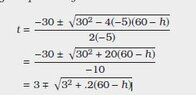
Hi - I'm trying to figure out the specific steps in a math textbook. I'm trying to figure out how the textbook did its algebra here with a quadratic formula to find an inverse of a function:
View attachment 5796
Sadly there's a step I'm supposed to know by now in the simplification algebra in there 3 steps shown...and I'm missing it.
From step 2 to step 3...it looks like only part of the equation is divided by the denominator -10. I didn't think it was possible to divide by 10 with individual numbers under the square root symbol. Furthermore - step 3 shows a reduced ".2(60-h)". How did 20 go to .2? How is (60-h) completely unaffected?
Sorry for such a simple question and thank you in advance for your help!
View attachment 5796
Sadly there's a step I'm supposed to know by now in the simplification algebra in there 3 steps shown...and I'm missing it.
From step 2 to step 3...it looks like only part of the equation is divided by the denominator -10. I didn't think it was possible to divide by 10 with individual numbers under the square root symbol. Furthermore - step 3 shows a reduced ".2(60-h)". How did 20 go to .2? How is (60-h) completely unaffected?
Sorry for such a simple question and thank you in advance for your help!
Attachments