rhody
Gold Member
- 680
- 3
First, the assembly, time lapsed of course...
http://www.youtube.com/watch?v=kVrUR_SOykk&feature=related"
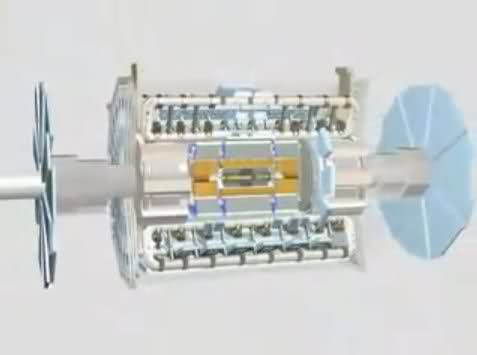
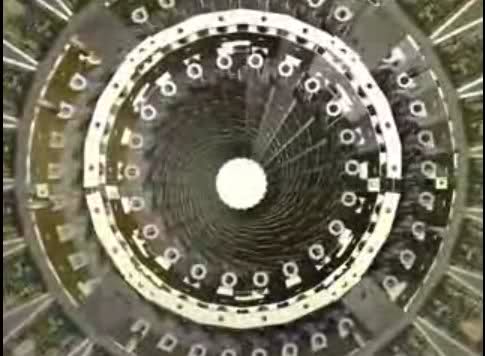
This is a blow up of the Transition Radiation, Semi-conductor and Pixel Detectors, innermost Atlas detectors.
Description of layers of detectors and what each one is capable of detecting, from the inside (core) projecting outward:
Summary:
1. Pixel Detectors, thin strips of silicon
2. Transition radiation and semi-conductor tracker, capable of measuring trajectories of charged particles with accuracy 1/100 of mm. Consists of several hundred thousand tubes filled with gas and gold wire.
3. Calorimeters arranged as barrels: placed in the center and at the ends of the detector, two types, tile calorimeter: steel and particle illuminating material, second type: electromagnetic calorimeter made of lead bathed in liquid argon.
4. Outside of calorimeters, Muon detectors, the size of several football fields.
5. Further detectors placed at ends to measure particles at small angles to the proton beams.
6. Toroidal magnets placed at the ends to create intense magnetic fields needed.
7. More detectors at the ends to detect particles that make it to the edge of the nested detectors.
The second and third video's describe the types of particles and where in the layered tracker arrays each is detected. Good descriptions and location on each detector plate, strip, etc... with the type of particle that is detected, in blow up form.
http://www.youtube.com/watch?v=OxENLH1ATV4&feature=fvste2"
http://www.youtube.com/watch?v=DUkzyDbMQ3E"
http://www.youtube.com/watch?v=b1afeb9Fp4o&feature=related"
Finally, a http://iopscience.iop.org/1748-0221/3/08" for all experiments at the LHC, including ATLAS.
Above link provided by a kind soul (many thanks) associated with the LHC Effort at CERN.
http://iopscience.iop.org/1748-0221/3/08/S08003/pdf/1748-0221_3_08_S08003.pdf" 438 pages, with better pictures and complete technical descriptions of Atlas, needless to say if this doesn't blow you away, then nothing will in this world. This link will be used for something I need to research a great deal more before posting.
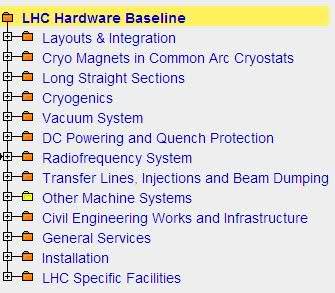
Additional http://www.lhcportal.com/Portal/Info/accelerators.htm" : LHC Cycle (shown), hardware list, Status OP Page description(s), LHC hardware Specs: (see image below) follow (Back at bottom of shown page to access other links)
Finally, comments, corrections, or omissions to what I have posted here are welcome. I want this to be as accurate as humanly possible.
Rhody...
http://www.youtube.com/watch?v=kVrUR_SOykk&feature=related"
This is a blow up of the Transition Radiation, Semi-conductor and Pixel Detectors, innermost Atlas detectors.
Description of layers of detectors and what each one is capable of detecting, from the inside (core) projecting outward:
Summary:
1. Pixel Detectors, thin strips of silicon
2. Transition radiation and semi-conductor tracker, capable of measuring trajectories of charged particles with accuracy 1/100 of mm. Consists of several hundred thousand tubes filled with gas and gold wire.
3. Calorimeters arranged as barrels: placed in the center and at the ends of the detector, two types, tile calorimeter: steel and particle illuminating material, second type: electromagnetic calorimeter made of lead bathed in liquid argon.
4. Outside of calorimeters, Muon detectors, the size of several football fields.
5. Further detectors placed at ends to measure particles at small angles to the proton beams.
6. Toroidal magnets placed at the ends to create intense magnetic fields needed.
7. More detectors at the ends to detect particles that make it to the edge of the nested detectors.
The second and third video's describe the types of particles and where in the layered tracker arrays each is detected. Good descriptions and location on each detector plate, strip, etc... with the type of particle that is detected, in blow up form.
http://www.youtube.com/watch?v=OxENLH1ATV4&feature=fvste2"
http://www.youtube.com/watch?v=DUkzyDbMQ3E"
http://www.youtube.com/watch?v=b1afeb9Fp4o&feature=related"
Finally, a http://iopscience.iop.org/1748-0221/3/08" for all experiments at the LHC, including ATLAS.
Above link provided by a kind soul (many thanks) associated with the LHC Effort at CERN.
http://iopscience.iop.org/1748-0221/3/08/S08003/pdf/1748-0221_3_08_S08003.pdf" 438 pages, with better pictures and complete technical descriptions of Atlas, needless to say if this doesn't blow you away, then nothing will in this world. This link will be used for something I need to research a great deal more before posting.
Additional http://www.lhcportal.com/Portal/Info/accelerators.htm" : LHC Cycle (shown), hardware list, Status OP Page description(s), LHC hardware Specs: (see image below) follow (Back at bottom of shown page to access other links)
Finally, comments, corrections, or omissions to what I have posted here are welcome. I want this to be as accurate as humanly possible.
Rhody...
Last edited by a moderator: