Undergrad Average of the B-field over a volume and surface integrals

Click For Summary
SUMMARY

The discussion centers on the method of calculating the average of the magnetic field ##\textbf{B}## over a volume using surface integrals, as proposed by Purcell in the third edition of his work. Specifically, it highlights that taking surface integrals over equally spaced planes, such as ##S_2## and ##S_3##, effectively samples the volume elements, thus providing a valid approach to compute the volume average of ##\textbf{B}##. The connection between the volume average $$\frac{1}{V}\int \textbf{B} dv$$ and the surface integrals $$\int_{S_2} \textbf{B} \cdot d\textbf{s}_{2}$$ and $$\int_{S_3} \textbf{B} \cdot d\textbf{s}_{3}$$ is explored, with references to the divergence theorem and Gauss's law, leading to the conclusion that $$\oint_{S_2+S_3} \mathbf{B}\cdot d\mathbf{s}=0$$ implies a relationship between the integrals over the surfaces.

PREREQUISITES
  • Understanding of magnetic fields and their representation as vector fields.
  • Familiarity with surface integrals and volume integrals in vector calculus.
  • Knowledge of Gauss's law and the divergence theorem.
  • Basic interpolation techniques for estimating values between known data points.
NEXT STEPS
  • Study the application of the divergence theorem in electromagnetism.
  • Learn about surface integrals in vector calculus, particularly in the context of magnetic fields.
  • Explore interpolation techniques for estimating integrals over surfaces.
  • Review the implications of Gauss's law for magnetic fields in closed surfaces.
USEFUL FOR

Physicists, electrical engineers, and students studying electromagnetism who seek to deepen their understanding of magnetic field calculations and integral methods.

Aaron121
Messages
15
Reaction score
1
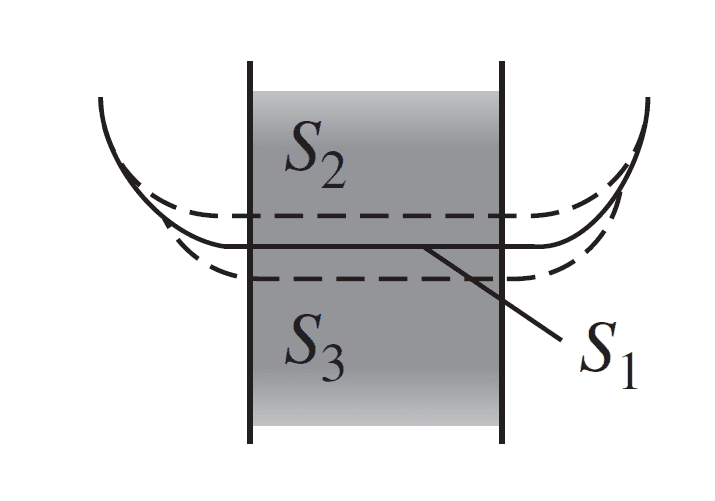
Purcell says that taking the surface integral of the magnetic field ##\textbf{B}## over the surfaces ##S_{1}, S_{2}, S_{3},...## below is a good way of finding the average of the volume integral of ##\textbf{B}## in the neighborhood of these surfaces.
1gUI9.png

More specifically, he says in page ##553## of the third edition,

Now taking the surface integral over a series of equally spaced planes like that is a perfectly good way to compute the volume average of the field ##\textbf{B}## in that neighborhood, for it samples all volume elements impartially.
I can't really see the connection between the volume average of ##\textbf{B}## over, say, the volume between ##S_2## and ##S_3 ## $$\frac{1}{V}\int \textbf{B} dv$$ and the surface integrals of ##\textbf{B}## over ##S_2## and ##S_3## $$\int_{S_3} \textbf{B}\cdot d\textbf{s}_{3},~~\int_{S_2} \textbf{B} \cdot d\textbf{s}_{2}.$$ Any indications?
 
  • Like
Likes Delta2
Physics news on Phys.org
This looks like it is some application of divergence theorem but I can't figure it out.

Also the way the surfaces are given in the figure, if we apply gauss's law in integral form for the magnetic field and in the closed surface consisting of ##S_2##+ ##S_3## we can conclude that it is $$\oint_{S_2+S_3} \mathbf{B}\cdot d\mathbf{s}=0 \Rightarrow \iint_{S_2} \mathbf{B}\cdot d\mathbf{s_2}=-\iint_{S_3}\mathbf{B}\cdot d\mathbf{s_3}$$
 
One other thing I can think of, and especially that the figure provided inspires me to think, is by using some interpolation technique to be able to compute $$f(x)=\iint_{S_x}\mathbf{B}\cdot d\mathbf{s_x}$$ for any parallel plane surface ##S_x## between ##S_2## and ##S_3##, and then to compute the volume integral
$$\iiint |\mathbf{B}|dV\approx\int_{x_2}^{x_3} f(x)dx$$
 
Last edited:
  • Like
Likes Aaron121
In sci-fi when an author is talking about space travellers or describing the movement of galaxies they will say something like “movement in space only means anything in relation to another object”. Examples of this would be, a space ship moving away from earth at 100 km/s, or 2 galaxies moving towards each other at one light year per century. I think it would make it easier to describe movement in space if we had three axis that we all agree on and we used 0 km/s relative to the speed of...

Similar threads

  • · Replies 5 ·
Replies
5
Views
2K
  • · Replies 6 ·
Replies
6
Views
2K
  • · Replies 7 ·
Replies
7
Views
2K
Replies
6
Views
3K
  • · Replies 0 ·
Replies
0
Views
1K
  • · Replies 6 ·
Replies
6
Views
2K
  • · Replies 5 ·
Replies
5
Views
2K
  • · Replies 3 ·
Replies
3
Views
2K
  • · Replies 4 ·
Replies
4
Views
2K
  • · Replies 15 ·
Replies
15
Views
5K