Average shear stress in the glue joint between a spliced rod?

Click For Summary

Discussion Overview

The discussion revolves around calculating the average shear stress in the glue joint between two spliced nylon rods, specifically focusing on the configuration of the glue application and the forces involved. The context includes technical reasoning related to mechanics and material properties.

Discussion Character

  • Technical explanation
  • Mathematical reasoning
  • Debate/contested

Main Points Raised

  • One participant presents a problem statement involving two nylon rods spliced with a plastic pipe and asks for the average shear stress in the glue when a tensile force is applied.
  • Another participant suggests that there is no glue between the ends of the nylon rods, indicating that the glue is only between the rod ends and the sleeve.
  • A subsequent post questions how the absence of glue at the ends affects the calculation of shear stress and proposes a formula based on the force and the cross-sectional area of the rods.
  • Another participant clarifies that the glue does not cover the cross-sectional ends of the rods but rather bonds the inner surface of the sleeve to the ends of the rods.
  • A later reply confirms the understanding that the area used for calculating shear stress should correspond to the area covered by the glue, while still using the applied force for the calculation.

Areas of Agreement / Disagreement

Participants express differing views on the configuration of the glue application and its implications for calculating shear stress. There is no consensus on the correct approach to the problem, as participants explore various interpretations of the glue's placement.

Contextual Notes

Participants have not fully resolved the assumptions regarding the glue's coverage and its impact on the shear stress calculation. The discussion includes various interpretations of the problem setup that could influence the final calculations.

kal854
Messages
13
Reaction score
0
Problem statement:
Two 3/4-in.-diameter nylon rods are spliced together by gluing a 2-in. section of plastic pipe over the rod ends, as shown in the figure. If a tensile force of P = 500 lb is applied to the spliced nylon rod, what is the average shear stress in the glue going between the pipe and rods?

Figure:
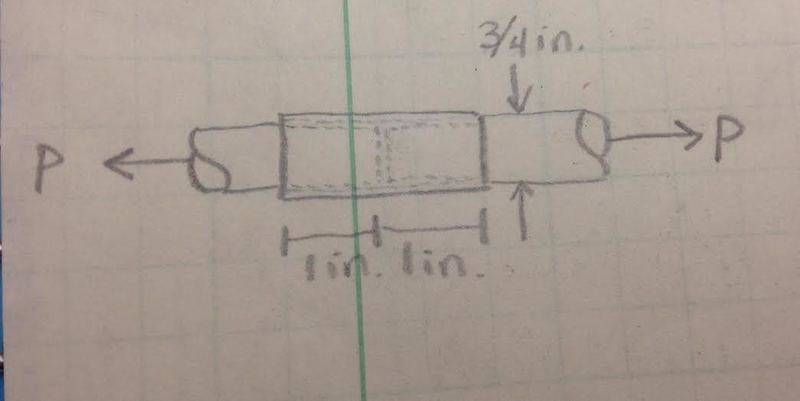
345zxbo.jpg


Obviously, {average shear stress} = {force} / {area}. But I am very confused when you take into account this splicing! Thank you in advance!
 
Physics news on Phys.org
Assume there is no glue between the ends of the nylon rods, i.e., all of the glue is between the surface of the rod ends and the sleeve.
 
SteamKing said:
Assume there is no glue between the ends of the nylon rods, i.e., all of the glue is between the surface of the rod ends and the sleeve.

How does that affect the problem? Is it as simple as {shear stress} = 500 lb / (pi/4 * (3/4)^2) ?
 
No, the glue doesn't cover the cross section ends of the rods, it covers the inner surface of the sleeve and bonds it to the 1" ends of the nylon rods.
 
SteamKing said:
No, the glue doesn't cover the cross section ends of the rods, it covers the inner surface of the sleeve and bonds it to the 1" ends of the nylon rods.

Ohh, so use the area that it covers to calculate the shear stress? And P for the force?

Thank you very much by the way!
 

Similar threads

  • · Replies 6 ·
Replies
6
Views
2K
  • · Replies 3 ·
Replies
3
Views
2K
  • · Replies 4 ·
Replies
4
Views
11K
Replies
3
Views
2K
  • · Replies 1 ·
Replies
1
Views
2K
  • · Replies 1 ·
Replies
1
Views
6K
Replies
4
Views
4K
  • · Replies 2 ·
Replies
2
Views
12K
  • · Replies 2 ·
Replies
2
Views
30K
  • · Replies 7 ·
Replies
7
Views
14K