Basics question of Inductor to powering high voltage lamp

Click For Summary
The discussion centers on the role of inductors in flyback converters, particularly regarding their polarity and voltage generation when powering a high-voltage neon lamp. Participants clarify that when the switch is opened, the inductor generates a high reverse voltage to maintain current flow, which can exceed the initial supply voltage, enabling the neon lamp to strike. Confusion arises over current direction and polarity, with some contributors emphasizing the difference between conventional current flow and electron flow. The inductor's ability to resist changes in current is highlighted, explaining that the current continues flowing in the same direction even after the switch is changed. Ultimately, the key takeaway is that the voltage across the inductor can change rapidly, allowing it to produce sufficient voltage to power the neon lamp.
  • #61
Sophiecentaur

Current path might have been a more appropriate term. But I don't see why we have been going to circles on a simple query:(
 
Engineering news on Phys.org
  • #62
I came to understand the concept. But people here are themselves debating about it. If someone can clear this to me and explain what happens in the circuit at each time instant, I would appreciate.

I don't know the inductor working to the point to know who is saying what right.
 
  • #63
The Electrician said:
This sure looks to me like you were talking about limiting the current after the switch moves to B, and is delivering energy to the neon bulb. At that time the resistor can't limit the current.
As a precautionary measure, I would include series resistance while adjusting circuit operation, then reduce the resistance in steps, until it was confirmed it could safely be eliminated (while preserving the essentially first-order operation). Neons can have their ratings exceeded.
 
  • #64
I didn't have a neon lamp handy, so I connected an approximately 100 volt zener diode across the inductor, with the polarity arranged to clamp the inductor voltage when the power supply was disconnected. Here is the scope capture of that event:
Can you explain why the zener voltage didn't reverse polarity?

Along with inductor voltage, it would be instructive if you inserted a small current-sensing resistor in series with the inductor, to demonstrate corresponding features of the current waveform. It can be tiny enough that it won't measurably affect the voltage waveshape.
 
  • #65
Jay_ said:
I came to understand the concept. But people here are themselves debating about it. If someone can clear this to me and explain what happens in the circuit at each time instant, I would appreciate.

I don't know the inductor working to the point to know who is saying what right.

What is it that you still want to know?
We have agreed that the induced emf is in the opposite direction when the switch opens. We have discussed time constants and damping (albeit, some of us don't seem to want actual values discussed or the importance of parasitics).
If you just remember dI/dt is what counts and use the values of the reactances to fine the rate of change of current then you can find the emf and the timescales involved.
 
  • #66
Hey Jay - the fact of the issue is that the case you presented is at the limit of "ideal" elements where many in the electrical field live and the theoretical. In this case the difference between an ideal switch (dt = 0 ... dI/dt is undefined) and a real switch where we can see through measurement and observation that dt > 0 for this inductive circuit ( similar issues with short circuit of a capacitor).
The amount if of instantaneous power available - when the switch is opened, can only be analyzed in the REAL world - there are no perfect switches and there are always parasitics (keepin' it real) - and I believe as shown in the scope traces, effects of just taking a measurement, or observing the case have a dramatic effect.
It is quite common here, in PF, that the discussion lives well beyond answering the original post - which in a way is unfortunate because the original poster ( you ) rightly assume there is more to the story than you understand. This post is a great case for this - there are people here with many ( dare I say all) levels of understanding, all (hopefully) looking to learn, but challenge and debate nonetheless.
My advice is offer some "Sympathy for the Devil" - no circuit is perfect - just like PF'ers.
 
  • #67
NascentOxygen said:
Can you explain why the zener voltage didn't reverse polarity?

I'm sure it did, but the zener is a forward biased diode in the reverse direction, and the voltage across wouldn't show up when the scope is set to 100 V/div. Furthermore, almost all the energy in the inductor was dissipated in the zener by the time reversal would occur.

NascentOxygen said:
Along with inductor voltage, it would be instructive if you inserted a small current-sensing resistor in series with the inductor, to demonstrate corresponding features of the current waveform. It can be tiny enough that it won't measurably affect the voltage waveshape.

It's easier to just use a current probe.
 
  • #68
The Electrician said:
I'm sure it did, but the zener is a forward biased diode in the reverse direction, and the voltage across wouldn't show up when the scope is set to 100 V/div. Furthermore, almost all the energy in the inductor was dissipated in the zener by the time reversal would occur.


It's easier to just use a current probe.

Depends what generation you are! :smile: Do you get a current probe in the box with Oscilloscopes these days? It's a long time since I bought one.
 
  • #69
The Electrician said:
I'm sure it did, but the zener is a forward biased diode in the reverse direction, and the voltage across wouldn't show up when the scope is set to 100 V/div.
I assumed that initial offset was [somehow] due to the power supply, but you say it isn't? Can you account for it? (The blue line marks zero, does it?)

attachment.php?attachmentid=55641.png


Furthermore, almost all the energy in the inductor was dissipated in the zener by the time reversal would occur.
Reversal occurs the instant that the power supply disconnects.
It's easier to just use a current probe.
Only if you have one. http://physicsforums.bernhardtmediall.netdna-cdn.com/images/icons/icon6.gif
 

Attachments

  • Clamp2.png
    Clamp2.png
    2.8 KB · Views: 593
Last edited by a moderator:
  • #70
NascentOxygen said:
Reversal occurs the instant that the power supply disconnects.

How long has this thread been running? Yet you still use terms like "instant". Nothing is "instant" in electronics. The time involved depends upon the REAL values of all the components involved. Have you still not grasped that?
 
  • #71
NascentOxygen said:
Reversal occurs the instant that the power supply disconnects.

Have a look at the capture where there was no clamping device. The first voltage excursion, which occurs just after the disconnection from the power supply, is positive going. I thought you were referring to the polarity reversal that occurs at 2.5 divisions, during the ringing.

attachment.php?attachmentid=55577&d=1360452536.png


I'll look into your "blue line" question when I get back home in a day or so.
 
  • #72
The Electrician said:
Have a look at the capture where there was no clamping device. The first voltage excursion, which occurs just after the disconnection from the power supply, is positive going. I thought you were referring to the polarity reversal that occurs at 2.5 divisions, during the ringing.
No, I wasn't referring to the unloaded ringing. I refer to the clamped waveform on which I added the blue notation: at the vertical rise the inductor voltage reverses and it stays reversed for the duration of that steady 120V* level. I expected the zener's voltage prior to that vertical rise would be of opposite polarity to what it is after that point, and I can't account for it not changing polarity at that point.
I'll look into your "blue line" question when I get back home in a day or so.
Fine, no hurry, I think this thread will still be going strong. :smile:

* is the oscilloscope indicating your "approx 100V" zener is close to 120V?

What does the 64V figure on the foot of the display indicate?
 
Last edited:
  • #73
NascentOxygen said:
* is the oscilloscope indicating your "approx 100V" zener is close to 120V?

Yes.

NascentOxygen said:
What does the 64V figure on the foot of the display indicate?

It's the trigger level, corresponding to the orange arrow on the right side of the screen.
 
  • #74
Concerning the offset you asked about in post #69. I connected the power supply to the inductor with a pair of alligator clip leads, and performed the disconnect by simply touching and then "un-touching" one of the alligator clips. When doing this, one gets a spark every time, and usually you don't get a clean ring waveform. I had to do it a number of times to get the waveform I posted. Even though I was able to get a single disconnect without any bounce, there was still an arc. The offset voltage you asked about is the voltage of the arc. The true disconnect doesn't happen until the arc stops, then the inductor current is truly interrupted.

This capture shows what happens with a current probe monitoring the current. The orange trace is the voltage across the inductor, and the blue trace is the current measured with a current probe clamped around the external inductor lead. Starting at the left edge of the screen until about 3.8 divisions, the current is ramping toward zero, the alligator clip having been disconnected and arcing is in progress. At 3.8 divisions, the ramp stops and the current suddenly jumps to zero and the ringing at the self resonance frequency commences. The oscillation results from energy exchange between the distributed capacitance of the inductor and the inductance itself. This oscillating current and voltage occurs completely internal to the inductor and no sign of it is seen in the blue trace which is the current in the external inductor lead.
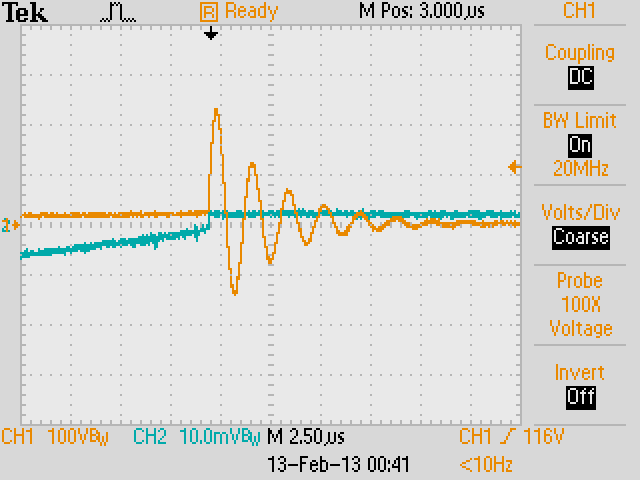
attachment.php?attachmentid=55704&stc=1&d=1360752746.png


This capture shows the current in a loop of the wire comprising the inductor. I pulled a single turn of the wire from the middle of the inductor and clamped the current probe around it. Now we can see oscillations in the current because we are sampling the current internal to the winding of the inductor.

attachment.php?attachmentid=55705&stc=1&d=1360752746.png


To get a better result, I got a couple of 500 volt power FETs (IRF740s) and connected them source to source, with the two drains available to interrupt the inductor current. This arrangement is necessary to avoid the clamping effect of the body diode which would occur if only a single FET were used.

This capture shows the current ramping up as the FETs are turned on and the power supply charges the inductor. The FETs are turned off at the middle of the screen.

attachment.php?attachmentid=55706&stc=1&d=1360752746.png


See the next post.
 

Attachments

  • Ring3.png
    Ring3.png
    2.9 KB · Views: 554
  • Ring2.png
    Ring2.png
    3.3 KB · Views: 545
  • Ring1.png
    Ring1.png
    3.3 KB · Views: 554
  • #75
In this capture we see at a shorter time scale the disconnecting of the power supply by turning off the FETs. The capacitance of the FETs is of the same order as the distributed capacitance of the inductor, and now we see quite a bit of oscillating current in the external lead of the inductor. The voltage oscillations (orange) are somewhat non-sinusoidal due to the nonlinear capacitance of the FETs.

attachment.php?attachmentid=55707&stc=1&d=1360753097.png


Notice that there is no offset in the voltage as we approach turn-off from the left side of the screen. There is no arcing before the complete disconnect from the power supply.
 

Attachments

  • Ring4.png
    Ring4.png
    3.7 KB · Views: 562
  • #76
You've abandoned the zener diode in all of these?
 
  • #77
I wouldn't have used the word "abandoned". I just didn't have it in place because I was demonstrating things that couldn't be seen with it in place.
 

Similar threads

  • · Replies 4 ·
Replies
4
Views
2K
  • · Replies 4 ·
Replies
4
Views
2K
  • · Replies 7 ·
Replies
7
Views
4K
Replies
10
Views
4K
  • · Replies 38 ·
2
Replies
38
Views
5K
  • · Replies 19 ·
Replies
19
Views
2K
  • · Replies 1 ·
Replies
1
Views
2K
  • · Replies 12 ·
Replies
12
Views
2K
  • · Replies 49 ·
2
Replies
49
Views
4K
  • · Replies 1 ·
Replies
1
Views
2K