Beginner circuits / ↓ the voltage & ↑ the efficiency

Click For Summary

Discussion Overview

The discussion revolves around wiring and controlling circuits involving motors and transistors, with a focus on troubleshooting issues related to simultaneous operation of components like motors and LEDs. Participants also explore the use of schematics and the importance of understanding electronic components, such as transistors and voltage regulators, in circuit design.

Discussion Character

  • Exploratory
  • Technical explanation
  • Debate/contested
  • Homework-related

Main Points Raised

  • One participant describes their circuit setup but encounters issues with the motor and LED not working simultaneously, suggesting a need for better wiring or additional components.
  • Another participant emphasizes the importance of drawing schematics for clarity and effective troubleshooting, suggesting that the original poster should create their own schematic.
  • A reference link is provided for a circuit involving transistors, although the participant acknowledges potential layout issues and missing components.
  • Some participants discuss the specific part numbers of transistors mentioned, indicating that one of the transistors should be a voltage regulator, and provide links to datasheets for clarification.
  • There is a suggestion for the original poster to obtain an introductory book on electronics to improve their understanding of the subject.
  • Participants express differing views on the learning process, with one stating that learning the language of electronics takes time and experience, while another encourages tinkering alongside learning.

Areas of Agreement / Disagreement

Participants generally agree on the importance of understanding schematics and the need for clarity in circuit design. However, there are differing opinions on the best approach to learning electronics, with some advocating for structured study and others supporting hands-on experimentation.

Contextual Notes

There are unresolved issues regarding the specific wiring configurations and the necessity of additional components, such as diodes and voltage regulators, which may affect circuit functionality.

Who May Find This Useful

Beginners in electronics, hobbyists working on circuit projects, and those interested in understanding the basics of wiring and component functionality in circuits.

SCHROEDERFPM
Messages
20
Reaction score
1
TL;DR
Hi.

So I'm beginning to teach myself the basics and I'm working on a motorised lamp made from two camera lenses taken apart and assembled together.

I'm looking for help with wiring the motor and led together, and how to best set up my circuit.


(Mind you, I have literally just begun and have basically no clue what I'm doing but I'm making strides, so please as much detail as you would like to share would be helpful)
So far this is what I have:
I have the power source, two triple in a battery case, negative to the T emitter, T output to the (-) of motor, T base through a resistor to the switch, switch to the (+) of motor.

I tried wiring the Led to this junction and the switch, but either the motor or the switch works not both simultaneously.
I tried wiring them parallel but I'm having some of the same issues, that or the led just stays on all the time or needs a separate switch so I'm doing something wrong.

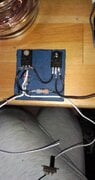
The second thing I'm working on is another lamp thing but with a fan inside, and this uses a 15v 3a wall input. For this one I tried to follow a blueprint for a system using two transistors to manage higher voltage as I'm just using a small cal and maybe one led in this.
This is a bit more out of my experience but I'll post a photo and any advice would be helpful.
(This is not connected yet just trying to figure out how to wire it.)
 

Attachments

  • received_1020601072329896.jpeg
    received_1020601072329896.jpeg
    34.8 KB · Views: 136
Engineering news on Phys.org
SCHROEDERFPM said:
I have the power source, two triple in a battery case, negative to the T emitter, T output to the (-) of motor, T base through a resistor to the switch, switch to the (+) of motor.
Sorry, but this verbal description is a poor substitute for a schematic. I could draw it myself (maybe), but I'd rather YOU do it for YOUR problem.

You simply can't do electronics well if you can't draw simple schematics. You also won't get as much help if you make us do the grunt work for you.

SCHROEDERFPM said:
The second thing I'm working on...
Should probably be a second thread.
 
DaveE said:
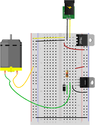
This is my reference for the second one, although I'm not sure my layout is perfect and I'm missing a diode,.
 

Attachments

  • images.png
    images.png
    7.8 KB · Views: 126
SCHROEDERFPM said:
 

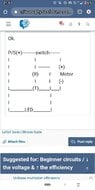
Attachments

  • Screenshot_20231220_211727.jpg
    Screenshot_20231220_211727.jpg
    21.9 KB · Views: 116
SCHROEDERFPM said:
Are all electrical engineers nasty people?
Mentor note: the post that contained the quote above has been deleted for violating forum rules.
No. They just appear that way to beginners, some of whom think that engineers must be mind readers. We can be quite good at guessing sometimes.

The language of electronics, is the schematic circuit diagram.
A clear picture is worth a thousand words.
https://en.wikipedia.org/wiki/Electronic_symbol

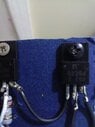
Regarding the big, black, three-terminal components, in post #4, what are their full part numbers?
Please give us a web link to the source of the circuit(s) you are building.
 
Last edited by a moderator:
  • Like
Likes   Reactions: SCHROEDERFPM
Baluncore said:
Three terminal components
 

Attachments

  • 17030777732456395255031759372469.jpg
    17030777732456395255031759372469.jpg
    32.1 KB · Views: 126
some advice (per your request):
Get an introductory book. Read it. You are literally trying to have a conversation in a language that you don't speak.
 
  • Like
Likes   Reactions: DaveE, phinds and SCHROEDERFPM
The picture you show has two NPN power transistors, marked D2394. They are part number 2SD2394, as a "2S" prefix is assumed on bipolar transistors numbered in the Asian series.
https://z3d9b7u8.stackpathcdn.com/pdf-down/2/S/D/2SD2394_SavantIC.pdf

While that 2SD2394 device is OK for the transistor, one of those devices needs to be a voltage regulator. The 5 volt regulator will have a part number like 7805.
See figure 14 in your web reference.
 
  • #10
Baluncore said:
The picture you show has two NPN power transistors, marked D2394. They are part number 2SD2394, as a "2S" prefix is assumed on bipolar transistors numbered in the Asian series.
https://z3d9b7u8.stackpathcdn.com/pdf-down/2/S/D/2SD2394_SavantIC.pdf

While that 2SD2394 device is OK for the transistor, one of those devices needs to be a voltage regulator. The 5 volt regulator will have a part number like 7805.
See figure 14 in your web reference.
Thankyou.
I appreciate the help Does it matter which one?
And is it just a matter of time and learning these part numbers / looking them up? I understand a voltage regulator and transistor are different but not quite sure how to tell .
 
  • #11
Dullard said:
You are literally trying to have a conversation in a language that you don't speak.
I'm pretty good with foreign languages, and you gotta start somewhere right?

No reason I can't tinker while I learn.
 
  • #12
SCHROEDERFPM said:
Does it matter which one?
Yes, because the connections are different, and they are in different places in the circuit.

SCHROEDERFPM said:
And is it just a matter of time and learning these part numbers / looking them up?
Yes. I have been doing it for more than 50 years. I would have learned quicker, if I'd had someone to ask for help.

SCHROEDERFPM said:
I understand a voltage regulator and transistor are different but not quite sure how to tell .
The only visible difference is in the part numbers. The physical package is standard.
 
  • Like
Likes   Reactions: SCHROEDERFPM
  • #13
Thread closed for Moderation...
 
  • Like
Likes   Reactions: SCHROEDERFPM

Similar threads

  • · Replies 15 ·
Replies
15
Views
2K
  • · Replies 9 ·
Replies
9
Views
2K
  • · Replies 26 ·
Replies
26
Views
7K
Replies
38
Views
7K
  • · Replies 5 ·
Replies
5
Views
3K
  • · Replies 2 ·
Replies
2
Views
2K
  • · Replies 2 ·
Replies
2
Views
2K
  • · Replies 10 ·
Replies
10
Views
2K
  • · Replies 5 ·
Replies
5
Views
4K
Replies
18
Views
9K