Bernoulli and Continuity Equations

  • Context: Undergrad 
  • Thread starter Thread starter bgq
  • Start date Start date
  • Tags Tags
    Bernoulli Continuity
Click For Summary

Discussion Overview

The discussion revolves around the application of Bernoulli's equation and the continuity equation to a scenario involving a vertical cylinder filled with water. Participants explore the implications of these equations when the water is suddenly released and the dynamics of fluid flow during this process.

Discussion Character

  • Exploratory
  • Technical explanation
  • Debate/contested
  • Mathematical reasoning

Main Points Raised

  • One participant asserts that according to the continuity equation, the velocities at the top and bottom of the cylinder should be equal (v1 = v2), while Bernoulli's equation suggests that the velocity at the bottom (v2) must be greater than at the top (v1) due to the height difference (H).
  • Another participant introduces the concept of molecular cohesion, suggesting that the velocity of the water at the bottom will not be uniform and will form a thinner jet, referencing the phenomenon of vena contracta.
  • A participant challenges the application of Bernoulli's equation, stating that it is only valid for steady flow, while the situation described involves unsteady flow as the water level changes over time.
  • Further discussion includes the need to account for the rate of change of mechanical energy in the fluid, indicating that the flow is not steady and velocities are changing with time.
  • One participant proposes a force balance on a fluid plug between two points, leading to a derived equation that suggests pressure remains constant throughout the fluid column, which contradicts hydrostatic principles, indicating the fluid is in free fall.
  • Another participant reiterates the force balance argument, emphasizing that the situation does not conform to hydrostatic equilibrium and that the pressures at various points in the fluid are equal to atmospheric pressure.

Areas of Agreement / Disagreement

Participants express disagreement regarding the applicability of Bernoulli's equation and the continuity equation in this scenario. There is no consensus on whether the flow can be considered steady or unsteady, and multiple competing views on the behavior of the fluid are present.

Contextual Notes

The discussion highlights limitations in applying classical fluid dynamics equations to a dynamic system where the fluid's state is changing over time. The assumptions regarding steady flow and hydrostatic equilibrium are questioned, and the implications of these assumptions are not resolved.

bgq
Messages
162
Reaction score
0
Hi,
Consider a vertical relatively long cylinder of constant radius open at both ends. We fill this cylinder with water and prevent water from falling down by a certain sheet as seen in the figure.
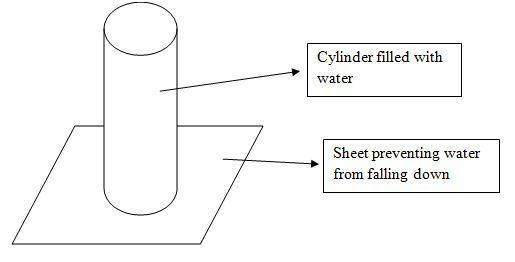
Capture.JPG


Now suppose we remove the sheet suddenly. Let v1 be the speed of the upper surface of water, and v2 be the speed of the water at the bottom of the cylinder.

According to the equation of continuity A1v1 = A2v2, since the cylinder has constant radius then A1=A2 and so v1 = v2.
According to Bernoulli's equation: P1 + 0.5pv12 + pgh1 = P2 + 0.5pv22 + pgh2
Setting P1 = P2 = P0 (of atmosphere), h1 - h2 = H, we get v22 = v12 + pgH which states clearly that v2 > v1

Question: Which one is correct and why?
 
Physics news on Phys.org
and v2 be the speed of the water at the bottom of the cylinder.

Due to molecular cohesion of water, the bottom of the water cylinder will not fall everywhere with the same velocity, but a ray will form which will get thinner as the water falls down, similar to water ray you can see falling down from the kitchen water tap. The pressure in the water varies with position, and only approaches the atmospheric pressure after it has traveled some distance from the orifice (bottom of the cylinder). Search for vena contracta, coefficient of contraction, efflux coefficient. In Feynman's lectures on physics, p. II, chapter on hydrodynamics 40-3, he gives great explanation why this happens.
 
bgq said:
Hi,
Consider a vertical relatively long cylinder of constant radius open at both ends. We fill this cylinder with water and prevent water from falling down by a certain sheet as seen in the figure.

View attachment 62754

Now suppose we remove the sheet suddenly. Let v1 be the speed of the upper surface of water, and v2 be the speed of the water at the bottom of the cylinder.

According to the equation of continuity A1v1 = A2v2, since the cylinder has constant radius then A1=A2 and so v1 = v2.
According to Bernoulli's equation: P1 + 0.5pv12 + pgh1 = P2 + 0.5pv22 + pgh2
Setting P1 = P2 = P0 (of atmosphere), h1 - h2 = H, we get v22 = v12 + pgH which states clearly that v2 > v1

Question: Which one is correct and why?

The form of the Bernoulli equation you used is for a steady flow (time independent) system, but the the system you describe is not a steady flow process because things within the tube are changing with time (namely, the amount of liquid in the tube). You need to include the rate of change of mechanical energy of the liquid in the tube.
 
Chestermiller said:
The form of the Bernoulli equation you used is for a steady flow (time independent) system, but the the system you describe is not a steady flow process because things within the tube are changing with time (namely, the amount of liquid in the tube). You need to include the rate of change of mechanical energy of the liquid in the tube.

Thanks to your reply.

But Suppose we consider two points in the tube A and B. We choose the system to be formed of the water between A and B. We study the motion of the water in the time interval when the upper surface of water is still above A as seen in the following figure.

Capture.JPG


During this time interval, the flow is steady, so we can apply Bernoulli's equation to find that VB > VA, but the continuity equation will say that VA = VB
 
The flow is not steady. The fluid contained between A and B is accelerating, even though, at any given time VA = VB. Both VA and VB are increasing with respect to time. If you take into account the rate of increase of kinetic energy of the fluid between A and B in the balance equation, it will resolve the issue.
 
Let's do a force balance on the plug of fluid between locations A and B and any given time. The forces acting on this fluid plug are the pressure forces on its ends, and the weight of the plug. The sum of these forces must equal the mass of the plug times its acceleration.

A(z_A-z_B)ρ\frac{dV}{dt}=(P_A-P_B)A+A(z_A-z_B)ρg

where A is the cross sectional area of the cylinder, ρ is the fluid density, z is distance measured upward, and V is the downward fluid velocity throughout the plug (VA=VB=V). If we divide this equation by A, and rearrange, we obtain:

P_A+ρgz_A=P_B+ρgz_B+ρ(z_A-z_B)\frac{dV}{dt}

This is the form of the equation applicable to your unsteady state situation. Note that there are no terms for kinetic energy at the two ends of the plug, since the velocities are the same at the two ends.

Here's something even more interesting. If you apply this same analysis to the entire column of fluid within the cylinder at any time, since the pressures at the top and bottom of the overall plug are atmospheric, you find simply that, for your situation:
\frac{dV}{dt}=g

If you substitute this into the previous relationship (for cross sections A and B), you find that

PA=PB

Since the locations A and B are totally arbitrary, this shows that the pressure P at all locations along the vertical column of fluid is constant, and equal to atmospheric pressure. How can this be, since it is incompatible with the hydrostatic equation? Well, it tells you that the situation in your problem isn't anywhere close to hydrostatic equilibrium. What these equations are telling you is that the column of fluid within the cylinder is actually in free fall, so you wouldn't expect the hydrostatic equation to come close to applying.
 
  • Like
Likes   Reactions: 1 person
Chestermiller said:
Let's do a force balance on the plug of fluid between locations A and B and any given time. The forces acting on this fluid plug are the pressure forces on its ends, and the weight of the plug. The sum of these forces must equal the mass of the plug times its acceleration.

A(z_A-z_B)ρ\frac{dV}{dt}=(P_A-P_B)A+A(z_A-z_B)ρg

where A is the cross sectional area of the cylinder, ρ is the fluid density, z is distance measured upward, and V is the downward fluid velocity throughout the plug (VA=VB=V). If we divide this equation by A, and rearrange, we obtain:

P_A+ρgz_A=P_B+ρgz_B+ρ(z_A-z_B)\frac{dV}{dt}

This is the form of the equation applicable to your unsteady state situation. Note that there are no terms for kinetic energy at the two ends of the plug, since the velocities are the same at the two ends.

Here's something even more interesting. If you apply this same analysis to the entire column of fluid within the cylinder at any time, since the pressures at the top and bottom of the overall plug are atmospheric, you find simply that, for your situation:
\frac{dV}{dt}=g

If you substitute this into the previous relationship (for cross sections A and B), you find that

PA=PB

Since the locations A and B are totally arbitrary, this shows that the pressure P at all locations along the vertical column of fluid is constant, and equal to atmospheric pressure. How can this be, since it is incompatible with the hydrostatic equation? Well, it tells you that the situation in your problem isn't anywhere close to hydrostatic equilibrium. What these equations are telling you is that the column of fluid within the cylinder is actually in free fall, so you wouldn't expect the hydrostatic equation to come close to applying.

This is extremely helpful, thank you very much :smile:
 

Similar threads

  • · Replies 4 ·
Replies
4
Views
1K
  • · Replies 34 ·
2
Replies
34
Views
8K
  • · Replies 1 ·
Replies
1
Views
2K
  • · Replies 7 ·
Replies
7
Views
4K
  • · Replies 16 ·
Replies
16
Views
3K
  • · Replies 3 ·
Replies
3
Views
3K
  • · Replies 6 ·
Replies
6
Views
6K
  • · Replies 4 ·
Replies
4
Views
2K
  • · Replies 7 ·
Replies
7
Views
3K
  • · Replies 6 ·
Replies
6
Views
4K