Bias-Tee Design for an RF Circuit

Click For Summary
SUMMARY

The discussion focuses on the design and understanding of Bias-Tees in RF circuits. A Bias-Tee functions as a high-pass filter, and its characteristic impedance is crucial for performance, typically set at 50 Ohms at the cutoff frequency. The user expresses uncertainty about determining the characteristic impedance without specific values for resistance (R) and conductance (G), suggesting that guessing inductance (L) and capacitance (C) may be necessary. The cutoff frequency must be well below the operating frequency to ensure proper functionality.

PREREQUISITES
  • Understanding of RF circuit design principles
  • Familiarity with high-pass filter configurations
  • Knowledge of impedance matching techniques
  • Basic concepts of inductance (L) and capacitance (C)
NEXT STEPS
  • Research the calculation of characteristic impedance in RF circuits
  • Learn about the design and analysis of high-pass filters
  • Explore methods for determining cutoff frequency in Bias-Tees
  • Study impedance matching techniques for RF applications
USEFUL FOR

RF engineers, circuit designers, and anyone involved in the design and optimization of RF circuits, particularly those working with Bias-Tees and high-pass filter configurations.

EEuser
Messages
4
Reaction score
0
Homework Statement
Design a Bias-Tee for a signal frequency of 10 GHz. Detail your solution by drawing a schematic and indicating Z0 and cable length.
Relevant Equations
see below
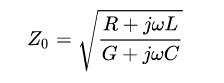
Am having a difficult time with Bias-Tees. I do not know how to get the characteristic impedance (although I assume it uses the equation below)
Screen Shot 2019-12-17 at 1.13.51 PM.png

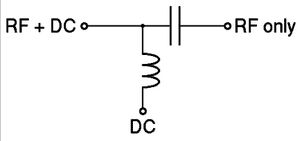
How would you use this if you are not given the R and the G? You could guess L and C. I know how Bias-Tees work and that a typical schematic would look like image below.
Screen Shot 2019-12-17 at 1.16.03 PM.png
Any help would be greatly appreciated :)
 
Physics news on Phys.org
Bias tee is high-pass filter. You should have its cutoff frequency (at which Z is roughly equal to 50 Ohm) well below your operating frequency.
 

Similar threads

  • · Replies 17 ·
Replies
17
Views
3K
  • · Replies 18 ·
Replies
18
Views
3K
  • · Replies 0 ·
Replies
0
Views
2K
  • · Replies 2 ·
Replies
2
Views
1K
  • · Replies 5 ·
Replies
5
Views
2K
  • · Replies 6 ·
Replies
6
Views
4K
  • · Replies 16 ·
Replies
16
Views
2K
Replies
19
Views
3K
Replies
5
Views
2K
  • · Replies 4 ·
Replies
4
Views
2K