Bode plots and crossover frequency

Click For Summary

Discussion Overview

The discussion revolves around the drawing of Bode plots based on given transfer functions and the determination of crossover frequencies. Participants are addressing homework problems related to these topics, focusing on both theoretical and practical aspects of Bode plots in control systems.

Discussion Character

  • Homework-related
  • Technical explanation
  • Conceptual clarification
  • Debate/contested

Main Points Raised

  • One participant seeks confirmation on the accuracy of their Bode plots and the calculation of the crossover frequency, noting a discrepancy between their calculated value and the graphical representation.
  • Some participants suggest that the Bode plots appear correct if the second plot crosses 0 dB at w=10, but they challenge the calculation of the crossover frequency, emphasizing the need to find the magnitude equal to 1 rather than the complex function equaling 1∠0.
  • There is a discussion about the nature of Bode plots as approximations, with a mention that the actual gain at the crossover point is -3 dB, which may lead to differences in the expected crossing point.
  • Another participant expresses confusion regarding the determination of the complex numerator and denominator at w=1, questioning the assumptions made about the magnitude being 20 dB.
  • Some participants clarify that the steady-state response of the system to a sinusoid is represented in the Bode plot, and they discuss the mathematical basis for calculating the magnitude and phase modifications for different frequencies.
  • There is a mention of the polar form of complex numbers and how it relates to the Bode plot calculations, with an emphasis on the product of magnitudes in the numerator and denominator.

Areas of Agreement / Disagreement

Participants generally agree on the appearance of the Bode plots but disagree on the calculation of the crossover frequency and the assumptions made regarding the magnitude at specific frequencies. The discussion remains unresolved regarding the exact values and methods for determining these parameters.

Contextual Notes

Limitations include potential misunderstandings about the definitions of crossover frequency and magnitude, as well as the approximation nature of Bode plots. There are also unresolved mathematical steps related to the complex functions involved.

faen
Messages
138
Reaction score
0
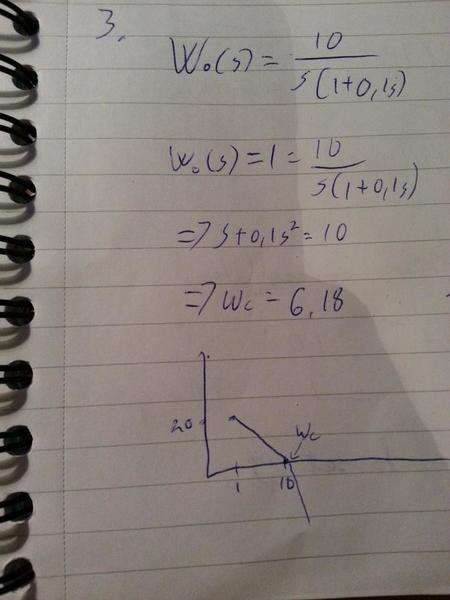
Below are a couple of problems given, 3 and 4. They are about drawing bode plots based on a given transfer function. I am wondering if anybody could please let me know if I drew the Bode plots right or wrong? Also I am not sure about how to find the crossover frequency. On task 3 I calculated it to be 6.18 by solving a second degree equation. However, the graph I found crosses the x-axis (frequency axis) at w = 10. I'd be thankful if anybody could help finding out which one of those solutions are wrong and why. Thanks a lot :)

Homework Statement


3. The transfer function W0 of the open loop is

(see corresponding picture below)

Draw the a(w)dB asymptotic magnitude plot, mark K and draw the j (w )
exact phase plot. Based on the plots, determine the crossover frequency c w
and phase margin t
j .
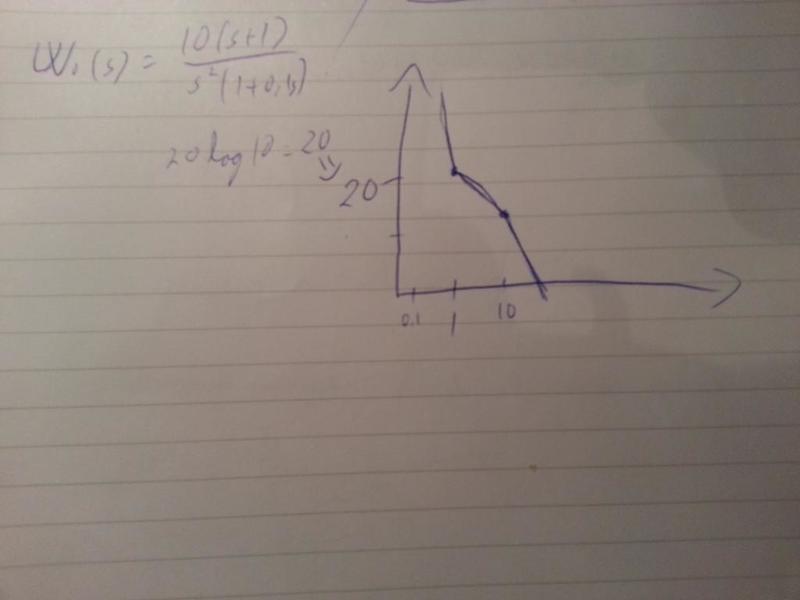
4. The transfer function W0 of the open loop is

(see picture below)

Draw the a(w)dB asymptotic magnitude plot, mark K and determine the
crossover frequency c w . Hint: What is the value of 2 K /w in case ofw = 1?

Homework Equations


The crossover frequency wc is the frequency where the absolute value of the transfer function equals to one. It is also where the graph crosses the x-axis (frequency axis). Is this right?
The Attempt at a Solution


20121029_173114.jpg


20121029_181636.jpg
 
Last edited:
Physics news on Phys.org
The bode plots look right, as long as the second one is crossing 0db at w=10.

Your calculation, on the other hand, is not quite right. Your are looking for the magnitude to be 1, not the complex function to equal 1∠0.

The answers still won't line up exactly because the bode plot is an approximation. Notice that you are approximating 1/(1+s/wo) with two straight lines joining at s=w0. The actual gain there is -3db (1/√2), not zero as marked on the graph so the crossing point will be left of what you find exactly.
 
aralbrec said:
The bode plots look right, as long as the second one is crossing 0db at w=10.

Your calculation, on the other hand, is not quite right. Your are looking for the magnitude to be 1, not the complex function to equal 1∠0.

The answers still won't line up exactly because the bode plot is an approximation. Notice that you are approximating 1/(1+s/wo) with two straight lines joining at s=w0. The actual gain there is -3db (1/√2), not zero as marked on the graph so the crossing point will be left of what you find exactly.

Thanks a lot, I understand it now, the absolute value of complex numbers is different than I previously assumed..

There's only one more question which I realized to be relevant now, regarding the second plot.. I earlier assumed that at w=1 the magnitude is 20 dB. However it was based on that I somehow assumed that all the other terms except for 10 is one. But I don't know how I can determine the complex nominator (s+1) and denominator (1+0.1s) at w=1?

I think it is approximately still 20 dB at w=1 if the rule abs(z1/z2)= abs(z1)/abs(z2) is correct. Is that statement true? (Where abs(z) means absolute value of a complex number z)
 
faen said:
There's only one more question which I realized to be relevant now, regarding the second plot.. I earlier assumed that at w=1 the magnitude is 20 dB. However it was based on that I somehow assumed that all the other terms except for 10 is one. But I don't know how I can determine the complex nominator (s+1) and denominator (1+0.1s) at w=1?

Remember we are looking at the steady state response of the system to a *sinusoid*. So the bode plot shows the magnitude and phase modification of an input sinusoid for a continuous range of frequencies.

The steady state response to an input sinusoid of frequency w is another sinusoid of the same frequency with different phase and magnitude. If you run through the math yourself (and you should at least once), this is seen in the Laplace domain as Y(s)=T(s)*L(cos wt), do a partial fraction expansion. Here you will see terms from T(s) which will die out if the system is stable and then a fraction representing the sinusoid. Using Heavyside cover up, you will see that the coefficient of the fraction for the sinusoid is just T(s=jw). The short answer is T(jw) tells you the magnitude and phase modification performed on the input sinusoid by the system, and that is what is plotted in the Bode plot for all frequencies.

"But I don't know how I can determine the complex nominator (s+1) and denominator (1+0.1s) at w=1?"

Back on track, we want to know the amplitude and phase modification for an input sinusoid at frequency w=1. So, compute T(s=jw=j1).

I think it is approximately still 20 dB at w=1 if the rule abs(z1/z2)= abs(z1)/abs(z2) is correct. Is that statement true? (Where abs(z) means absolute value of a complex number z)

Yes. Think in polar form. z1=r1*ejθ1, z2=r2ejθ2. Magnitude of both is just r1, r2. Divide z1/z2 = (r1/r2) ej(θ1-θ2) magnitude is r1/r2.

This is, in fact, the basis of the bode plot.

Your T(s) at s=jw, is a bunch of (1-jw/wo) terms in the numerator and denominator. Each can be regarded as a complex number. So the completed multiplication / division of terms sees the resulting magnitude being the product of the magnitudes in the numerator divided by the magnitudes in the denominator. Take 20 log (N/D) = 20 log N - 20 log D = 20log n1 + 20 log n2 + 20 log n3 + ... - 20 log d1 - 20 log d2 - ... So in such a graph, 20 log of the magnitude is just the sum of 20 log magnitudes of the numerator terms minus the 20log magnitudes of the denominators. On the bode plot, each term is plotted separately and then added / subtracted together.


As for what was happening at w=1, keep in mind the bode plot approximation for those terms. For example, one term is (1 + 0.1s) = (1 + s/10) = (1 + jw/10). We say this complex number is approximately 1 until w=10. At much larger frequencies, the 1 is unimportant. On the diagram, the change where w becomes important (at 10 rad) is a corner.
 
aralbrec said:
Remember we are looking at the steady state response of the system to a *sinusoid*. So the bode plot shows the magnitude and phase modification of an input sinusoid for a continuous range of frequencies.

The steady state response to an input sinusoid of frequency w is another sinusoid of the same frequency with different phase and magnitude. If you run through the math yourself (and you should at least once), this is seen in the Laplace domain as Y(s)=T(s)*L(cos wt), do a partial fraction expansion. Here you will see terms from T(s) which will die out if the system is stable and then a fraction representing the sinusoid. Using Heavyside cover up, you will see that the coefficient of the fraction for the sinusoid is just T(s=jw). The short answer is T(jw) tells you the magnitude and phase modification performed on the input sinusoid by the system, and that is what is plotted in the Bode plot for all frequencies.

"But I don't know how I can determine the complex nominator (s+1) and denominator (1+0.1s) at w=1?"

Back on track, we want to know the amplitude and phase modification for an input sinusoid at frequency w=1. So, compute T(s=jw=j1).


Yes. Think in polar form. z1=r1*ejθ1, z2=r2ejθ2. Magnitude of both is just r1, r2. Divide z1/z2 = (r1/r2) ej(θ1-θ2) magnitude is r1/r2.

This is, in fact, the basis of the bode plot.

Your T(s) at s=jw, is a bunch of (1-jw/wo) terms in the numerator and denominator. Each can be regarded as a complex number. So the completed multiplication / division of terms sees the resulting magnitude being the product of the magnitudes in the numerator divided by the magnitudes in the denominator. Take 20 log (N/D) = 20 log N - 20 log D = 20log n1 + 20 log n2 + 20 log n3 + ... - 20 log d1 - 20 log d2 - ... So in such a graph, 20 log of the magnitude is just the sum of 20 log magnitudes of the numerator terms minus the 20log magnitudes of the denominators. On the bode plot, each term is plotted separately and then added / subtracted together.


As for what was happening at w=1, keep in mind the bode plot approximation for those terms. For example, one term is (1 + 0.1s) = (1 + s/10) = (1 + jw/10). We say this complex number is approximately 1 until w=10. At much larger frequencies, the 1 is unimportant. On the diagram, the change where w becomes important (at 10 rad) is a corner.

Finally I feel like I can have some in depth understanding of bode plots. I really appreciate your good explanations. Thanks again :)
 

Similar threads

  • · Replies 3 ·
Replies
3
Views
3K
  • · Replies 3 ·
Replies
3
Views
3K
  • · Replies 4 ·
Replies
4
Views
2K
  • · Replies 1 ·
Replies
1
Views
2K
  • · Replies 3 ·
Replies
3
Views
4K
  • · Replies 3 ·
Replies
3
Views
2K
Replies
2
Views
2K
Replies
4
Views
2K
  • · Replies 1 ·
Replies
1
Views
4K
  • · Replies 8 ·
Replies
8
Views
3K