Building an IR Modulator: Troubleshooting Low Voltage Output

Click For Summary
The discussion focuses on troubleshooting a low voltage output issue in an IR modulator design using a TL555 timer and a transistor. The current setup results in a low millivolt output despite the transistor switching at 38kHz. Suggestions include replacing the second transistor with a PNP configuration and repositioning the LEDs to connect from +5V to the collector while grounding the emitter. It is emphasized that a current limiting resistor should be used to prevent LED burnout. Proper circuit design is crucial to avoid damaging semiconductors by directly connecting them to power sources.
jbord39
Messages
74
Reaction score
0
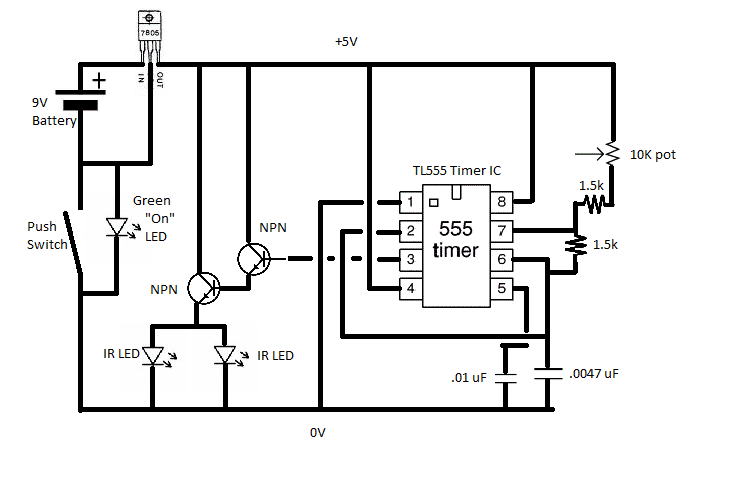
Hey all. I am building an IR modulator but seem to have a small kink in the design. Here is my schematic:
Toyschematic.png


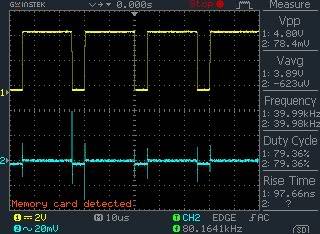
Here is a picture of the oscilloscope, connected between ground and the output of the TL555 timer and the output of the second transistor (the output pulse going into the LED's).
DS0004.jpg


The problem is that the transistor looks like it IS switching at 38kHz, but the off voltage is only in the low mV range. How could I make it so that this is actually modulating on/off?

Thanks for any help,

John
 
Engineering news on Phys.org
The transistor is hooked in a common collector configuration which doesn't have any voltage gain.

You could replace the second transistor with a PNP, or move the LEDs up across Vcc and collector while grounding the emitter.
 
So instead of putting the LED's between the second transistors emitter and ground, I would connect it from +5V to the collector, and connect the emitter to ground?

Thanks, I just want to be sure. Also, do you think this would increase the maximum current (Should I be careful to not burn out my LED's when switching)?

John
 
jbord39 said:
So instead of putting the LED's between the second transistors emitter and ground, I would connect it from +5V to the collector, and connect the emitter to ground?

yes

Also, do you think this would increase the maximum current (Should I be careful to not burn out my LED's when switching)?

Yeah it would. One may place a current limiting resistor between 5V and the LEDs.
 
You probably need a circuit like the one in this post:


https://www.physicsforums.com/showpost.php?p=2612341&postcount=35"

As a general rule, never put semiconductors directly across a source of power either on their own or in series. They are quite capable of destroying themselves if you do that.
You always need a resistor in series with them to limit the possible current.
 
Last edited by a moderator:
I am trying to understand how transferring electric from the powerplant to my house is more effective using high voltage. The suggested explanation that the current is equal to the power supply divided by the voltage, and hence higher voltage leads to lower current and as a result to a lower power loss on the conductives is very confusing me. I know that the current is determined by the voltage and the resistance, and not by a power capability - which defines a limit to the allowable...

Similar threads

  • · Replies 14 ·
Replies
14
Views
2K
  • · Replies 34 ·
2
Replies
34
Views
3K
  • · Replies 10 ·
Replies
10
Views
3K
  • · Replies 58 ·
2
Replies
58
Views
11K
  • · Replies 22 ·
Replies
22
Views
7K
  • · Replies 18 ·
Replies
18
Views
4K
  • · Replies 41 ·
2
Replies
41
Views
7K
  • · Replies 11 ·
Replies
11
Views
3K
  • · Replies 5 ·
Replies
5
Views
2K
Replies
18
Views
9K