Calculate R1 and R2 given equivalent resistance

Click For Summary
SUMMARY

The discussion focuses on calculating resistances R1 and R2 to achieve an input resistance (Rin) of 200kΩ using Ohm's Law and Kirchhoff's Voltage Law (KVL). The original textbook solution employs a voltage divider approach, while the user proposes an alternative method that also yields the correct result. Key insights include the identification of common terms in both the voltage divider and input resistance equations, specifically the term &frac{R2}{R1 + R2}, which can be substituted to simplify calculations.

PREREQUISITES
  • Understanding of Ohm's Law
  • Familiarity with Kirchhoff's Voltage Law (KVL)
  • Knowledge of voltage divider and current divider concepts
  • Basic circuit analysis skills
NEXT STEPS
  • Study the principles of voltage dividers in circuit analysis
  • Learn about current dividers and their applications
  • Explore small signal analysis techniques in electronic circuits
  • Investigate Thevenin's theorem for simplifying complex circuits
USEFUL FOR

Electrical engineering students, circuit designers, and anyone involved in analyzing or designing resistor networks in electronic circuits.

SuperCat
Messages
26
Reaction score
1
Note: I have come up with a solution myself, but I am trying to understand a different approach to the problem. My textbook solves it in a different manner, and I am having trouble following along.

Homework Statement


The last part of the problem "determine R1 and R2 such that Rin = 200k". I am having trouble understanding the solution for it. Note the graph for the problem is on the left.
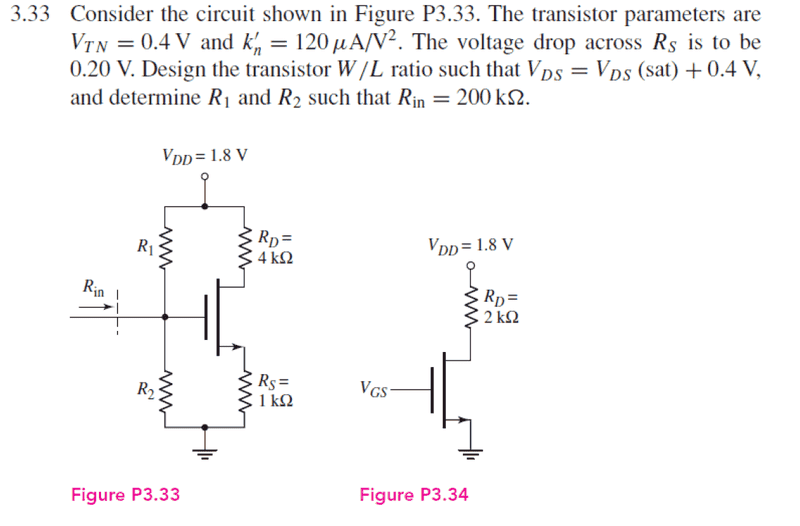
5c6db0e3b46eafad9b26f130c72d4fdc.png


Homework Equations


Ohm's law and KVL.

The Attempt at a Solution


Solution provided to me:
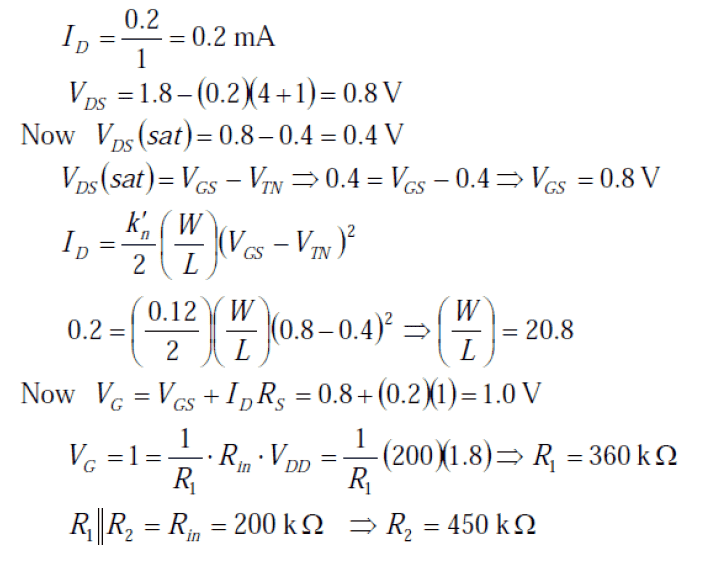
7c9f13e0ba2ff972f0f2f2521767cf3a.png

The solution for the resistance starts towards the bottom, once the gate voltage has been calculated. I do not understand why that formula is used to solve for the first resistor. To me it looks like conductance of the first resistor is being used with the Vdd to get a current. That current is being multiplied by the equivalent thevinin resistance of the two resistors. I just don't understand why that would be useful/how that would lead to calculating the resistance.
 
Last edited:
Physics news on Phys.org
I have just come up with a solution myself. I took a very different approach but received the same answer.
Here is my approach:
9b4f352da704a20f4d22e538156ac405.png


I receive the correct answer, and I found this to be more straightforward. But I would appreciate if someone could explain to me how the textbook solution goes along.
 
Write two equations that involve R1 and R2:

1. The expression for the gate potential (voltage divider)
2. The expression for Rin

Look for commonalities in the two expressions that you can exploit.
 
gneill said:
Write two equations that involve R1 and R2:

1. The expression for the gate potential (voltage divider)
2. The expression for Rin

Look for commonalities in the two expressions that you can exploit.
Isn't that similar to what I have in the post above? I think my textbook does it with a current divider. Which gives me the impression that they had decided to assume there an AC signal, and decide to do small signal analysis.
 
SuperCat said:
Isn't that similar to what I have in the post above?
Yup. But then it's bound to be similar since there's not much leeway as to what are the "givens".

What I picked out and exploited was the fact that the term ##\frac{R_2}{R_1 + R_2}## occurs in both equations, and its occurrence in the voltage divider equation can be replaced with its value from the input resistance equation.
 

Similar threads

Replies
5
Views
4K
  • · Replies 2 ·
Replies
2
Views
2K
  • · Replies 4 ·
Replies
4
Views
2K
  • · Replies 11 ·
Replies
11
Views
8K
  • · Replies 18 ·
Replies
18
Views
3K
  • · Replies 8 ·
Replies
8
Views
2K
  • · Replies 14 ·
Replies
14
Views
5K
  • · Replies 8 ·
Replies
8
Views
3K
  • · Replies 5 ·
Replies
5
Views
2K
  • · Replies 9 ·
Replies
9
Views
7K