Discussion Overview
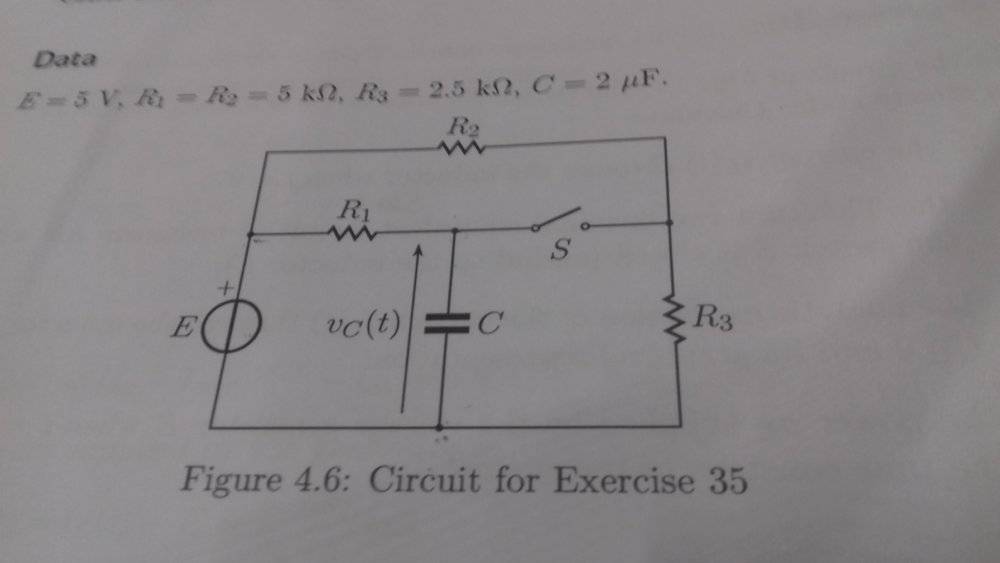
The discussion revolves around finding the Thevenin equivalent resistance from the perspective of a capacitor in a circuit with an open switch. Participants are exploring the implications of the switch's state on the equivalent resistance and the correct procedure for calculating it.
Discussion Character
- Technical explanation, Debate/contested, Homework-related
Main Points Raised
- One participant expresses confusion about why the equivalent resistance is considered to be R1, noting that R2 and R3 have not been accounted for.
- Another participant challenges the first by suggesting that the attempt at a solution lacks effort, emphasizing that the open switch affects the equivalent resistance.
- A subsequent post confirms that the question specifically involves the switch being open.
- Another participant inquires about the usual procedure for determining Thevenin resistance, indicating a desire for clarification on the method.
- One participant outlines a method for calculating Rth, stating that the E source should be short-circuited and that R2 and R3 are in series and short-circuited, leaving only R1 for the calculation.
Areas of Agreement / Disagreement
Participants do not appear to reach a consensus on the correct equivalent resistance, with differing views on the roles of R1, R2, and R3, and the implications of the switch's state.
Contextual Notes
There are unresolved assumptions regarding the circuit configuration and the definitions of the components involved, particularly concerning the open switch and its effect on the equivalent resistance calculation.