Calculate the total resistance by integration using the conductivity equation

Click For Summary
SUMMARY

The discussion focuses on calculating total resistance by integration using the conductivity equation, specifically addressing the resistance of a rod divided into discs of thickness dx. The resistance of a typical disc is given by the formula R(x'dx)=dx/(g(x)A). The final resistance expression derived is R(ab) = (L/(A*(Gb-Ga))) * Log(Gb/Ga), which aligns with numerical integration results. The participants clarify the setup of the integral and the significance of the limits, ultimately resolving the confusion regarding the presence of g_al in the logarithmic term.

PREREQUISITES
  • Understanding of basic calculus, particularly integration techniques.
  • Familiarity with electrical concepts such as resistance and conductance.
  • Knowledge of linear interpolation methods in mathematical modeling.
  • Experience with logarithmic functions and their properties.
NEXT STEPS
  • Study the derivation of resistance in non-uniform materials using calculus.
  • Learn about linear interpolation techniques in engineering applications.
  • Explore the properties of logarithmic functions and their applications in physics.
  • Investigate numerical integration methods for solving complex resistance problems.
USEFUL FOR

Students and professionals in electrical engineering, physicists working with electromagnetic fields, and anyone involved in calculating resistance in varying materials.

Dr-LucienSanchez
Messages
3
Reaction score
0
Homework Statement
The conductivity of a non-homogeneous rod (length l, cross sectional area A) varies linearly from the value ##g_a## at the end to the value ##g_b## at the end b; that is, at any point on the cross section of the rod lying at the distance x from a we have g (x) (below).

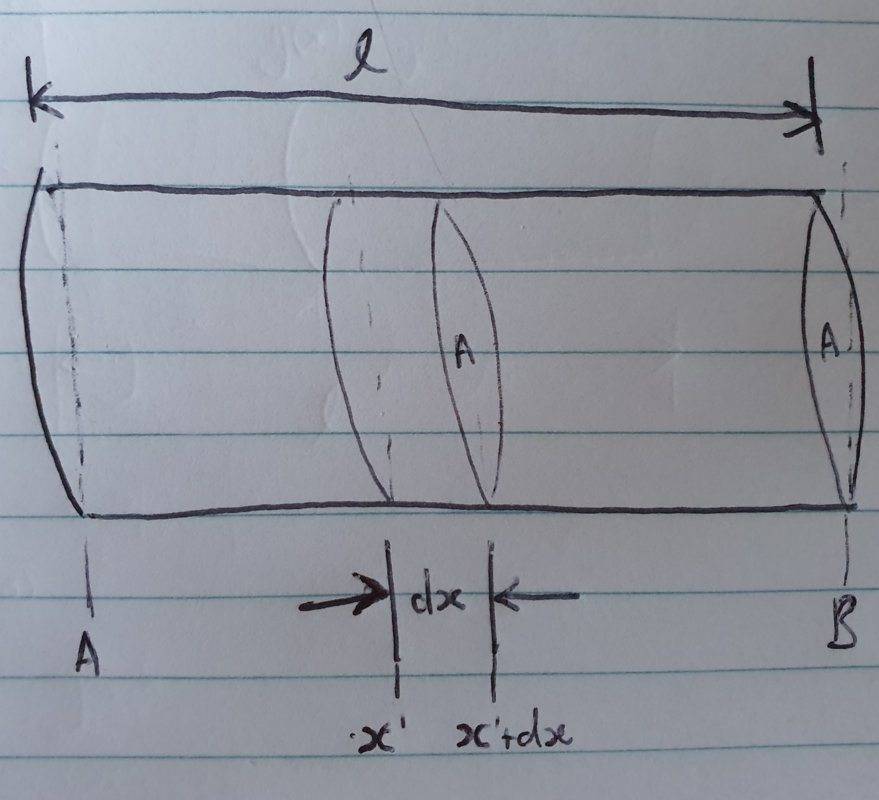
Divide the rod into discs of thickness dx, (i) compute the resistance of a typical disc, (ii) and show by integration that the total resistance of the rod is R (below)
Relevant Equations
Conductance at point x: (*) g(x) = g_a + (( g_b-g_a ) x ) / l
Total Resistance: (**) R = ( l/A ) * ( 1 / (g_b-g_a) ) * ln( g_b/g_a )

Between ends a and b of a conducting rod of length l and area A:
Average conductivity for non-homogeneous cylindrical conductors: (***) g_ave = (l / A)*G(ab)
Resistivity is the reciprocal of the conductivity i.e: (****) R(ab) = (l/gA), where g is the electric conductivity
(i) Dividing the rod into thicknesses of dx we get discs of area A with lengths=dx so using (****) we have the resistance of a typical disc (between point x' and x'+dx) as:
242568


(1) ##R(x'dx)=\frac{dx}{g(x)A}##

(ii) Using (1) and (*) and the integrating from a to b of the entire rod we get:

##R(ab)=\int_{g_a}^{g_b}\frac{dx}{g_a+\frac{(g_b-g_a)x}{l}A}=\frac{l}{A}\int_{g_a}^{g_b}\frac{dx}{g_a l + (g_b-g_a)x}=\frac{l}{(g_b-g_a)A}ln(g_al+(g_b-g_a))##

Now my solution has a pesky ##g_al## which if it was not there then the total resistance would be the same as (**). However it is there which is why i need help.

I suspect that I have set up the problem incorrectly which leads me to integrate the wrong equation or I am missing something else.

Can anyone assist me to figure out where I have tripped up?
FYI this problem is from "Electromagnetic Fields and Waves" by Vladimir Rojansky page 11.
 
Last edited by a moderator:
Physics news on Phys.org
Welcome to PF.
What do you not understand about the question?
 
Baluncore said:
Welcome to PF.
What do you not understand about the question?
I guess I am unsure why I have the ##g_al## in the log of my final answer when it is not in (**). Because it is there leads me to think that I have not set up the integral correctly by the way I compute the resistance of a typical disc in (i).
So I guess I don't understand how to set up the resistance of a typical disc so that I can form and solve the integral for the total resistance.
 
What happens if you instead interpolate by; Gx = ( ( Ga * ( L - x ) + x * Gb ) / L )
then r = integral from x=0 to L; 1 / ( A * Gx ) .dx
 
It appears you are integrating from Ga to Gb ? rather than x=0 to Length.

Conductance varies linearly so we define a straight line y = m*x+c
At x=0 we have Gx=Ga, at x=L we have Gx=Gb. Then m = (Gb-Ga)/L and c = Ga.
Table of integrals gives; Integral dx/(m*x+c) = (1/m)* Log(m*x+c)
We integrate from x=0 to x=L.
When x=L we have; (1/m)*Log(m*L+c)
When x=0 we have; (1/m)*Log(c)
Difference is; (1/m)* (Log(m*L+c) - Log(c))
But 1/m = L/(Gb-Ga); also (m*L+c) = ((Gb-Ga)/L)*L+Ga = Gb; and c = Ga.
So; L/(Gb-Ga) * (Log(Gb) - Log(Ga)) = (L/(Gb-Ga))*Log(Gb/Ga)
Don't forget to include the constant rod area A;
R = L / ( A * ( Gb - Ga ) ) * Log( Gb / Ga )
which agrees with numerical integration.
 
  • Like
Likes Dr-LucienSanchez
Baluncore said:
It appears you are integrating from Ga to Gb ? rather than x=0 to Length.

looks like I derped out on my limits, thanks for spotting that.

Baluncore said:
Conductance varies linearly so we define a straight line y = m*x+c
At x=0 we have Gx=Ga, at x=L we have Gx=Gb. Then m = (Gb-Ga)/L and c = Ga.
Table of integrals gives; Integral dx/(m*x+c) = (1/m)* Log(m*x+c)
We integrate from x=0 to x=L.
When x=L we have; (1/m)*Log(m*L+c)
When x=0 we have; (1/m)*Log(c)
Difference is; (1/m)* (Log(m*L+c) - Log(c))
But 1/m = L/(Gb-Ga); also (m*L+c) = ((Gb-Ga)/L)*L+Ga = Gb; and c = Ga.
So; L/(Gb-Ga) * (Log(Gb) - Log(Ga)) = (L/(Gb-Ga))*Log(Gb/Ga)
Don't forget to include the constant rod area A;
R = L / ( A * ( Gb - Ga ) ) * Log( Gb / Ga )
which agrees with numerical integration.

Thanks for explaining this it helped me a lot 😃
 

Similar threads

  • · Replies 10 ·
Replies
10
Views
1K
Replies
44
Views
4K
Replies
28
Views
2K
Replies
1
Views
2K
Replies
2
Views
2K
  • · Replies 16 ·
Replies
16
Views
2K
  • · Replies 13 ·
Replies
13
Views
2K
  • · Replies 3 ·
Replies
3
Views
602
Replies
3
Views
2K
  • · Replies 2 ·
Replies
2
Views
2K