Calculating crossproduct integral, Parametrization

Click For Summary

Homework Help Overview

The discussion revolves around calculating a cross product integral related to a solenoid modeled as a cylinder. Participants are exploring parametrization techniques and coordinate systems, specifically cylindrical coordinates, to facilitate their calculations.

Discussion Character

  • Exploratory, Conceptual clarification, Mathematical reasoning, Problem interpretation

Approaches and Questions Raised

  • The original poster attempts to define the surface of the cylinder and its parametrization, questioning the placement in the coordinate system. They also express uncertainty about the correctness of their surface element calculation and seek faster methods for solving the integral.
  • Some participants suggest using cylindrical polar coordinates and adjusting the limits for z to simplify the problem. They discuss the outward normal surface element and the unit vectors involved in the cross product calculations.
  • Others raise concerns about the correctness of substitutions made in the calculations and the implications of assuming a constant magnetic field, prompting further verification of previous steps.

Discussion Status

The discussion is active with multiple participants providing insights and suggestions. Some guidance has been offered regarding the use of cylindrical coordinates and the implications of symmetry in the problem. There is a recognition of potential errors in calculations, and participants are encouraged to verify their approaches without reaching a definitive conclusion.

Contextual Notes

Participants are working under the constraints of homework rules, which may limit the information they can share. There is an ongoing examination of assumptions related to the magnetic field and its representation in different coordinate systems.

Karl Karlsson
Messages
104
Reaction score
12
Homework Statement
Consider a circular solenoid with length L and radius R. The solenoid is wound with n revolutions per unit length and is traversed by a current ##I_0##. If the solenoid is tightly wound (ie, n is large), the current density can be approximated by a surface current of the form ##d\vec I = I_0n\vec e_3\times d\vec S##.

The magnetic force ##d\vec F## from an external magnetic field ##\vec B## on a small surface element is given by ##d\vec F = d\vec I\times \vec B##

i) Motivate and write down a parameterization of the surface occupied by the solenoid. (Start by placing the solenoid in an appropriately selected way in a Cartesian coordinate system.) Specify in particular how the Cartesian coordinates depend on your parameters and which parameter values are allowed.

ii) Calculate the surface element ##d\vec S## in your parameterization.

iii) The solenoid is placed in an arbitrary constant magnetic field ##\vec B##. Write down the expression for dF and simplify this as far as possible.

iiii) The total moment of force on the solenoid relative to a position ##\vec x_0## is obtained by integrating ##\vec T = \int_S (\vec x - \vec x_0 )\times d\vec F## over the entire solenoid surface S. Calculate this integral for the situation described in iii) when ##\vec x_0## is the center of the solenoid.
Relevant Equations
##d\vec I = I_0n\vec e_3\times d\vec S##
##d\vec F = d\vec I\times \vec B##
##\vec T = \int_S (\vec x - \vec x_0 )\times d\vec F##
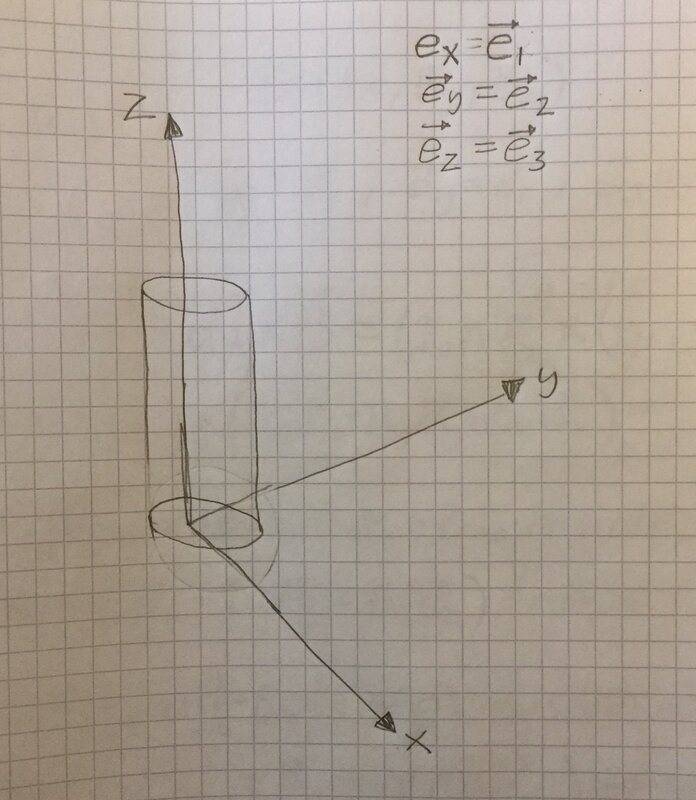
i) I approximate the solenoid as a cylinder with height L and radius R. I am not sure how I am supposed to place the solenoid in the coordinate system but I think it must be like this, right?
IMG_0703.jpg


The surface occupied by the cylinder can be described by all vectors ##\vec x =(x,y,z)## so that ##x^2+y^2=R^2## , 0 ≤ z ≤ L. One parametrization to this could be ##x(t) = R\cdot cos(t), y(t)=R\cdot sin(t)## , 0 ≤ z ≤ L , 0≤t ≤ ##2\pi## , t = 0 at the x-axis and positive rotation is counterclockvise around the z axis. ##\vec x = (R\cdot cos(t), R\cdot sin(t), z)##

ii) I get ##d\vec S = \frac {d\vec x} {dt}\times \frac {d\vec x} {dz} \cdot dzdt = (R\cdot cos(t), R\cdot sin(t), 0) \cdot dzdt##. Do you get the same and is this correct?

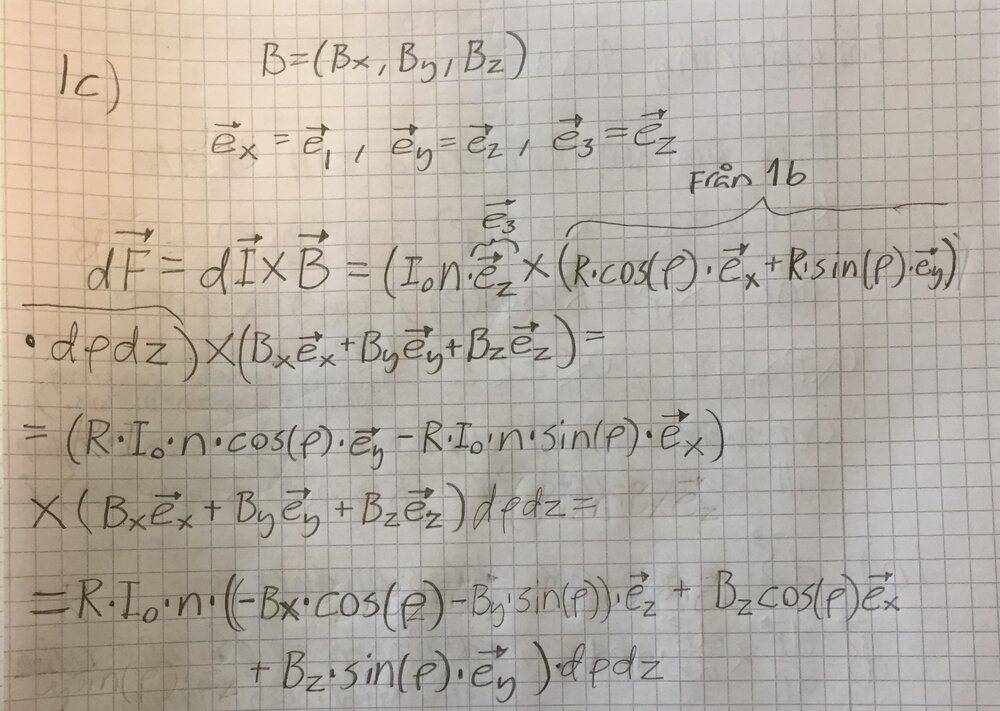
iii) From here the expressions get so long that I will post a picture with what I wrote by hand and I wrote ρ instead of t while doing the calculations below so t = ρ
IMG_0704.jpg

Is there any faster way to get to the result above?

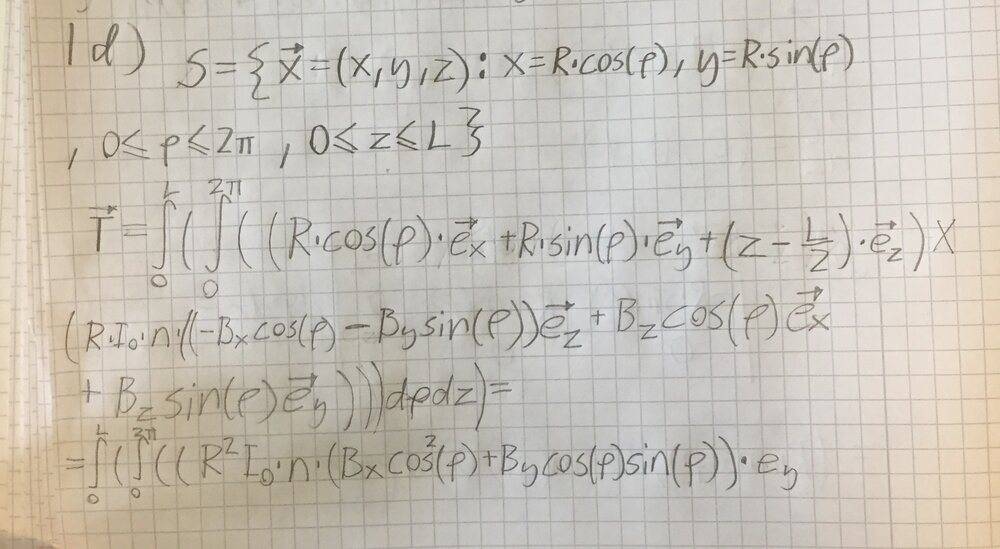
iiii) Here the calculations will be even longer. If I insert the expression i got in iii) above in the integral in iiii) as the picture below shows, then I get a long expression
IMG_0705.jpg

So as you can see I only started calculating the vectorproduct within the integral above until I had a feeling this is not the fastest way of solving this problem and maybe iii) as well? But how else are you supposed to do it?

Thanks in advance!
 
Physics news on Phys.org
Cylindrical polar coordinates (r, \phi, z) are the obvious choice. With an eye to part (iv) I would take -\frac12L \leq z \leq \frac12L rather than 0 \leq z \leq L so that \mathbf{x}_0 = 0.

The surface element of the cylinder with outward normal is then d\mathbf{S} = R\mathbf{e}_r\,d\phi\,dz where \begin{align*}\mathbf{e}_r &= \cos \phi\,\mathbf{e}_x + \sin \phi\,\mathbf{e}_y \qquad\mbox{and} \\ \mathbf{e}_\phi &= -\sin \phi\,\mathbf{e}_x + \cos \phi\,\mathbf{e}_y \end{align*} are the unit vectors in the directions of increasing r and \phi respectively.

Now set \mathbf{B} = B_r \mathbf{e}_r + B_\phi \mathbf{e}_\phi + B_z \mathbf{e}_z and calculate the cross products using the identities <br /> \mathbf{e}_r \times \mathbf{e}_\phi = \mathbf{e}_z, \qquad<br /> \mathbf{e}_\phi \times \mathbf{e}_z = \mathbf{e}_r, \qquad<br /> \mathbf{e}_z \times \mathbf{e}_r = \mathbf{e}_\phi.
 
pasmith said:
Cylindrical polar coordinates (r, \phi, z) are the obvious choice. With an eye to part (iv) I would take -\frac12L \leq z \leq \frac12L rather than 0 \leq z \leq L so that \mathbf{x}_0 = 0.

The surface element of the cylinder with outward normal is then d\mathbf{S} = R\mathbf{e}_r\,d\phi\,dz where \begin{align*}\mathbf{e}_r &amp;= \cos \phi\,\mathbf{e}_x + \sin \phi\,\mathbf{e}_y \qquad\mbox{and} \\ \mathbf{e}_\phi &amp;= -\sin \phi\,\mathbf{e}_x + \cos \phi\,\mathbf{e}_y \end{align*} are the unit vectors in the directions of increasing r and \phi respectively.

Now set \mathbf{B} = B_r \mathbf{e}_r + B_\phi \mathbf{e}_\phi + B_z \mathbf{e}_z and calculate the cross products using the identities <br /> \mathbf{e}_r \times \mathbf{e}_\phi = \mathbf{e}_z, \qquad<br /> \mathbf{e}_\phi \times \mathbf{e}_z = \mathbf{e}_r, \qquad<br /> \mathbf{e}_z \times \mathbf{e}_r = \mathbf{e}_\phi.
Hi! Apperently the magnetic field is supposed to be constant. So I had to write B with cartesian coordinates for it to be constant. Is my attempt on iiii) below correct and is this the shortest way of solving iiii)? I assumed I had done iii) correctly. Is iii) correct?
IMG_0706.jpg

IMG_0707.jpg

Thanks in advance!
 
I agree with you as far as <br /> \mathbf{T} = nI_0 R \int_{-L/2}^{L/2} \int_0^{2\pi} (RB_r +zB_z) \mathbf{e}_\phi\,d\phi\,dz.

Unfortunately at this point you have substituted the wrong value for \mathbf{e}_\phi = -\sin\phi\,\mathbf{e}_x + \cos\phi\,\mathbf{e}_y.

Also, because the solenoid is axially symmetric, you can choose the direction of the x axis such that \mathbf{B} = B_x\mathbf{e}_x + B_z\mathbf{e}_z. This should simplify the calculations.
 
Last edited:
pasmith said:
I agree with you as far as <br /> \mathbf{T} = nI_0 R \int_{-L/2}^{L/2} \int_0^{2\pi} (RB_r +zB_z) \mathbf{e}_\phi\,d\phi\,dz.

Unfortunately at this point you have substituted the wrong value for \mathbf{e}_\phi = -\sin\phi\,\mathbf{e}_x + \cos\phi\,\mathbf{e}_y.
Thanks for spotting that misstake!
pasmith said:
Also, because the solenoid is axially symmetric, you can choose the direction of the x axis such that \mathbf{B} = B_x\mathbf{e}_x + B_z\mathbf{e}_z. This should simplify the calculations.
I did not think of that. That makes the expressions shorter, thanks!
 
Could somebody please check if my solutions on i - iiii are correct in the pdf attached to this post?

Thanks in advance!
 

Attachments

Similar threads

  • · Replies 9 ·
Replies
9
Views
2K
Replies
6
Views
2K
Replies
3
Views
2K
  • · Replies 9 ·
Replies
9
Views
2K
Replies
6
Views
1K
  • · Replies 14 ·
Replies
14
Views
3K
  • · Replies 4 ·
Replies
4
Views
2K
  • · Replies 9 ·
Replies
9
Views
1K
  • · Replies 7 ·
Replies
7
Views
3K
  • · Replies 2 ·
Replies
2
Views
1K