Calculating Force Components in a Rotating Link System

Click For Summary
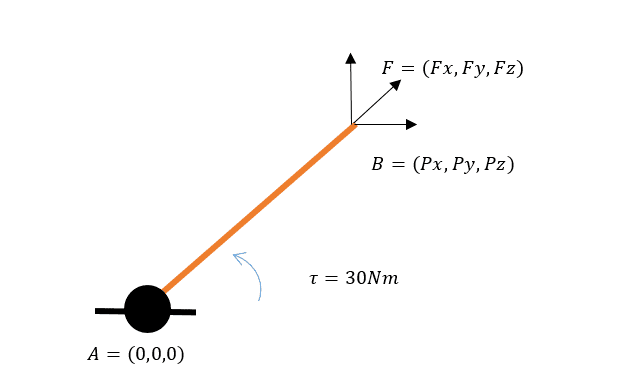
The discussion focuses on calculating the force components exerted by a rotating link actuated by a motor providing 30Nm of torque. The user seeks to determine the force in the x, y, and z directions, represented as F=[Fx,Fy,Fz]. There is confusion regarding the diagram, specifically whether the orange component is solid or flexible, resembling a chain or rope wrapped by a gear at point A. Clarification on the nature of the orange component is crucial for accurate force calculations. Understanding these details will aid in deriving the correct force equations.
kubedgamer
Messages
6
Reaction score
0
I am conducting some research into finding the force which a rotating link will exert.

The link is actuated by a motor which provides 30Nm of torque. I need to find force in x,y,z directions

F=[Fx,Fy,Fz];

Is the answer [Fx,Fy,Fz]=[tau/Px,tau/Py,tau/Pz]
upload_2016-6-15_16-42-10.png
 
Physics news on Phys.org
I'm a bit confused by the diagram. Is the orange thing solid? Or is it like a chain or rope that's getting wrapped up by a gear at A?
 
For simple comparison, I think the same thought process can be followed as a block slides down a hill, - for block down hill, simple starting PE of mgh to final max KE 0.5mv^2 - comparing PE1 to max KE2 would result in finding the work friction did through the process. efficiency is just 100*KE2/PE1. If a mousetrap car travels along a flat surface, a starting PE of 0.5 k th^2 can be measured and maximum velocity of the car can also be measured. If energy efficiency is defined by...

Similar threads

  • · Replies 4 ·
Replies
4
Views
2K
  • · Replies 6 ·
Replies
6
Views
2K
Replies
20
Views
4K
  • · Replies 4 ·
Replies
4
Views
2K
  • · Replies 1 ·
Replies
1
Views
2K
  • · Replies 22 ·
Replies
22
Views
4K
  • · Replies 1 ·
Replies
1
Views
2K
  • · Replies 3 ·
Replies
3
Views
1K
  • · Replies 1 ·
Replies
1
Views
1K
  • · Replies 2 ·
Replies
2
Views
2K