Calculating Induced Electric field

Click For Summary

Discussion Overview

The discussion revolves around calculating the induced electric field generated by a changing magnetic field, specifically through the application of Faraday's Law. Participants explore the implications of using closed integrals versus open integrals in this context, addressing the nature of induced electric fields and their non-conservative characteristics.

Discussion Character

  • Technical explanation
  • Debate/contested
  • Mathematical reasoning

Main Points Raised

  • One participant questions the use of an open integral in the calculation of work done by the electric field, suggesting that a closed integral should be used instead.
  • Another participant asserts that the induced electric field is not conservative, referencing Stokes' law and the relationship between the curl of the electric field and the rate of change of the magnetic field.
  • Some participants agree that the instructor should have used a closed integral for the calculation, reinforcing the non-conservative nature of the induced electric field.
  • There is a discussion about the necessity of using an extra symbol in the context of Stokes' theorem, with some participants expressing confusion over this requirement.

Areas of Agreement / Disagreement

Participants generally agree on the non-conservative nature of the induced electric field and the appropriateness of using closed integrals. However, there is some disagreement regarding the necessity of additional symbols in the mathematical expressions.

Contextual Notes

The discussion highlights the dependence on definitions and the implications of using different types of integrals in the context of electromagnetic theory. Some assumptions about the nature of the electric field and its calculation remain unresolved.

Arman777
Insights Author
Gold Member
Messages
2,163
Reaction score
191
In class we were trying to calculate the induced electric field created by changing the magnetic field stregth.
Imagine there's a circular surface which magnetic field out of the screen.Since we are changing the magnetic field from Faraday's Law there should be a induced current or charge flow simply.To create this motion we need electric field.So he drew another circle inside the outer surface with radius r Here is the pic
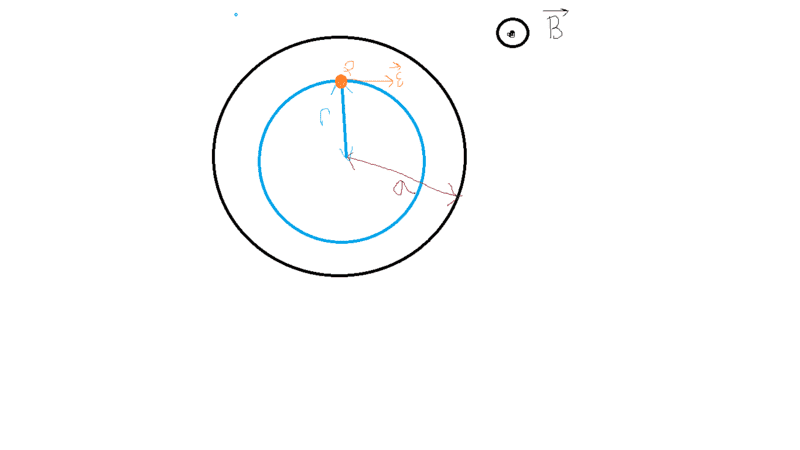
Adsız.png

Then he said let's suppose there's a charge on the point P.And he explained the Electric Field and direction etc.And He said let's suppose It rotates once the circle

Now then He did something like this;

##W=qε=\int {\vec{F}⋅d\vec{r}}##
##W=qε=Eq2πr##
##ε=E2πr## Then he used Faraday's Law and we found the E field.
I am stucked cause
##W=qε=\int {\vec{F}⋅d\vec{r}}## should be zero.Cause it comes to same point.
##W=\int_p^p {\vec{F}⋅d\vec{r}}=0##
He never used ##\oint##
What am I missing ?
If were used closed integral like ##\oint_p^p q\vec {E}⋅d\vec{r}=Eq2πr## ?

I think He should use closed integral.
 
Last edited:
Physics news on Phys.org
The induced electric field from a changing magnetic field is not a conservative field. Electrostatic fields (conservative fields) satisfy ## \nabla \times E=0 ## so that ## \oint E \cdot ds=0 ## by Stokes law. This is not the case for the induced ## E ## field because ## \nabla \times E=-\frac{dB}{dt} ## so that by Stokes law ## \oint E \cdot ds=-\frac{d \Phi_m}{dt} ##. And yes, your instructor should use ## \oint ## for this integral.
 
  • Like
Likes   Reactions: Arman777
Charles Link said:
The induced electric field from a changing magnetic field is not a conservative field. Electrostatic fields (conservative fields) satisfy ## \nabla \times E=0 ## so that ## \oint E \cdot ds=0 ## by Stokes law. This is not the case for the induced ## E ## field because ## \nabla \times E=-\frac{dB}{dt} ## so that by Stokes law ## \oint E \cdot ds=-\frac{d \Phi_m}{dt} ##. And yes, your instructor should use ## \oint ## for this integral.
I understand , thanks a lot :)
 
  • Like
Likes   Reactions: Charles Link
Well, of course in Stokes's theorem the line integral is around a closed path. Otherwise it's wrong. Why one should need an extra symbol, I however don't know ;-).
 
vanhees71 said:
Why one should need an extra symbol, I however don't know ;-).

Its more nice,I like it :p
 

Similar threads

  • · Replies 9 ·
Replies
9
Views
4K
  • · Replies 10 ·
Replies
10
Views
3K
  • · Replies 3 ·
Replies
3
Views
2K
  • · Replies 10 ·
Replies
10
Views
2K
  • · Replies 2 ·
Replies
2
Views
2K
  • · Replies 4 ·
Replies
4
Views
2K
  • · Replies 2 ·
Replies
2
Views
2K
  • · Replies 8 ·
Replies
8
Views
2K
  • · Replies 3 ·
Replies
3
Views
2K
  • · Replies 12 ·
Replies
12
Views
2K