Calculating Jupiter's Magnetic Dipole Moment Using a Dipole Approximation

Join the discussion
Ask a follow-up here, or get your own question answered by working scientists, mathematicians and engineers — people, not an autocomplete.
Real named experts · corrections over time · the nuance an AI answer skips
6 replies · 4K views
Noreturn
Messages
49
Reaction score
0

Homework Statement


Jupiter has the strongest magnetic field in our solar system, about 14 G at its poles.
Approximating the field as that of a dipole, find Jupiter's magnetic dipole moment

radius= 69.9*x10^6

Homework Equations


u=2UB
or
T=U*B

The Attempt at a Solution


T= (14x10^-4)*(.138*10^3)
.1932 A*M^2

Which is wrong
So then I tried:
2(14.4x10^-4)(.138*10^3)
.3864 A*M^2

Edit just noticed that I had units wrong on the diameter of Jupiter. If I change the calculation to:

T=(14*10^-4)(1.38*10^8)
we get: 1.932*10^5 A*M^2

Is that right?
 
on Phys.org
8081b701f00082f56579a1810b9285813750ca42


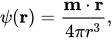
That one sounds more correct. M is a magnetic moment constant (14G in our case) and radius is 69.9*10^6m.

So then that works out to be:
2.6*10^29 A/M^2

Those equations were wrong because it was equation for torque. And B was magnetic strength.
 
So equation is:

2Uo(M*r/4pir^3)

So 6.5*10^23