Calculating magnetic flux density using Biot-Savart law.

Click For Summary
SUMMARY

The forum discussion centers on calculating magnetic flux density using the Biot-Savart law, specifically addressing the integration of current elements in the x-y plane. Participants critique the initial approach, highlighting the importance of correctly defining the vectors dl and R, which should only have components in the x and y directions, as the problem is confined to the x-y plane. The necessity of multiplying the final result by three to account for three wires is emphasized, along with the need for clarity on the integration limits from -a to a. The discussion underscores the significance of the right-hand rule in determining the direction of the magnetic field.

PREREQUISITES
  • Understanding of the Biot-Savart law and its application in electromagnetism.
  • Familiarity with vector calculus, particularly cross products.
  • Knowledge of cylindrical coordinates and their relevance in magnetic field calculations.
  • Basic principles of magnetic flux density and its dependence on current elements.
NEXT STEPS
  • Review the derivation of the Biot-Savart law and its applications in various geometries.
  • Learn how to compute vector components in the context of magnetic field calculations.
  • Study the right-hand rule and its implications for determining magnetic field direction.
  • Explore examples of magnetic flux density calculations involving multiple current-carrying wires.
USEFUL FOR

Students and professionals in physics and electrical engineering, particularly those focusing on electromagnetism and magnetic field calculations.
3OPAH
Messages
11
Reaction score
0
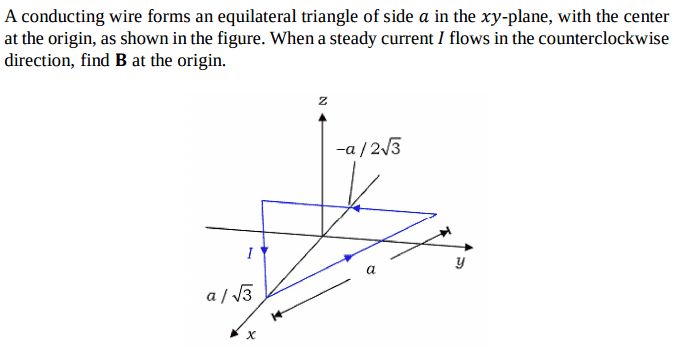
Hello, all. I have been working on the following problem and was wondering if someone could check my work and provide some valuable input:
hJAsGCN.png

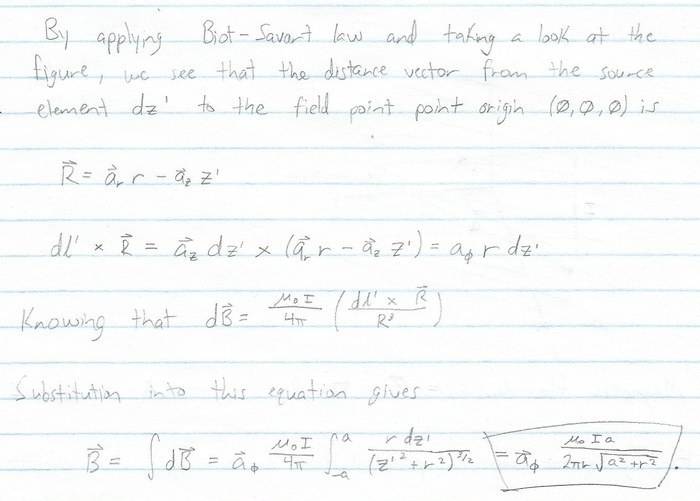
Here is my work:
ajT4OsT.jpg


What do you guys think about my approach to this problem?

 
Physics news on Phys.org
What is r, why do you consider z if everything happens in the x/y plane? Where does the expression for ##\vec{R}## come from?
In particular, how can your result depend on "r" which does not appear in the problem statement? The direction of the answer does not seem to make sense - how can something at the origin point in the direction of an angle?

Did you try to use cylindrical coordinates? I don't think that helps.

I don't understand why you integrate from -a to a.

I think you forgot to multiply the final result by 3 for the three wires, but there are several other things to fix first.
 
mfb said:
What is r, why do you consider z if everything happens in the x/y plane? Where does the expression for ##\vec{R}## come from?
In particular, how can your result depend on "r" which does not appear in the problem statement? The direction of the answer does not seem to make sense - how can something at the origin point in the direction of an angle?

Did you try to use cylindrical coordinates? I don't think that helps.

I don't understand why you integrate from -a to a.

I think you forgot to multiply the final result by 3 for the three wires, but there are several other things to fix first.
You are correct. Neither dl nor R should have components along ez. Since the triangle lies in the x-y plane (z=0), dl should have components along ex and ey. Also, R should only have components along ex and ey because it's pointing from the location of dl , which is in the x-y plane, to the origin, which is also in the x-y plane. Accordingly, the cross product dl x R would come out to be along ez, which is what we should expect from the right hand rule.

I am having a hard time computing dl and R. When I find dl and R it's a simple substitution into dB from there. Could you show me how you would calculate dl and R ?
 
Did you find the coordinates of the three corners? dl will be along one of the edges - there is an easy one and two more complicated edges. R follows from the choice of the edge. Note that it varies along the length of the wire.
 

Similar threads

  • · Replies 4 ·
Replies
4
Views
2K
Replies
1
Views
1K
Replies
3
Views
3K
  • · Replies 0 ·
Replies
0
Views
988
  • · Replies 7 ·
Replies
7
Views
304
  • · Replies 4 ·
Replies
4
Views
2K
Replies
2
Views
1K
  • · Replies 2 ·
Replies
2
Views
3K
  • · Replies 18 ·
Replies
18
Views
5K
Replies
3
Views
3K