Saptarshi Sarkar
- 98
- 13
- Homework Statement
- In order to pull out the nail at B, as shown in the figure, the force F exerted on the handle of the hammer must produce a clockwise moment of 500 lb-in about point A. Determine the required magnitude of force F.
- Relevant Equations
- ##T=F\times l##
First of all, sorry for the units. This is a problem I found on the internet and am confused about the solution.
I calculated the two components of the moment (torque) to be
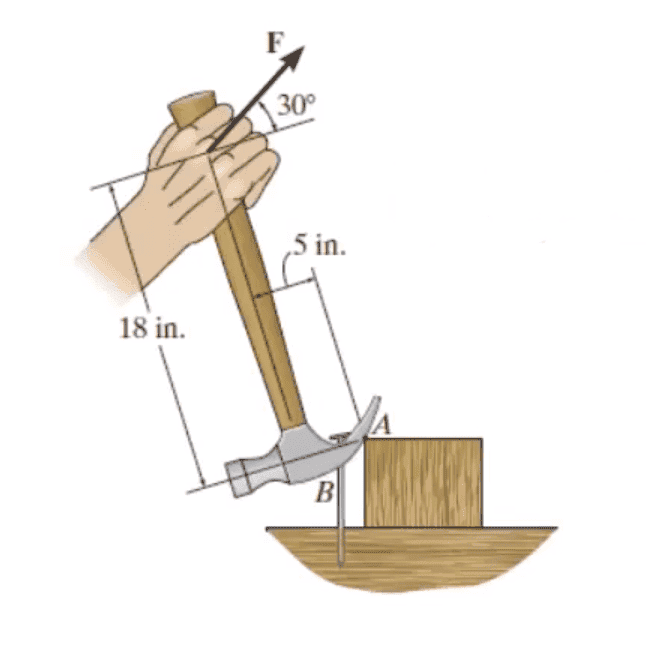
##T_x = 18\times Fcos(30)## and ##T_y=5\times Fsin(30)##
The problem is, I got the proper answer (the two options were 27.64 lb and 55.28 lb) by direct addition of the two components but did not get it by vector addition (for magnitude).
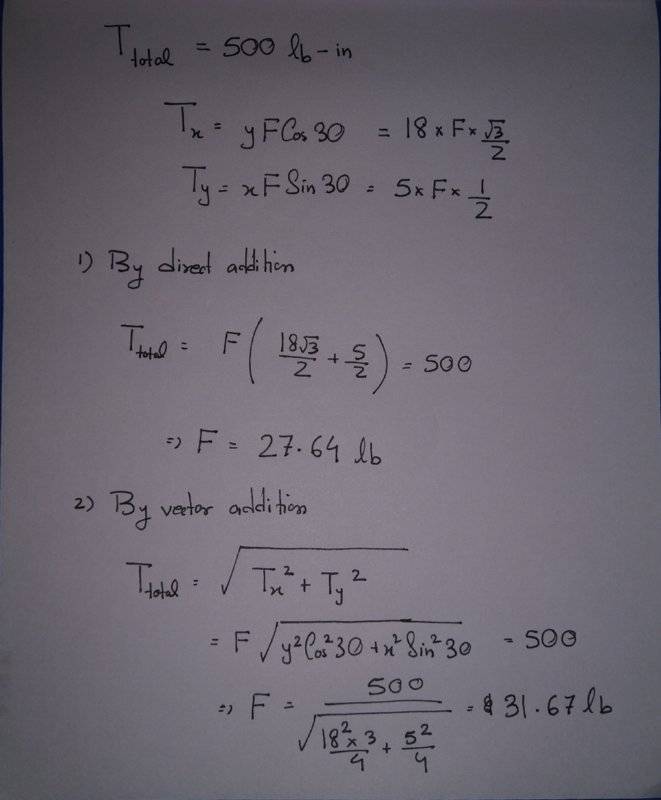
I am not sure how I got the correct answer using a seemingly incorrect method.
I calculated the two components of the moment (torque) to be
##T_x = 18\times Fcos(30)## and ##T_y=5\times Fsin(30)##
The problem is, I got the proper answer (the two options were 27.64 lb and 55.28 lb) by direct addition of the two components but did not get it by vector addition (for magnitude).
I am not sure how I got the correct answer using a seemingly incorrect method.