SUMMARY
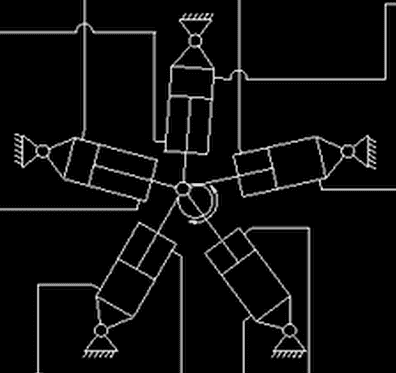
The forum discussion focuses on calculating the input torque required for a radial piston arrangement using an interactive Google Sheets tool. Key calculations involve determining the force on each piston due to pressure and the torque about the crank axis, factoring in the angles between the connecting rod and crank throw. The torque is proportional to the sine of these angles, and the discussion emphasizes the importance of understanding kinematics and the effects of multiple cylinders in operation. The final torque achieved is approximately 4900 lb-in at 2000 psi, with an 8% variance throughout the rotation.
PREREQUISITES
- Understanding of kinematics in mechanical systems
- Familiarity with torque calculations in radial piston engines
- Knowledge of pressure forces in hydraulic systems
- Proficiency in using Google Sheets for mathematical modeling
NEXT STEPS
- Research "kinematic analysis of slider-crank systems" for deeper insights
- Learn about "torque calculations in radial piston engines" for practical applications
- Explore "Google Sheets formulas for engineering calculations" to enhance spreadsheet skills
- Investigate "effects of angle on torque in mechanical systems" for advanced understanding
USEFUL FOR
Engineers, mechanical designers, and students interested in hydraulic systems, particularly those working with radial piston engines and torque calculations in mechanical arrangements.