Calculating Resistance - Electrical Circuits & Networks

Click For Summary
SUMMARY

The forum discussion focuses on calculating equivalent resistances in electrical circuits, specifically addressing a problem involving a Wheatstone bridge and short-circuited resistors. The user identified that the equivalent resistance Rcd should be zero due to a short circuit and sought clarification on the bridge configuration. Participants discussed the importance of circuit topology and provided insights on visualizing the circuit by rearranging the diagram. Additionally, they explored calculating the resistance seen by a source and creating an Admittance matrix.

PREREQUISITES
  • Understanding of Wheatstone bridge configurations
  • Knowledge of electrical circuit topology
  • Familiarity with equivalent resistance calculations
  • Basic concepts of Admittance matrices in electrical engineering
NEXT STEPS
  • Study Wheatstone bridge analysis techniques
  • Learn about short circuits and their effects on circuit resistance
  • Explore methods for calculating equivalent resistances in complex networks
  • Research the creation and application of Admittance matrices in circuit analysis
USEFUL FOR

Electrical engineering students, circuit designers, and anyone involved in analyzing and optimizing electrical networks will benefit from this discussion.

Hidd
Messages
15
Reaction score
3
Thread moved from the technical forums, so no Homework Template is shown
Hello!

I've took a course about Electrical circuits and Networks at the university, and i found out a problem which is uploaded by my professor, and i think he made a mistake!
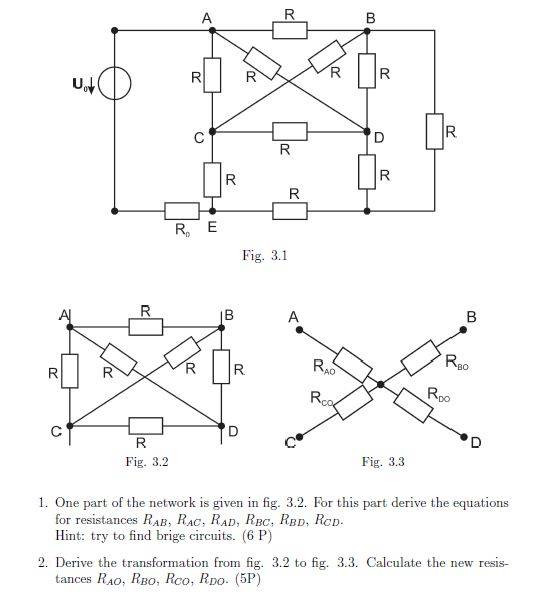
i3ii4k.jpg


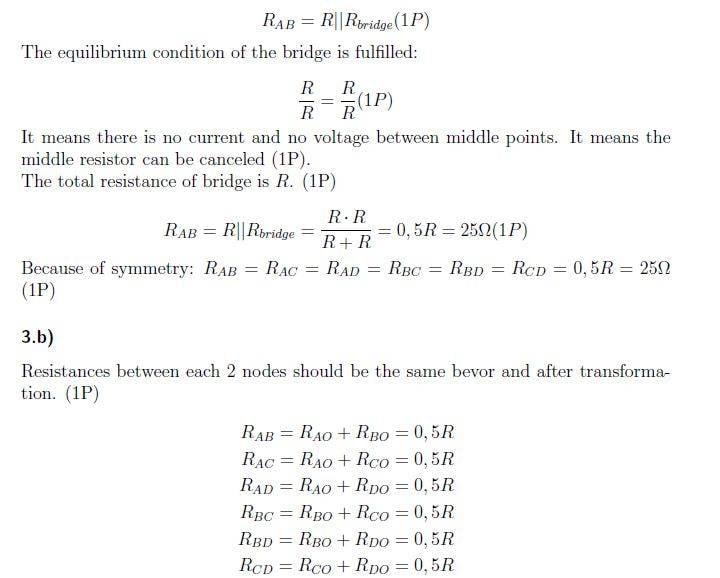
this is the solution

10gwl04.jpg


i think that the equivalent resistances are wrong (beside Rab), for example if you look at Rcd it must be 0, because it's short circuited.
And i coudn't find "the bridge" that he mentioned.

Thanks for help!
All the best,
 

Attachments

  • i3ii4k.jpg
    i3ii4k.jpg
    31.4 KB · Views: 1,432
  • 10gwl04.jpg
    10gwl04.jpg
    41.2 KB · Views: 1,379
Physics news on Phys.org
Hidd said:
i think that the equivalent resistances are wrong (beside Rab), for example if you look at Rcd it must be 0, because it's short circuited.
Note that there is no connection "dot" where those wires cross :wink: Every other junction has a dot.
 
  • Like
Likes   Reactions: scottdave and Hidd
gneill, Thank you for your reply and i think you're right! but what about the "bridge"?
we worked on "Wheatstone bridge" which looks like that:
https://www.electronics-tutorials.ws/wp-content/uploads/2013/10/wheatstone1.gif

but i couldn't find similarities with the one that i mentioned earlier!
 
You may need to re-draw your circuit (rearrange the diagram) in order to be able to visualize the bridges. For example, if you remove the resistor that connects node A to node B, then you have:
upload_2018-2-15_17-38-37.png


Which can be rearranged as:
upload_2018-2-15_17-39-15.png


Note that the same resistors still connect to nodes with the same labels; the topology of the circuit is the same as before. Now can you "see the bridge"?
 

Attachments

  • upload_2018-2-15_17-38-37.png
    upload_2018-2-15_17-38-37.png
    2.2 KB · Views: 789
  • upload_2018-2-15_17-39-15.png
    upload_2018-2-15_17-39-15.png
    1.5 KB · Views: 755
  • Like
Likes   Reactions: scottdave and Hidd
Yep! now i see it, Thank you very much gneill.
 
You can think of ABCD as a tetrahedron, with resistance R on each of the edges.
I was having a hard time drawing one, so I found an image of one.
z1bpW8g.jpg

Then you can look at it from above A, and project it flat, so A is in the center of the triangle, and it connects outward to B C and D.
 

Attachments

  • z1bpW8g.jpg
    z1bpW8g.jpg
    9.2 KB · Views: 741
  • Like
Likes   Reactions: Hidd
For extra credit. what is the resistance seen by the source Uo in Fig. 3.1 if ALL (including Rd) of the resistors are 50 ohms?
 
@The Electrician. Can I get extra credit for clarifying the diagram and setting the source to one amp ?
Network_R.png
 

Attachments

  • Network_R.png
    Network_R.png
    42.2 KB · Views: 703
For doubleplusgood credit, calculate the resistance from every node to every other node. First number all the nodes in the original network.

Network.jpg


Then do the math:

All Resistances.png

In the final result matrix the resistance from node j to node k is given by the (j,k) element of the matrix. The resistance from node j to k is, of course, the same as the resistance from node k to node j, hence the matrix is symmetric. And we see all zeroes on the main diagonal because the resistance from a node to itself is zero.
 

Attachments

  • Network.jpg
    Network.jpg
    9 KB · Views: 610
  • All Resistances.png
    All Resistances.png
    57.9 KB · Views: 1,077
Last edited:
  • Like
Likes   Reactions: scottdave
  • #10
The Electrician said:
For doubleplusgood credit, calculate resistance from every node to every other node...
Then do the math:

View attachment 221247
I am now curious, since I just went through a Linear Algebra course: what is the key to creating the Admittance matrix by inspection?
 
  • #11
scottdave said:
I am now curious, since I just went through a Linear Algebra course: what is the key to creating the Admittance matrix by inspection?

 
  • Like
Likes   Reactions: scottdave
  • #12
The Electrician said:

Thanks.
 

Similar threads

Replies
5
Views
4K
  • · Replies 1 ·
Replies
1
Views
2K
  • · Replies 7 ·
Replies
7
Views
2K
  • · Replies 9 ·
Replies
9
Views
6K
Replies
10
Views
3K
  • · Replies 5 ·
Replies
5
Views
2K
  • · Replies 9 ·
Replies
9
Views
5K
Replies
2
Views
2K
Replies
1
Views
1K
Replies
2
Views
2K