Calculations for a capacitor charging from another capacitor

Click For Summary
SUMMARY

The discussion focuses on calculating the voltage behavior in a sample-and-hold circuit involving capacitors and resistors, specifically for a PIC18 microcontroller. The hold capacitor (CH = 10pF, RH = 8.5k) charges from a source voltage (Vs = 2.11V) through a resistor (RS = 825k) and a Thevenin equivalent circuit. Participants recommend using Laplace Transforms to analyze the circuit in the s-domain and suggest confirming results with LTSpice simulation. The conversation emphasizes the need to understand the relationships between the time constants of the RC pairs to accurately model the charging profile.

PREREQUISITES
  • Understanding of sample-and-hold circuits
  • Familiarity with Laplace Transforms
  • Knowledge of RC time constants
  • Experience with circuit simulation tools like LTSpice
NEXT STEPS
  • Study Laplace Transforms for circuit analysis
  • Learn about second-order differential equations in electrical circuits
  • Explore the use of LTSpice for simulating capacitor charging behavior
  • Research the impact of source impedance on ADC performance
USEFUL FOR

Electrical engineers, circuit designers, and anyone involved in designing or analyzing sample-and-hold circuits for analog-to-digital converters (ADCs).

cjs94
Messages
16
Reaction score
0
Thread moved from the technical forums, so no Homework Template is shown
Hi all,

I'd appreciate help in calculating the voltages in the circuit shown. I thought it should be fairly straight forward, but it has me stumped. This is a sample-and-hold circuit for an ADC -- the switch is closed to charge the hold capacitor with the sample voltage and then opened to isolate during conversion. I'm trying to model the charging profile of the hold capacitor when the switch is closed.

I've shown the initial conditions as well as the basic circuit equations, but I can't figure out how to actually solve it, mainly I think because the differentials are sort of co-dependent.
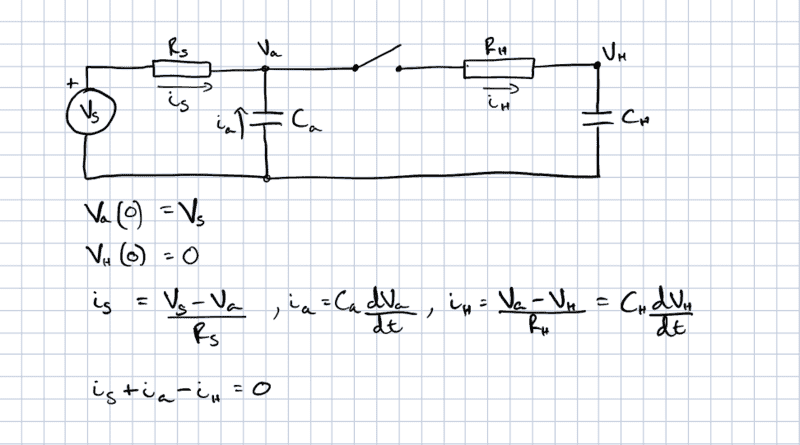
Note 27 Jun 2018.png


Thanks in advance,
Chris
 

Attachments

  • Note 27 Jun 2018.png
    Note 27 Jun 2018.png
    18.6 KB · Views: 724
Physics news on Phys.org
Are actual component values given, or perhaps some relationships between them? For example, if the time constant of the left hand side RC pair is much greater than that of the right hand side pair, you can make certain simplifying approximations...
 
gneill said:
Are actual component values given, or perhaps some relationships between them? For example, if the time constant of the left hand side RC pair is much greater than that of the right hand side pair, you can make certain simplifying approximations...

Sure. The right-hand side is the input stage of a PIC18, so CH = 10pF and RH is about 8.5k (for Vcc = 3.3V). The left-hand side, Vs = 2.11V and RS = 825k -- the actual circuit is a 4.7M/1M divider from 12V, I just simplified it to a Thevenin equivalent. Ca = 100nF. So, l.h.s. RC >> r.h.s. RC.

My reason for the calculation is that the maximum recommended source impedance is 10k. Without Ca the source impedance is obviously much greater than that, however I realize that I have no idea how to think about the effect of Ca on that impedance in response to an impulse event (which is effectively what happens when the switch is closed). My intuition (right or wrong) tells me that CH will see a very low impedance by virtue of Ca, until the charge on both capacitors has equalised, then the impedance should rise substantially as both capacitors continue to charge from Vs. I'm looking for a formal way to characterise that.

While I have actual values, I would like to know how to approach this from first principles, since it is something that I thought I understood and should be able to do. I was wrong.

Regards,
Chris
 
Okay, looks like you've got a handle on how the circuit will behave overall.

As to a formal approach, my suggestion would be to employ Laplace Transforms and solve the circuit in the s-domain via the usual KVL and KCL methods (nodal or mesh analysis).

You should be able to confirm your results using a simulator such as LTSpice.
 
One of the complications of this circuit when is it requires you to set up and solve a second order differentiation equation.
 
At first I think is-ia-ih=0 [if Va potential is more than Ca potential].
Second dVa(t)/dt>>s*Va(s)-Va(0)[=Vs] and dVh/dt>>s*Vh(s) [Vh(0)=0].
From is-ia-ih=0 and is*Rs+ih*Rh+∫ih.dt/Ch=Vs you'll get something like:
Vh(s)=(As^2+B*s+C)/(D*s^3+E*s^2+F*s+G)
It's a lot to calculate that's all.
 
Babadag said:
At first I think is-ia-ih=0 [if Va potential is more than Ca potential].

Va is always equal to Vc

Babadag said:
Second dVa(t)/dt>>s*Va(s)-Va(0)[=Vs] and dVh/dt>>s*Vh(s) [Vh(0)=0].

Your notation makes no sense to me, what is s? are you doing something with Laplace transforms?
 
If Va=Vc no current will flow to Ca. The symbol “>>” it means " the Laplace transform is"
 
You can start from the idea Vh = 0 for t = 0 and Vh = Vs for t = [infinite] and it is constantly increasing. Then Vh=Vs[1-e^(-t/k)]. ih=dVh/dt/Ch and ih*Rh+Vh=Va
 
  • #10
cjs94 said:
While I have actual values, I would like to know how to approach this from first principles, since it is something that I thought I understood and should be able to do. I was wrong.
You can combine the equations you have to get
\begin{align*}
\frac{dV_\text{H}}{dt} &= \frac{1}{R_\text{H}C_\text{H}}(V_\text{a}-V_\text{H}) \\
\frac{dV_\text{a}}{dt} &= \left(\frac {1}{R_\text{H}C_\text{a}}+\frac{1}{R_\text{s}C_\text{a}}\right)V_\text{a} - \frac{1}{R_\text{H}C_\text{a}}V_\text{H} - \frac{1}{R_\text{s}C_\text{a}}V_\text{s}
\end{align*} (or something similar if I made algebra or sign mistakes). You can solve this system using matrix methods.

If you're not familiar with that method, you could solve the first equation for ##V_\text{a}## and then plug the result into the second equation to get a second-order differential equation for ##V_\text{H}##.
 
  • Like
Likes   Reactions: Babadag
  • #12
Thanks for all the replies. I have some reading to do!
 

Similar threads

  • · Replies 22 ·
Replies
22
Views
5K
  • · Replies 10 ·
Replies
10
Views
3K
  • · Replies 4 ·
Replies
4
Views
2K
  • · Replies 5 ·
Replies
5
Views
2K
  • · Replies 4 ·
Replies
4
Views
2K
  • · Replies 7 ·
Replies
7
Views
4K
  • · Replies 7 ·
Replies
7
Views
2K
  • · Replies 5 ·
Replies
5
Views
2K
Replies
3
Views
2K
  • · Replies 7 ·
Replies
7
Views
2K