Can an ODE accurately model an RLC circuit with additional sources?

Click For Summary
SUMMARY

The discussion focuses on the modeling of RLC circuits using ordinary differential equations (ODEs) when additional current sources are introduced. It highlights that the presence of multiple sources can create conflicting conditions that complicate the circuit's behavior. Specifically, it addresses the challenges of enforcing voltage drops across circuits with ideal current sources in series and the interaction between current sources and voltage sources in parallel configurations. The conclusions emphasize that the ODEs must be adjusted to account for these complexities in circuit analysis.

PREREQUISITES
  • Understanding of RLC circuit theory
  • Familiarity with ordinary differential equations (ODEs)
  • Knowledge of circuit analysis techniques
  • Experience with ideal voltage and current sources
NEXT STEPS
  • Study the impact of additional sources on RLC circuit ODEs
  • Learn about the superposition theorem in circuit analysis
  • Explore the behavior of ideal current sources in series with voltage sources
  • Investigate the conditions for stability in RLC circuits with multiple sources
USEFUL FOR

Electrical engineers, circuit designers, and students studying circuit theory who are interested in advanced modeling techniques for RLC circuits with multiple sources.

Jhenrique
Messages
676
Reaction score
4
The equation for this physical model is:
http://upload.wikimedia.org/wikipedia/commons/f/fb/RLC_series_circuit_v1.svg

8a89f7d3622fc859d3bc910a8691b9e9.png


And for this is:
http://upload.wikimedia.org/wikipedia/commons/d/d0/RLC_parallel_circuit_v1.svg

8383fa6312eb5e0b7befb1b4172ae749.png


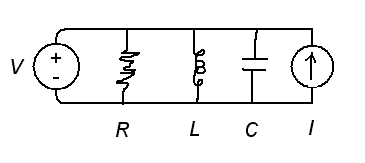
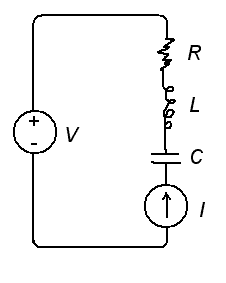
But and if now I add a source of current in those schemes, the ODE changes?
attachment.png

attachment.png
 

Attachments

  • x.PNG
    x.PNG
    1.1 KB · Views: 619
  • y.PNG
    y.PNG
    1.1 KB · Views: 580
Physics news on Phys.org
These circuits do not really work. Each of the sources are going to require conditions that are at odds to the other.

Plus, how do you enforce a voltage drop across a circuit with an ideal current source in series? How do you enforce a current source in parallel to an ideal voltage source?

In the former, at best the voltage source does not contribute. The current source acts like the only source. In the latter, the voltage source is the only effective source.
 
  • Like
Likes   Reactions: 1 person

Similar threads

  • · Replies 4 ·
Replies
4
Views
3K
  • · Replies 2 ·
Replies
2
Views
2K
  • · Replies 8 ·
Replies
8
Views
3K
  • · Replies 4 ·
Replies
4
Views
2K
  • · Replies 16 ·
Replies
16
Views
4K
  • · Replies 1 ·
Replies
1
Views
2K
Replies
2
Views
3K
  • · Replies 3 ·
Replies
3
Views
4K
  • · Replies 3 ·
Replies
3
Views
2K
Replies
15
Views
3K