Can anyone help me solve this Integration of three terms?

  • Thread starter Thread starter mahmud_dbm
  • Start date Start date
  • Tags Tags
    Integration Terms
Click For Summary

Homework Help Overview

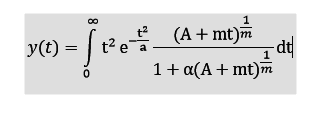
The discussion revolves around the integration of a complex function involving constants A, m, alpha, and a. The original poster expresses uncertainty about the feasibility of the integration and has attempted various methods without success.

Discussion Character

  • Exploratory, Assumption checking, Mathematical reasoning

Approaches and Questions Raised

  • Participants discuss different methods of integration, including simplification of variables and the introduction of new constants. There are inquiries about the assumptions made regarding the parameters and the conditions for convergence of the integral.

Discussion Status

Some participants have provided insights into the assumptions necessary for convergence and the nature of the integral. There is ongoing exploration of numerical methods and series expansion as potential approaches to tackle the integration problem. However, there is no explicit consensus on a definitive method or solution yet.

Contextual Notes

Participants highlight the importance of certain parameter values being positive to avoid divergence and undefined behavior in the integrand. There are also discussions about the output from numerical methods and the expectations for the form of the answer.
mahmud_dbm
Messages
17
Reaction score
0
Member warned about posting without the template and with no effort
I have been trying to solve an integration that i have

upload_2015-3-3_0-54-32.png

I am not even sure if it's possible. Here, A, m, alpha, a these are constants. I have tried few methods, but couldn't find any way out. I would appreciate any help.
 
Physics news on Phys.org
mahmud_dbm said:
I have been trying to solve an integration that i have

View attachment 79831
I am not even sure if it's possible. Here, A, m, alpha, a these are constants. I have tried few methods, but couldn't find any way out. I would appreciate any help.

Please show us first some of the methods you HAVE tried, whether or not they failed. (Those are PF requirements.)
 
  • Like
Likes   Reactions: mahmud_dbm
Ray Vickson said:
Please show us first some of the methods you HAVE tried, whether or not they failed. (Those are PF requirements.)

Thank you so much for replying.
Like is said, i tried with multiple integration method but individual terms were also complicated, like
upload_2015-3-3_1-45-55.png


then i don't know where to go.
 
mahmud_dbm said:
Thank you so much for replying.
Like is said, i tried with multiple integration method but individual terms were also complicated, likeView attachment 79834

then i don't know where to go.

If I were doing it I would simplify it first, by re-defining some of the variables and introducing some new constants. If we start with
[tex]f(t) = t^2 e^{-t^2/a} \frac{(A+mt)^{1/m}}{1+\alpha (A + mt)^{1/m}},[/tex]
and assume that ##a > 0##, we can let ##t/\sqrt{a} = v##, ##C = a^{3/2} A^{1/m}##, ##k = m \sqrt{a}/A##, ##b = \alpha A^{1/m}## and, finally, ##p = 1/m##. We then have the cleaner-looking result that
[tex]\int_0^{\infty} f(t) \, dt = C \int_0^{\infty} v^2 e^{-v^2} \frac{(1+k v)^p}{1 + b(1+k v)^p} \, dv[/tex]
If we further let ##1 + kv = y## (assuming ##k > 0##) we can get
[tex]\text{integral} = \frac{C e^{1/k}}{k^3} \int_1^{\infty} \frac{(y-1)^2 y^p}{1+b y^p} e^{-y/k} \, dy[/tex]
I doubt that there is a closed-form formula for this, but one can tackle it numerically if you are given the parameter values.
 
Last edited:
  • Like
Likes   Reactions: mahmud_dbm
Ray Vickson said:
If I were doing it I would simplify it first, by re-defining some of the variables and introducing some new constants. If we start with
[tex]f(t) = t^2 e^{-t^2/a} \frac{(A+mt)^{1/m}}{1+\alpha (A + mt)^{1/m}},[/tex]
and assume that ##a > 0##, we can let ##t/\sqrt{a} = v##, ##C = a^{3/2} A^{1/m}##, ##k = m \sqrt{a}/A##, ##b = \alpha A^{1/m}## and, finally, ##p = 1/m##. We then have the cleaner-looking result that
[tex]\int_0^{\infty} f(t) \, dt = C \int_0^{\infty} v^2 e^{-v} \frac{(1+k v)^p}{1 + b(1+k v)^p} \, dv[/tex]
If we further let ##1 + kv = y## (assuming ##k > 0##) we can get
[tex]\text{integral} = \frac{C e^{1/k}}{k^3} \int_1^{\infty} \frac{(y-1)^2 y^p}{1+b y^p} e^{-y/k} \, dy[/tex]
I doubt that there is a closed-form formula for this, but one can tackle it numerically if you are given the parameter values.
Dear Ray

Thank you so much.

I already see some lights.

Now as you said, if the parameter values were given, then it could be solved. Now, you were right in assuming a>0, because a = 0.1, m = 1, 2, 3, 4, 5 upto 20. So, yes k>0. But I want to understand how did you come up with all the right assumptions?? By the way, so now i have the integration, how do we do the integration ? Still i have multiple terms in the integration.
 
Last edited:
mahmud_dbm said:
Dear Ray

Thank you so much.

I already see some lights.

Now as you said, if the parameter values were given, then it could be solved. Now, you were right in assuming a>0, because a = 0.1, m = 1, 2, 3, 4, 5 upto 20. So, yes k>0. But I want to understand how did you come up with all the right assumptions?? By the way, so now i have the integration, how do we do the integration ? Still i have multiple terms in the integration.

Looking at the original integral, we need a > 0 in order to have a convergent integral. Why is that? Well, the integrand is not defined at all if a = 0, and the integral diverges exponentially if a < 0. Next, we need A > 0 in order that (A + mt) be ≥ 0 for all t > 0. This is needed because if (A + mt) < 0 in a range of t-values, then (A + mt)^(1/m) will involve roots of negative numbers, so will involve complex numbers, etc. Finally, we need α ≥ 0 in order to not have the denominator go through 0 at t increases up from 0. If the denominator did go through 0, we would need to worry about the possible divergence of the integral, and whether to interpret as a principle-value integral, or whatever. All these issues are avoided if we just assume all your original parameters a, A,m,α are > 0.

As to how to integrate: NUMERICALLY! Or, perhaps you can expand things in convergent infinite series and then integrate term-by-term.
 
  • Like
Likes   Reactions: julianwitkowski
Ray Vickson said:
Looking at the original integral, we need a > 0 in order to have a convergent integral. Why is that? Well, the integrand is not defined at all if a = 0, and the integral diverges exponentially if a < 0. Next, we need A > 0 in order that (A + mt) be ≥ 0 for all t > 0. This is needed because if (A + mt) < 0 in a range of t-values, then (A + mt)^(1/m) will involve roots of negative numbers, so will involve complex numbers, etc. Finally, we need α ≥ 0 in order to not have the denominator go through 0 at t increases up from 0. If the denominator did go through 0, we would need to worry about the possible divergence of the integral, and whether to interpret as a principle-value integral, or whatever. All these issues are avoided if we just assume all your original parameters a, A,m,α are > 0.

As to how to integrate: NUMERICALLY! Or, perhaps you can expand things in convergent infinite series and then integrate term-by-term.

Dear Sir

Thank you so much for you reply and thorough analysis.

Sir, in the 4th line, should it be exp(-v^2) ?
And sir, i tried with MATLAB, it's showing values. I don't know how they got the value.

and what did you mean by "expand things in convergent infinite series", how do i expand that term, especially that y^p/(1+b*y^p) format?

Thanks in advance.
 
Last edited:
mahmud_dbm said:
Dear Sir

Thank you so much for you reply and thorough analysis.

Sir, in the 4th line, should it be exp(-v^2) ?
And sir, i tried with MATLAB, it's showing values. I don't know how they got the value.

and what did you mean by "expand things in convergent infinite series", how do i expand that term, especially that y^p/(1+b*y^p) format?

Thanks in advance.
Ray

I mean, as i said earlier m>1, so that means p is fractional. How do i expand that fractional power thing?
 
How can y be a function of t if the integral is over t?

Chet
 
  • #10
Does the answer have to be closed form, or can it be expressed as an infinite series?

Chet
 
  • #11
mahmud_dbm said:
Dear Sir

Thank you so much for you reply and thorough analysis.

Sir, in the 4th line, should it be exp(-v^2) ?
And sir, i tried with MATLAB, it's showing values. I don't know how they got the value.

and what did you mean by "expand things in convergent infinite series", how do i expand that term, especially that y^p/(1+b*y^p) format?

Thanks in advance.

Yes, the 4th line should have exp(-v^2), not exp(-v). I have edited out this typo.

Exactly what input did you use with MATLAB, and what type of answer did MATLAB deliver?
 
  • #12
Chestermiller said:
Does the answer have to be closed form, or can it be expressed as an infinite series?

Chet

Dear Chet

The answer should be just a value, for the given parameters, so it should be in closed form, but now i doubt if it's possible. So, finite or infinite solution, please do enlighten me.
 
Last edited:
  • #13
Ray Vickson said:
Yes, the 4th line should have exp(-v^2), not exp(-v). I have edited out this typo.

Exactly what input did you use with MATLAB, and what type of answer did MATLAB deliver?

Ray

I simply wrote the function, integrated using built-in integration function.

bt=0.02;
s=1;
g=3;
a=0.1;
k=g*s/bt;
p=1/g;
b=a*bt^p;
C=2*s*bt^p;

fun=@(y) (C/k^3)*((y-1).^2.*exp(-(y-1)./k).^2.*y.^p)./(1+b.*y.^p);
m=integral(fun,0,Inf);

the m is now 0.6839.
 
  • #14
mahmud_dbm said:
Ray

I simply wrote the function, integrated using built-in integration function.

bt=0.02;
s=1;
g=3;
a=0.1;
k=g*s/bt;
p=1/g;
b=a*bt^p;
C=2*s*bt^p;

fun=@(y) (C/k^3)*((y-1).^2.*exp(-(y-1)./k).^2.*y.^p)./(1+b.*y.^p);
m=integral(fun,0,Inf);

the m is now 0.6839.

So, did MATLAB give you a numerical answer, or did it give you a "formula"?
 
  • #15
Ray Vickson said:
So, did MATLAB give you a numerical answer, or did it give you a "formula"?
MATLAB gave me a numerical answer i need to know the how and the formula.
 
  • #16
mahmud_dbm said:
MATLAB gave me a numerical answer i need to know the how and the formula.

I suspect that there is NO possible formula. I did say---more than once---that I guessed you would need to do numerical integration when looking at a numerical example (that is, with numerical values of the inputs). MATLAB probably tried some "analytical" methods, found it could not be done, and then applied one of its built-in numerical integration routines.
 
  • #17
Ray Vickson said:
I suspect that there is NO possible formula. I did say---more than once---that I guessed you would need to do numerical integration when looking at a numerical example (that is, with numerical values of the inputs). MATLAB probably tried some "analytical" methods, found it could not be done, and then applied one of its built-in numerical integration routines.
Ray

Surely your reply helped me a lot, now i understand the problem at least. Thank you so much for your time.
Using MATLAB, i would probably get the numerical value but i won't be able to explain how i got that.
That's why i needed the explanation. I will share if i can find anything.

Thank you all.
 
  • #18
mahmud_dbm said:
Ray

I simply wrote the function, integrated using built-in integration function.

bt=0.02;
s=1;
g=3;
a=0.1;
k=g*s/bt;
p=1/g;
b=a*bt^p;
C=2*s*bt^p;

fun=@(y) (C/k^3)*((y-1).^2.*exp(-(y-1)./k).^2.*y.^p)./(1+b.*y.^p);
m=integral(fun,0,Inf);

the m is now 0.6839.

Please give the original parameters in your first post. Here you have bt, s and g, none of which were present in the original post. Just tell us the values of m, a, A, and α, as they appeared in post #1. I want to check your numerical value, but to do that I need to know exactly what you computed.

Anyway, it looks like you have entered (in part) exp(-(y-1)/k)^2 , which is = exp(-2(y-1)/k), instead of the correct form exp(-[ (y-1)/k ls]^2) = exp(-(y-1)^2/k^2), which is very different.
 
  • #19
Ray Vickson said:
Please give the original parameters in your first post. Here you have bt, s and g, none of which were present in the original post. Just tell us the values of m, a, A, and α, as they appeared in post #1. I want to check your numerical value, but to do that I need to know exactly what you computed.

Anyway, it looks like you have entered (in part) exp(-(y-1)/k)^2 , which is = exp(-2(y-1)/k), instead of the correct form exp(-[ (y-1)/k ls]^2) = exp(-(y-1)^2/k^2), which is very different.
Dear Ray
upload_2015-3-3_23-31-27.png

Another constant can be multiplied sometimes which is (2/a^4), this is optional.

There is a little change from the 1st post, it's a^2 instead of a. It's a constant, so doesn't make any difference.
Other values are like alpha = 0.1, a=1, m=3 (usually >1), A = 0.02.

You are right about the exponential term, my mistake.
 
  • #20
Shouldn't those x's be t's?

Chet
 
  • #21
Chestermiller said:
Shouldn't those x's be t's?

Chet

Right Right, x's be t's, there is no x in the equation.
 
  • #22
mahmud_dbm said:
Dear RayView attachment 79893
Another constant can be multiplied sometimes which is (2/a^4), this is optional.

There is a little change from the 1st post, it's a^2 instead of a. It's a constant, so doesn't make any difference.
Other values are like alpha = 0.1, a=1, m=3 (usually >1), A = 0.02.

You are right about the exponential term, my mistake.

You say "...so it doesn't make any difference". It DOES make a difference when you are telling other people what you did; they need to know exactly what your parameters are. Of course, when a = 1 it really does not make a difference, since a^2 = a in that case; but when a ≠ 1 this no longer holds. In general, you should not change the notation in your posts without telling anyone.
 
  • #23
Ray Vickson said:
You say "...so it doesn't make any difference". It DOES make a difference when you are telling other people what you did; they need to know exactly what your parameters are. Of course, when a = 1 it really does not make a difference, since a^2 = a in that case; but when a ≠ 1 this no longer holds. In general, you should not change the notation in your posts without telling anyone.
Okay so, now you can omit that optional constant part, which i haven't included, and it's a^2, not a, it was a mistake in the first post. But, like i said, a=1, so it wouldn't make any difference, in my case.
 

Similar threads

  • · Replies 6 ·
Replies
6
Views
2K
  • · Replies 8 ·
Replies
8
Views
1K
  • · Replies 7 ·
Replies
7
Views
2K
  • · Replies 1 ·
Replies
1
Views
2K
Replies
25
Views
3K
  • · Replies 22 ·
Replies
22
Views
3K
  • · Replies 16 ·
Replies
16
Views
3K
Replies
2
Views
1K
  • · Replies 9 ·
Replies
9
Views
3K
  • · Replies 2 ·
Replies
2
Views
3K