michael872940
- 1
- 0
Classical problems for hookes law generally give either mass or spring constant.
What if I have a graph of a wavelike structure that is oscillating which I can use to measure for example: T (period), t (time), Δx (displacement), v (velocity), a (acceleration) and other variables is this possible? Gravity is not a factor in this example.
I realize that graphs are different cases. The second graph is more similar to the graph I might observe. I have been using them to conceptualize this issue and try to figure out how to rearrange different equations of Force (ma, -kx) without success.
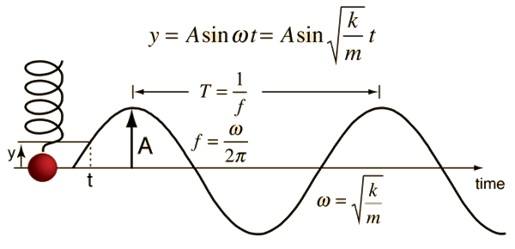
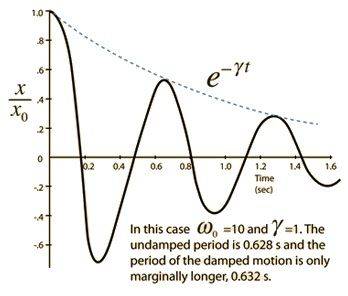
I have been thinking that the answer could be approximated by solving for M using an equation applied to pendulums
M=4π²I/gDT²
and substituting the acceleration for gravity (which is not present in this case). Even though, this is different than a pendulum, perhaps there is a vector component of acceleration that is acting on each of the turning points of the waves that that acts in a similar fashion to gravity in a pendulum. Once I find this value I could then solve for the k constant.
Alternatively, maybe I could solve for k by using Uel(x) = 1/2kx² where the points of the graph are used to plot Uel(x) and then using this value and displacement solving for k by using k= d²Uel/dx².
Is there some better solution to solve for M and K or getting the approximate answer?
What if I have a graph of a wavelike structure that is oscillating which I can use to measure for example: T (period), t (time), Δx (displacement), v (velocity), a (acceleration) and other variables is this possible? Gravity is not a factor in this example.
I realize that graphs are different cases. The second graph is more similar to the graph I might observe. I have been using them to conceptualize this issue and try to figure out how to rearrange different equations of Force (ma, -kx) without success.
I have been thinking that the answer could be approximated by solving for M using an equation applied to pendulums
M=4π²I/gDT²
and substituting the acceleration for gravity (which is not present in this case). Even though, this is different than a pendulum, perhaps there is a vector component of acceleration that is acting on each of the turning points of the waves that that acts in a similar fashion to gravity in a pendulum. Once I find this value I could then solve for the k constant.
Alternatively, maybe I could solve for k by using Uel(x) = 1/2kx² where the points of the graph are used to plot Uel(x) and then using this value and displacement solving for k by using k= d²Uel/dx².
Is there some better solution to solve for M and K or getting the approximate answer?
Last edited: