Can Trig Substitution with Cosine be Used Instead of Sine?

Click For Summary

Discussion Overview

The discussion revolves around the use of trigonometric substitution in integration, specifically whether cosine substitution can be used interchangeably with sine substitution. Participants explore the implications of using each method on the results of an integral involving the function √(9 - x²) / x².

Discussion Character

  • Debate/contested
  • Mathematical reasoning

Main Points Raised

  • One participant questions the validity of using cosine substitution instead of sine, noting discrepancies in the results obtained from both methods.
  • Another participant points out that using sine results in an inverse sine function, while cosine leads to an inverse cosine, which are related but yield different expressions.
  • A participant suggests that the difference in answers is not a matter of validity but rather a result of the constants involved in the integration process.
  • It is mentioned that the choice between sine and cosine is largely dependent on convenience and that both substitutions can be valid under the right conditions.
  • One participant elaborates on the function being integrated and the importance of selecting an appropriate substitution that aligns with the function's defined interval.
  • A later reply indicates that testing both substitution methods yields the same answer, suggesting that the initial concerns may have been resolved through practical application.

Areas of Agreement / Disagreement

Participants express differing views on the validity and outcomes of using sine versus cosine substitutions, with no consensus reached on a definitive preference or resolution of the discrepancies noted.

Contextual Notes

Participants discuss the implications of constants introduced by different substitutions and the importance of selecting appropriate intervals for integration, but do not resolve the underlying mathematical differences between the two approaches.

UMath1
Messages
361
Reaction score
9
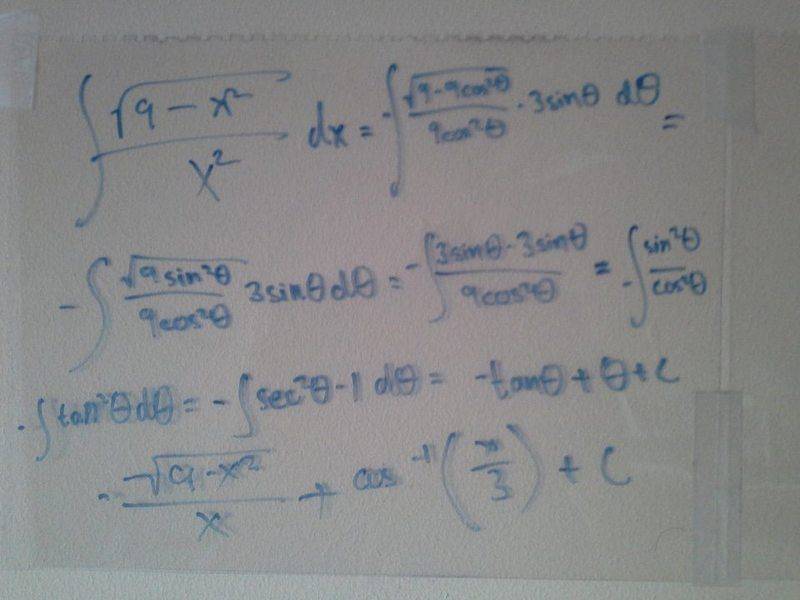
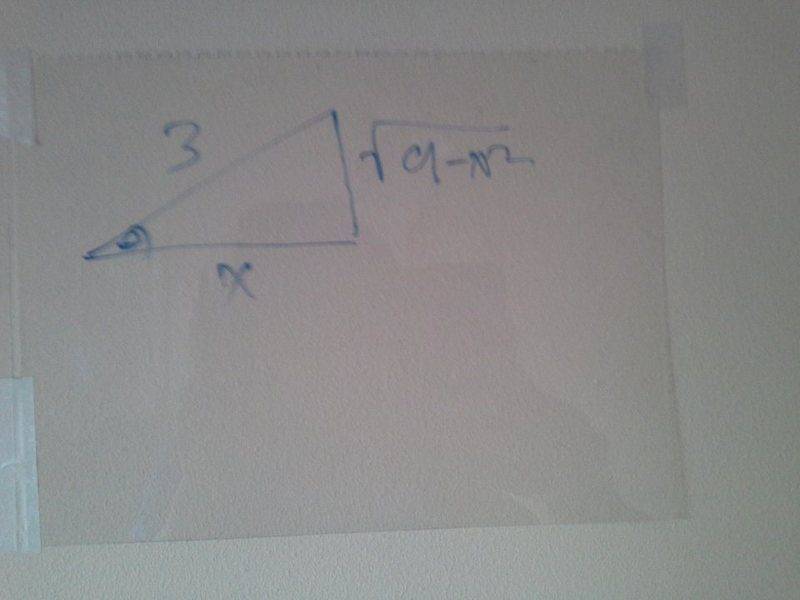
I was wondering if you could do a trig substitution with cosine instead of sine. All the textbooks I have referred to use a sine substitution and leave no mention as to why cosine substitution was not used. It seemed that it should work just the same, until I tried it for the following Fint [sqrt(9-x^2)]/ [x^2]. I checked to see if my answer differed by only a constant but that was not the case. I have attached pictures of my work. Can anyone tell me why it does not work?
20160130_164904.jpg
20160130_164853.jpg
 
Physics news on Phys.org
If you use sine instead, you will end up with ##\sin^{-1}## in place of ##\cos^{-1}##. But the two expressions are related by ##\cos^{-1}x = \pi/2-\sin^{-1}x##.
 
I know but why are the answers different? Is one less valid than the other?

Btw the textbook which uses sine has the same answer but with -sin^-1(x/3) instead of cos^-1(x/3) like I have it.
 
UMath1 said:
Btw the textbook which uses sine has the same answer but with -sin^-1(x/3) instead of cos^-1(x/3) like I have it.
That's exactly the point I addressed in my previous post. Replace -sin^-1(x/3) with the equation I wrote before. You will indeed have an additional ##\pi/2## but it's a constant and hence can be absorbed into the integration constant ##C##.
 
There's really nothing magic about using sin or cos. It just depends on what is more convenient for each case. As for signs, using the relevant relations from trigonometry - like the one that blue_leaf77 mentions, you can substitute sin for cos and vice versa and find the appropriate sign.
 
The function being integrated is

f(x) = √(9 - x2) / x2

. This is defined for 0 < |x| ≤ 3.

When making a substitution we want to choose an interval where f(x) makes sense, and the easiest one is 0 < x ≤ 3.

We also want to choose a substitution that takes the same values that f(x) does over the interval of definition, and that's between 0 and 3.

Each of y = 3 sin(x) and y = 3 cos(x) satisfy this condition, so either one can be used for the substitution.

Using 3 sin(x) to substitute might be a tiny bit easier than cosine because its derivative is 3 cos(x), and this does not introduce negative signs.
 
Ok...I see it now. I tried some test bounds of integration and got the same answer from both options.
 

Similar threads

  • · Replies 6 ·
Replies
6
Views
3K
  • · Replies 6 ·
Replies
6
Views
3K
  • · Replies 3 ·
Replies
3
Views
4K
  • · Replies 7 ·
Replies
7
Views
2K
  • · Replies 1 ·
Replies
1
Views
2K
  • · Replies 1 ·
Replies
1
Views
2K
  • · Replies 5 ·
Replies
5
Views
2K
  • · Replies 5 ·
Replies
5
Views
2K
  • · Replies 1 ·
Replies
1
Views
2K
  • · Replies 11 ·
Replies
11
Views
4K