Discussion Overview
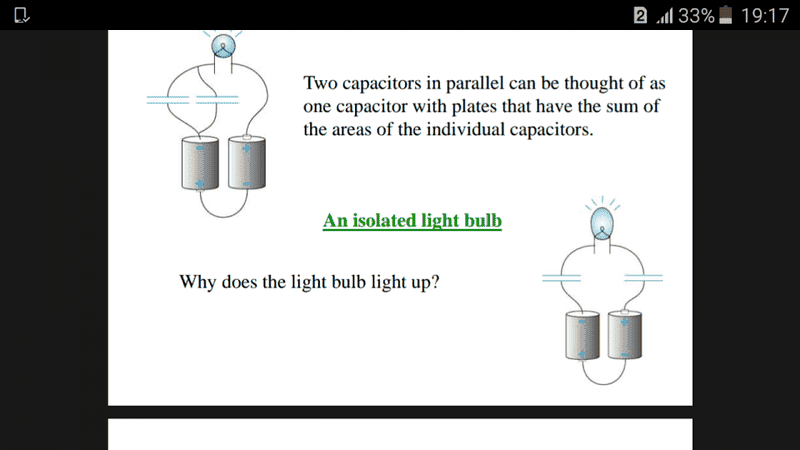
The discussion revolves around the behavior of capacitors in series and the propagation of electric fields through dielectrics in electrical circuits. Participants explore the intuitive understanding of how surface charges interact and affect the flow of current, particularly in relation to a light bulb connected to a circuit with capacitors.
Discussion Character
- Exploratory
- Technical explanation
- Debate/contested
Main Points Raised
- One participant shares their understanding of surface charge feedback theory and seeks clarification on how electric fields reach a light bulb through dielectrics in a series capacitor arrangement.
- Another participant asserts that the light bulb must be at some potential and that AC current will flow through the circuit, but does not elaborate on the mechanism of field propagation.
- Several participants discuss the behavior of the electric field within a capacitor and how it develops in the dielectric, emphasizing that the electric field propagates at near the speed of light.
- There are claims that the bulb will only light briefly with a DC supply due to the equalization of charge on the capacitors, and that it will remain lit only with an AC supply.
- One participant questions how the electric field travels through the dielectric, even for a short time, and seeks a detailed explanation of the mechanism involving surface charges.
- Another participant explains that the electric field does not stop at the dielectric and that the movement of electrons in the circuit is a result of the electric field created by the charged capacitor plates.
- There is a discussion about the nature of voltage and its relationship to the electric field, with one participant clarifying that voltage does not "move" through the circuit.
- One participant draws a comparison to a resistor connected to a battery, discussing the initial period where surface charges build up before steady current flows.
Areas of Agreement / Disagreement
Participants express differing views on the behavior of the light bulb with DC versus AC supply, and there is no consensus on the exact mechanism of how the electric field interacts with the dielectric and the bulb. The discussion remains unresolved with multiple competing perspectives on these topics.
Contextual Notes
Participants reference various assumptions about the behavior of electric fields, surface charges, and the nature of voltage, but these assumptions are not universally agreed upon. The discussion includes unresolved questions about the specifics of charge movement and field propagation in the context of capacitors in series.