Cathodes/Anodes in Chemistry and Physics

  • Context: Undergrad 
  • Thread starter Thread starter quanticism
  • Start date Start date
  • Tags Tags
    Chemistry Physics
Click For Summary

Discussion Overview

The discussion centers on the differing definitions and roles of cathodes and anodes in chemistry and physics, particularly in the context of galvanic cells and vacuum tubes. Participants explore the implications of conventional current versus electron flow and how these concepts apply in various devices.

Discussion Character

  • Conceptual clarification
  • Debate/contested

Main Points Raised

  • One participant expresses confusion about the designation of cathodes as positive in chemistry and negative in physics, seeking clarification.
  • Definitions of anode and cathode are provided, highlighting that an anode is where conventional current flows into a device, while a cathode is where it flows out.
  • Another participant notes that inside a CRT, electrons flow from the cathode to the anode, while outside, conventional current flows from the anode to the cathode, suggesting a distinction between internal and external flow.
  • A participant emphasizes the difference between conventional current (flowing from positive to negative) and electron current, referencing a link for further explanation.
  • One participant mentions that electrons are repelled from the cathode and attracted to the anode, and discusses the movement of electrons in a galvanic cell, noting their movement through the external circuit rather than through a porous disk.

Areas of Agreement / Disagreement

Participants do not reach a consensus on the definitions and roles of cathodes and anodes, as there are multiple interpretations and explanations presented. The discussion remains unresolved regarding the implications of these definitions in different contexts.

Contextual Notes

There are limitations in the discussion regarding the assumptions made about conventional current and electron flow, as well as the specific contexts of devices like galvanic cells and CRTs. The definitions provided may depend on the specific application or device being discussed.

quanticism
Messages
29
Reaction score
3
Hi,

I'm confused at why cathodes are the positive terminal in chemistry but appear to be the negative terminal in physics. I hope someone can clear this up for me.

Definitions:
Anode: An anode is an electrode through which conventional current flows into a polarized electrical device.
Cathode: A cathode is an electrode through which conventional current flows out of a polarized electrical device

Galvanic Cell
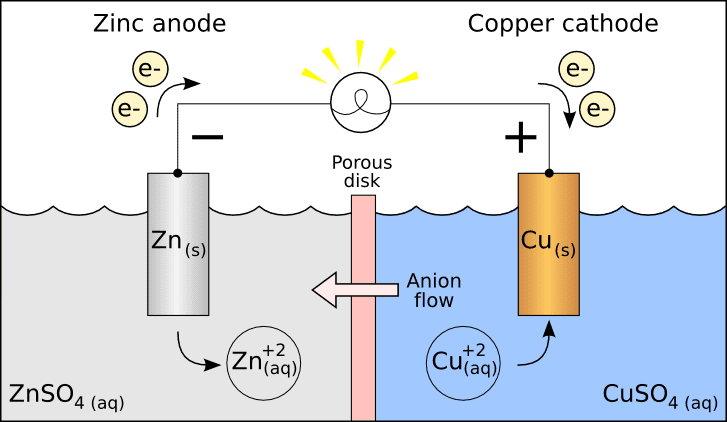
Galvanic_cell_with_no_cation_flow.png


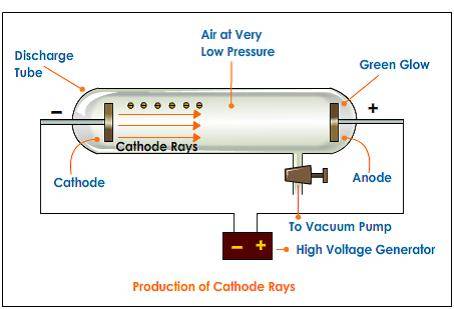
Vacuum Tube
cathode-rays-formation.jpe


Going by the definition above, I agree with the galvanic cell "cathode/anode" labels.

However, looking at the vacuum tube, the electrons traveling to the right through the partial vacuum and entering the anode, ie conventional current is leaving the anode which seems to contradict the provided definition.
 
  • Like
Likes   Reactions: davidbenari
Physics news on Phys.org
The definitions describe what happens outside the device.

Inside the CRT, electrons travel from the cathode to the anode.

Outside the CRT, to complete the circuit, electrons travel from the anode to the cathode.

So outside the CRT, conventional current travels from the cathode to the anode.

So conventional current flows from outside the CRT into the anode.
 
  • Like
Likes   Reactions: davidbenari
Thank you very much! I finally see the light now :)
 
There is a difference between conventional current (taken as flowing from positive to negative) and electron current. This link will explain it and the history of the convention. http://web.engr.oregonstate.edu/~traylor/ece112/lectures/elect_flow_vs_conv_I.pdf
 
Last edited by a moderator:
The electrons are reppeled from Cathode and attracted to Anode.
The electrons in galvanic cell can not move trough the Porous disk, and they move trough the outside circuit.
 
Last edited:

Similar threads

  • · Replies 2 ·
Replies
2
Views
2K
  • · Replies 3 ·
Replies
3
Views
3K
  • · Replies 17 ·
Replies
17
Views
4K
  • · Replies 15 ·
Replies
15
Views
3K
  • · Replies 19 ·
Replies
19
Views
4K
Replies
4
Views
2K
  • · Replies 3 ·
Replies
3
Views
3K
  • · Replies 5 ·
Replies
5
Views
2K
  • · Replies 1 ·
Replies
1
Views
3K
  • · Replies 10 ·
Replies
10
Views
2K