Center of gravity of a portion of cylinder

Click For Summary
SUMMARY

The discussion focuses on calculating the center of gravity (CG) of a portion of a cylinder filled with mass. Users attempted to determine the CG using a combination of rectangular and triangular areas but found discrepancies with results from 3D modeling software, which indicated a CG of 41.89 from the left end. The conversation highlights the importance of considering circular segments when calculating CG for cylindrical shapes and suggests using numerical integration methods, such as Simpson's first rule, to achieve accurate results. Additionally, resources for calculating circular segment areas and practical examples are provided.

PREREQUISITES
  • Understanding of center of gravity calculations
  • Familiarity with numerical integration techniques, specifically Simpson's first rule
  • Knowledge of circular segments and their properties
  • Proficiency in using spreadsheet software like Excel for calculations
NEXT STEPS
  • Research "Simpson's first rule for numerical integration" for accurate CG calculations
  • Study "Circular segment area calculations" to understand the geometry involved
  • Explore examples of CG calculations for cylindrical shapes in engineering contexts
  • Practice using Excel for creating tables and performing numerical integration
USEFUL FOR

Engineers, students in mechanical and civil engineering, and anyone involved in stability analysis of cylindrical structures will benefit from this discussion.

subbby
Messages
22
Reaction score
0
Attachments
  1. Figure # 1
  2. Figure # 2 reproduced from http://www.lmnoeng.com/Volume/InclinedCyl.htmhttp://www.lmnoeng.com/Volume/InclinedCyl.htm

Description
The blue is the mass inside a cylinder. In steady condition, I would want to know where its Center of gravity point shall be from either of the ends. Technically its like one mentioned in figure # 2 .It can be regarded as a portion of cylinder

Trials :
1) Divided them as a rectangle and a triangle and tried to combine the CG . (answer did not match with 3D models)
Workout :

Combined Center of gravity = area of Rectangle*Center of gravity of Rectangle + Area of triangle* Center of gravity of triangle/(Area of Rectangle+ Area of Triangle)
In this case, (taking all from left end : CG=(500*50+250*33.33)/(500+250)

No clue why it doesn’t match with the 3D modeling software’s answers. Per software, Center of gravity = 41.89 from left Any ideas ?
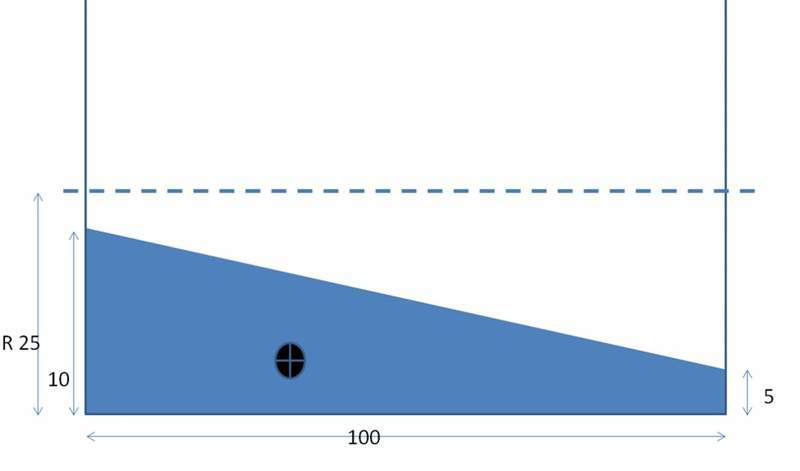
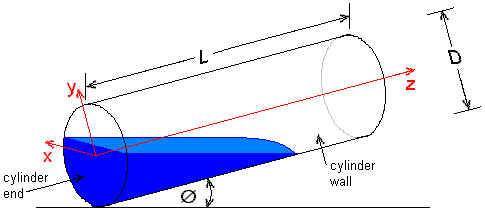
figure 1.jpg


figure 2.jpg
 
Physics news on Phys.org
I don't understand how your first picture combines with the second.
 
It's just to give an idea. However, if figure 2 is viewed from the side it translates to what I have in figure 1 except for the depth on right hand side of the filled portion
 
If you look a Fig. 2, you'll see that cross sections cut thru the cylinder perpendicular to the centerline axis form circular segments. You can't simply use the dimensions from the side projection in Fig. 1 and calculate a meaningful result for a circular cylinder. If you had a rectangular tank, you could get away with it.

You can calculate an approximate value of the longitudinal c.g. of the contents by using numerical integration (e.g., Simpson's first rule) by figuring the area at a series of equally spaced cross sections and then calculating moments from one end of the cylinder. The final result should give you the volume of the contents and the first moment about one end, and you can calculate the c.g. by dividing the moment by the volume.
 
You can calculate an approximate value of the longitudinal c.g. of the contents by using numerical integration (e.g. said:
Is there any example I can look at ?
 
subbby said:
Is there any example I can look at ?

Yes, in this attachment:

http://www.pomorci.com/Skole/Stabilitet/STABILITY 10,11,12.pdf

You'll also want some info about calculating the areas of the various circular segments:

http://en.wikipedia.org/wiki/Circular_segment

In your calculation, the distance of the cross section from one end of the cylinder will be x, and the area of the cross section of the contents will be y, which is also called the ordinate. You'll want to create a table of these x and y values and then apply the Simpson's multipliers and the ordinate values. This type of calculation works well using a spreadsheet program like Excel.

Pay close attention to the end of the cylinder where the depth of the contents gradually vanishes. You may want to use more closely spaced cross sections in this region to improve accuracy.
 
  • Like
Likes   Reactions: 1 person

Similar threads

  • · Replies 3 ·
Replies
3
Views
2K
  • · Replies 2 ·
Replies
2
Views
3K
  • · Replies 14 ·
Replies
14
Views
2K
  • · Replies 9 ·
Replies
9
Views
3K
  • · Replies 33 ·
2
Replies
33
Views
3K
  • · Replies 2 ·
Replies
2
Views
2K
Replies
0
Views
2K
  • · Replies 15 ·
Replies
15
Views
6K
  • · Replies 26 ·
Replies
26
Views
5K
  • · Replies 1 ·
Replies
1
Views
3K