Charge accumulation for in series batteries

Click For Summary

Discussion Overview

The discussion revolves around the behavior of electrons and charge accumulation in a series circuit of four 1.5V batteries when short-circuited. Participants explore concepts related to current flow, potential difference, and the implications of an open circuit.

Discussion Character

  • Exploratory
  • Technical explanation
  • Debate/contested

Main Points Raised

  • One participant questions whether electrons would accumulate in the batteries when short-circuited, suggesting that this could lead to a net positive charge in battery 1 and a net negative charge in battery 4.
  • Another participant asserts that no charge accumulates because the current entering one terminal of a battery equals the current leaving the other terminal.
  • A participant corrects their earlier misunderstanding about electron flow, stating that electrons would actually move from the negative terminal of battery 4 to the positive terminal of battery 1.
  • One participant proposes that the flow of electrons through the series of batteries accounts for the net voltage of 6V, questioning how this occurs if the circuit is not closed.
  • Another participant challenges the idea of electron flow in an open circuit, asking why electrons would move without a charge imbalance or a complete circuit.
  • A later reply emphasizes that the principles of circuit theory, specifically Kirchhoff's Voltage Law (KVL) and Kirchhoff's Current Law (KCL), govern the behavior of the circuit, suggesting that the scenario described would violate KCL.
  • One participant acknowledges the explanation about current flow and the necessity of a closed circuit for any movement of charge.

Areas of Agreement / Disagreement

Participants express differing views on the behavior of electrons in the circuit, particularly regarding charge accumulation and the implications of an open circuit. There is no consensus on the effects of short-circuiting the batteries or the flow of electrons in this context.

Contextual Notes

The discussion highlights limitations in understanding circuit behavior, particularly regarding assumptions about charge movement and the applicability of circuit theory versus more advanced theories.

DonYuri
Messages
3
Reaction score
2
Take the following diagram of 4 1.5V batteries connected in series to creat and net voltage of 6V (the numbers are of no significance here).
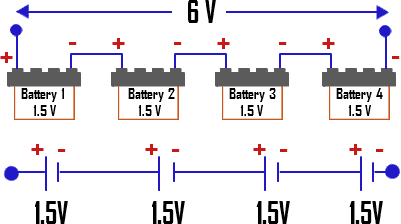
batteries-in-series.PNG


If we were to short circuit the system by connecting battery 1 to battery 4 (or run the current through a load), wouldn't there be electrons traveling from the positive terminal of battery 1 into the negative terminal of battery 4 and accumulating there? Wouldn't this then create a net positive charge in battery 1 and a net negative charge in battery 4 until the current is inversed? This would matter in a scenario where you allowed such a charge buildup to occur and then separated the batteries leading to the permanent separation of those charges, no?

The way I see it, the electrons do not have a way of returning to the negative terminal of battery 1. This leads to my second questiong which is: why is there a net potential difference of 6V if the only 2 electrodes that are interacting are the positive of battery 1 and the negative of battery 4? Essentially I don't understand the interactions of batteries 2 and 3 and their effect on the net voltage. If someone could explain the path of an electron in this system I would be very appreciative.

Thanks in advance!
 
Physics news on Phys.org
DonYuri said:
Wouldn't this then create a net positive charge in battery 1 and a net negative charge in battery 4 until the current is inversed?
No, there is no charge accumulation. For each battery, the amount of current entering one terminal is equal to the amount of current leaving the other terminal. So no charge accumulates.
 
  • Like
Likes   Reactions: DonYuri
DonYuri said:
If we were to short circuit the system by connecting battery 1 to battery 4 (or run the current through a load), wouldn't there be electrons traveling from the positive terminal of battery 1 into the negative terminal of battery 4 and accumulating there?

No, they would move from the negative terminal of battery 4 to the positive terminal of battery 1, not the other way around.
 
  • Like
Likes   Reactions: DonYuri
Okay sorry, got electron and current flow inversed. So I think I see what you are saying, Dale. The electrons would flow from the negative terminal of 4 to the positive of 1. BUT, to compensate for this, the negative terminal of 1 will give and electron to the positive terminal of 2. And then from 2 to 3, and then finally the circuit is complete when 3 gives and electron back to 4. This would therefore result in electrons being put at a lower potential 4 times which accounts for the net voltage of 6V. Am I correct on this?

In addition, if the circuit from 1 to 4 is NOT closed, why wouldn't electrons still flow from the negative terminal of 1 to the positive terminal of 2? Despite not being able to offer a regeneration of charge in battery 1, the electron would still be moving to a lower potential which should be favourable, no?
 
DonYuri said:
In addition, if the circuit from 1 to 4 is NOT closed, why wouldn't electrons still flow from the negative terminal of 1 to the positive terminal of 2? Despite not being able to offer a regeneration of charge in battery 1, the electron would still be moving to a lower potential which should be favourable, no?

you have to ask yourself ... why would they move...
1) when there is no charge imbalance in that setup ?
2) when there is no complete circuit ?
 
DonYuri said:
In addition, if the circuit from 1 to 4 is NOT closed, why wouldn't electrons still flow from the negative terminal of 1 to the positive terminal of 2? Despite not being able to offer a regeneration of charge in battery 1, the electron would still be moving to a lower potential which should be favourable, no?
Circuit theory has two governing laws: KVL and KCL. What you are describing would violate KCL.

If you are learning circuit theory then you should never even use the word "electron", it is not even part of the theory. In circuit theory there are only voltages and currents and circuit elements. The voltages follow KVL and the currents follow KCL.

That is not to say that it cannot happen, just that it is something that doesn't happen within the domain of validity of circuit theory. So you would need to use a more advanced theory like Maxwell's equations or quantum electrodynamics.
 
Last edited:
  • Like
Likes   Reactions: DonYuri
Dale, that makes a lot of sense now. Current going out must equal to current going in so unless the circuit is closed nothing can happen. Thank you!
 
  • Like
Likes   Reactions: davenn and Dale

Similar threads

  • · Replies 58 ·
2
Replies
58
Views
6K
  • · Replies 36 ·
2
Replies
36
Views
7K
  • · Replies 1 ·
Replies
1
Views
1K
  • · Replies 7 ·
Replies
7
Views
2K
  • · Replies 22 ·
Replies
22
Views
8K
  • · Replies 4 ·
Replies
4
Views
3K
  • · Replies 21 ·
Replies
21
Views
2K
  • · Replies 16 ·
Replies
16
Views
3K
  • · Replies 14 ·
Replies
14
Views
6K
  • · Replies 7 ·
Replies
7
Views
3K