Cloaking a drone

  • Thread starter Thread starter .Scott
  • Start date Start date
  • Featured
Join the discussion
Registration is free. Ask a follow-up in this thread, or start your own.
13 replies · 2K views
Messages
4,045
Reaction score
2,091
TL;DR
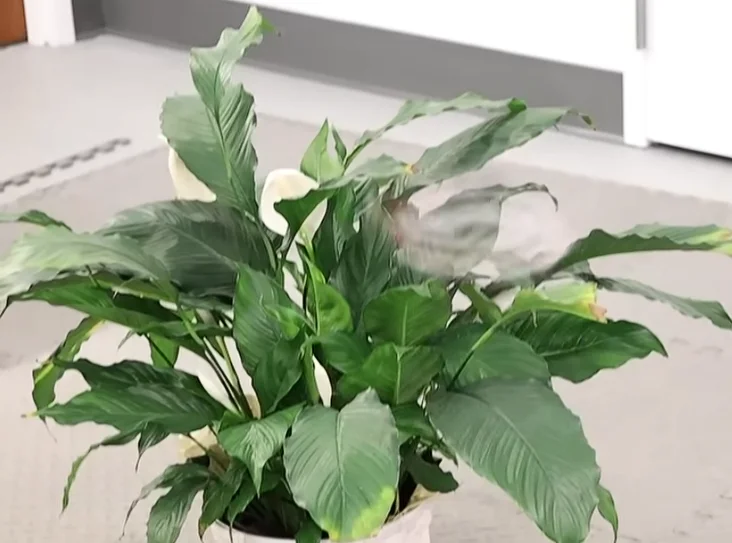
If this drone was hovering right in front of you, you would only see its ghost.
In an article from Northwestern University, engineers have designed a blurry drone and built a prototype.
The photo below is a screenshot from the video that accompanies the article:
Screenshot 2026-07-22 110551.webp


Yes. That's it hovering in front of the plant - that ghostly torus-like thing.

Per the article:
To design the drone, the Northwestern team first used a computational model to generate roughly 20,000 drone configurations capable of stable flight. Then, they used artificial intelligence (AI) and optimization algorithms to repeatedly rearrange the drones’ major components, including a motor, propeller, circuit board, counterweight and batteries.

After sifting through many different configurations, the algorithms determined the ideal placement of the drone’s components to minimize its visibility from virtually every viewing angle while allowing for stable flight.

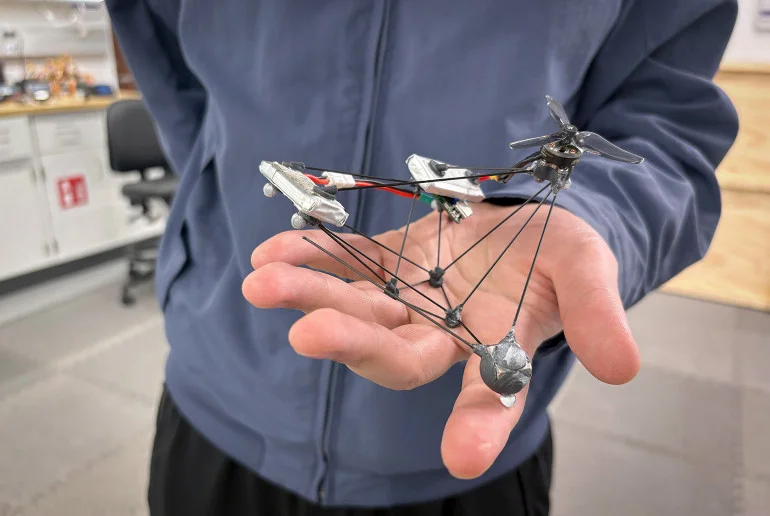
When the device is at rest, it looks like this:
drone1540__ScaleMaxWidthWzc3MF0.webp
 
Reply
  • Like
  • Informative
Likes   Reactions: Lischka, sbrothy, russ_watters and 2 others
Physics news on Phys.org
Dale said:
That has to put a lot of stress and vibration on the components.
When they develop a model with a cockpit, we'll have you check that out for us.
 
Reply
  • Haha
  • Like
Likes   Reactions: sbrothy, sophiecentaur and berkeman
Interesting using the concept of persistence of vision for their drone model.
Always a new idea cropping up,
At a spin rate of 25 rps ( 1500 rpm ) of the drone body, the eye can just not keep up.
A stroboscope would be able to stop action the spinning machine.

The fan in my window does the same thing, I cannot see the blades individually, but just a blur and not even much of that, from any angle, even if the 3 blades pass the same sweep area.
Really old and trusted technology from the manufacturer to achieve see-through fan blades.
So one could say that the fan blades have been rendered transparent.

The AI seems to have produced the most ugly configuration, with extra weights added.
The resulting design spread the components around the drone — at different heights and different angles with lots of space in between — to prevent them from visually overlapping when spinning.

Are we sure that there is not a more simpler arrangement? without the weights.
Could it be that the AI is doing the hokey pokey on them, and they 'wisely' accepted.
Wonder what the other 20000 capable of stable flight looked like.
 
That is just brilliantly evil.

Watch the video - mind-blowing.


Noisy as an angle grinder tho...

I'm Imagining it flying around covertly while yelling at the top of its tiny lungs: "I'M INVISIBLE!!! INVISIBLE SPY DRONE OVER HERE!"
 
Reply
  • Haha
  • Informative
  • Like
Likes   Reactions: .Scott, sbrothy, jrmichler and 2 others
256bits said:
Interesting using the concept of persistence of vision for their drone model.
Having now seen a picture the drone itself I think we're in the realms of a rotating bicycle wheel; its spokes look blurred and objects behind it tend to dominate.

The drone could be useful for some applications but its mass would be dominated by its own working parts so a payload would need to be small and the battery energy would be low.

It would certainly make you jump if one turned up in front of you. A bit like a dragonfly buzzing in your face.
 
Dale said:
That has to put a lot of stress and vibration on the components.
Yeah, it's gonna be a while before it can do anything beyond reconnaissance like carry munitions. Though probably shorter than we think. I'm betting this is sugar for DARPA. (if not already payed by by them).

EDIT: BTW, wasn't there something a while back about light being bend around a tank?
 
Greg Bernhardt said:
We're concerned over privacy implications right? Right? :oops:
Comparing a surveillance drone that is silent but visible vs. one that is invisible but noisy, I think the silent one would have the stealth advantage.

If this thing was in a room with you, you would know it - and you would quickly spot it. It's hard enough making fan blades relatively quiet, making the entire spinning drone (with surveillance payload) quiet would be much more difficult. Plus, it is stuck in flying mode. As soon as it lands, its cloaking is gone. And if it crosses a room, the changing location of the whirling noise would attract immediate attention. Women and children would scream and run. Men would pull out the fly swatters and brooms. Engineers would play with it.

In the outdoors, people seldom look straight up. And even if they do, a drone with a telephoto lens will always see you better than you see it. In terms of automatic detection, this cloaking would make the drone more detectable. Its spread-out form makes it a bigger optical (non-human) and radar target. All-in-all, it is not very stealthy.

I don't see huge privacy implications with this. But perhaps someone with more imagination could describe situations where it would better show its stealth.
 
Reply
  • Like
Likes   Reactions: Greg Bernhardt
I always thought it was more diabolical to make the drone look like a bird, fly like a bird, and land like a bird.


So I guess the next innovation would be to make a hummingbird drone where the hummingbird appears and disappears at will.
 
.Scott said:
I don't see huge privacy implications with this. But perhaps someone with more imagination could describe situations where it would better show its stealth.
Here's a privacy implication that should creep everyone out.
I would be "good" for peering through windows - or, at least sound proof windows.
 
jedishrfu said:
hummingbird drone
Already been done.
https://en.wikipedia.org/wiki/AeroVironment_Nano_Hummingbird.

Flapping wing drones are easier to make than what one would think from narrator in the video seems to imply. They have been around for quite some time.
Glidder --> flap the wings a bit --> propelled flight.
Drone flapping wing falcons have been used at some airports to control bird populations at airports. Ted talks and campus presentations of flapping wing drones have been done to wow audiences.

The hummingbird, though doesn't glide.
Flight starts at 45 sec.

Here the flapping wing movement, IIRC, has to trace out a figure 8. The design becomes a wee bit more complicated compared to the glider flapping wing drone bird.

I do not imagine how one could make this invisible in the same manner as the fully rotational body 'invisible' drone in the opening OP.

In any case, the one in the opening OP as is, is ugly, noisy, needs support to initiate flight, and cannot land without destruction.